Author Archives: AB

Article: Italy, Libya and the EU: Co-dependent systems and interweaving imperial interests at the Mediterranean border

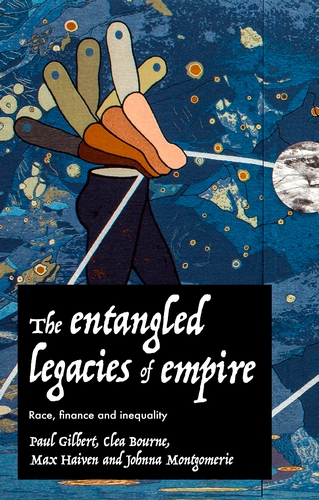
Alessandra Ferrini, “Italy, Libya and the EU: Co-dependent systems and interweaving imperial interests at the Mediterranean border”, in The Entangled legacies of empire Race, finance and inequality, edited by Paul Gilbert, Clea Bourne, Max Haiven & Johnna Montgomerie (Manchester University Press, 2023), 197–207. Open Access.

Abstract: The picture at the opening of the chapter portrays former Italian Prime Minister Silvio Berlusconi greeting Libyan President Muammar Gaddafi as he arrives in Rome in 2009. The meeting celebrated the Treaty on Friendship, Partnership and Cooperation between Italy and Libya and the signing of the Bilateral Agreements that have led to the current racialization of the Mediterranean border (through Italy’s right to send migrants arriving by sea back to Libya, where they are incarcerated in detention camps that severely violate human rights). Pinned to Gaddafi’s chest was a photograph of the Libyan anticolonial leader Omar al-Mukhtar in chains, taken before he was executed by Mussolini’s army in 1931. This gesture sparked outrage in Italy, as it was perceived as a mockery of Berlusconi’s earlier visits to Libya where he presented formal apologies and reparations for the Italian occupation of Libya (1911–43) as part of the Treaty. Yet, Berlusconi’s politics of apology was motivated by Italy’s need to reach agreements with Gaddafi on the control of migration across the Mediterranean, as well as agreements on commercial deals – from the supply of oil and gas to the creation of a free market zone in Libya for Italian companies. Thus, colonial reparations were accompanied by a reinforcement of neocolonial relations.

Book: Confronting the Archive of Coloniality Across Italy and Libya

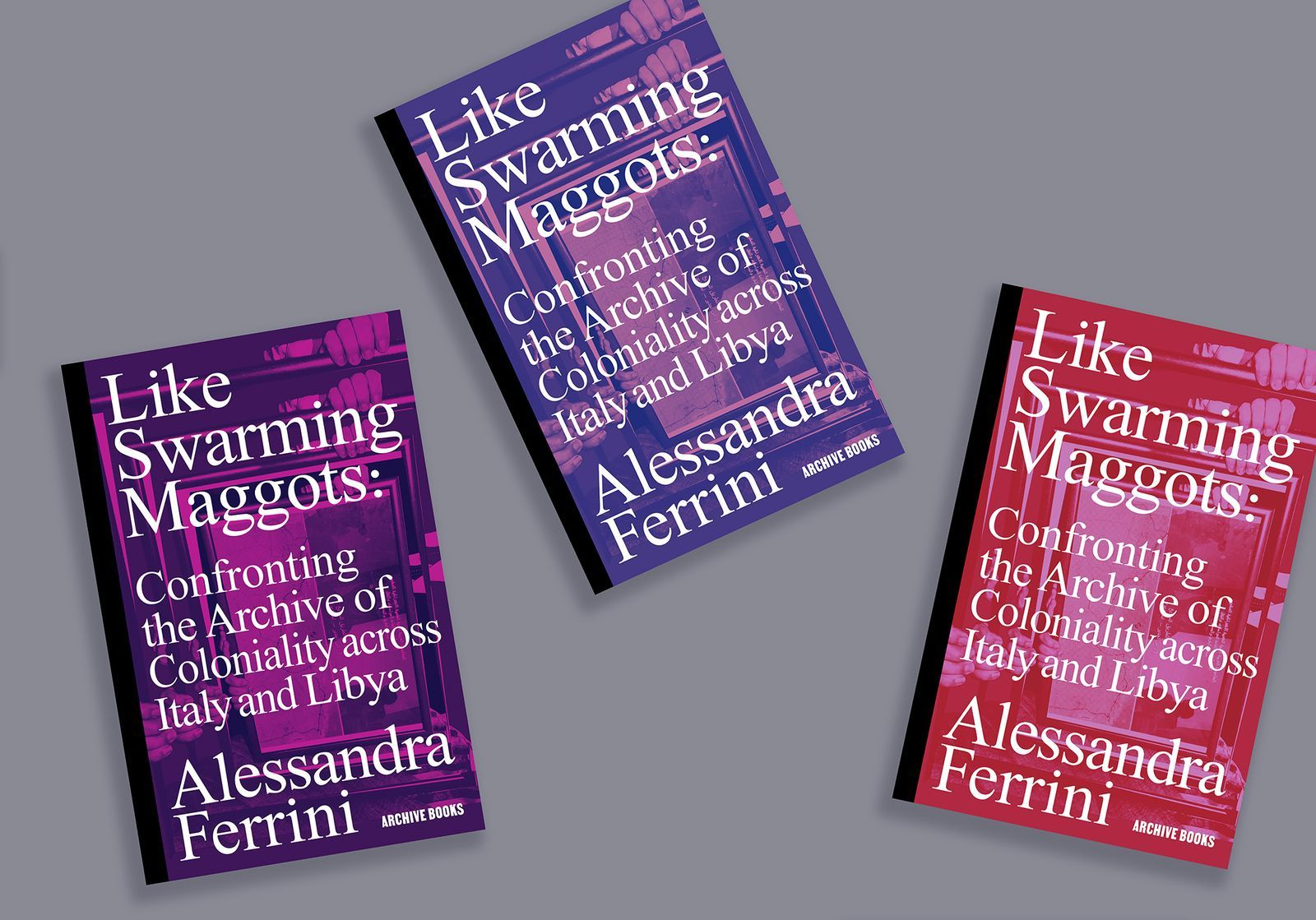
A new book by artist Alessandra Ferrini, entitled Like Swarming Maggots: Confronting the Archive of Coloniality Across Italy and Libya with contributions from a number of artists and writers (including yours truly), has just been published by Berlin-based Archive Books.

Featuring Ferrini’s long-term research on the colonial and neo-colonial relations between Italy and Libya through a critical engagement with the Italian ‘archive of coloniality’ and its structural violence. The book includes documentation of Ferrini’s major project Gaddafi in Rome, whose last iteration is currently exhibited at the 60th International Art Exhibition of La Biennale di Venezia curated by Adriano Pedrosa, as well as a series of works reflecting on positionality, censorship, and the erasure of the genocide perpetrated by the Italians in Libya.

Building on the artist’s interest in writing, translation, and collaboration as forms of resistance practice, it brings together different voices and visual materials, putting forward a reflection on the ethical dimension of cultural work. As a result, the book includes original contributions, reprints, and translations by writers, scholars, curators, and practitioners pivotal to the development of Ferrini’s work and thinking.

Like Swarming Maggots: Confronting the Archive of Coloniality Across Italy and Libya includes a preface by Bassam El Baroni and contributions by: Tewa Barnosa, Adam Benkato, NiccolòAcram Cappelletto, Chiara Cartuccia, Sarri Elfaitouri, Amalie Elfallah, Khaled Mattawa, Maaza Mengiste, Barbara Spadaro, Daphne Vitali.

Article: The Emancipatory Strategies of Black Tunisians and Libyans

Houda Mzioudet, “Yearning for Freedom, Reclaiming Agency: The Emancipatory Strategies of Black Tunisians and Libyans” in Mediterranean Mobilities: Between Migrations and Colonialism ed. Gabriele Montalbano (viella, 2024), pp. 175–184

The history of Black people in Libya and Tunisia remain shrouded in mystery and historical ambiguity; little is know with regards to their origin, movement and settlement in North Africa, and the slavery connection remains the quintessentially legitimate historical reason for this settlement. While more anthropological and historical work has been done since the 1980s by scholars such as Jouili, Bahri, Mrad-Dali, Montana, Jankowsky and Taleb on slavery and post-slave Libyan and Tunisian societies, numerous murky areas remain in the narratives of disenfranchised Blacks, alongside a lack of accounts where Blacks are no longer mere recipients, passive actors who lacked agency in building a Black North African history. In this chapter, I attempt to weave my arguments around Mrad-Dali and Montalbano’s historical and anthropological research on Libyan immigrants to Tunisia and enslaved Black Libyans who developed a web of solidarity to escape slavery in eastern and western Libya, all while stressing these marginalised groups’ activity as agents of change and of self-emancipatory action.

Archive: British Institute for Libyan and Northern African Studies

The British Institute for Libyan and Northern African Studies (BILNAS), formerly known as the Society for Libyan Studies from 1969 to 2022, supports research, scholarship, and collaboration relating to the history, archaeology, culture, art, and literature of Libya and Northern Africa.

The BILNAS Archive. Photograph by Design Services, University of Leicester.

The BILNAS Archive has been housed at the University of Leicester since 2012. It holds a number of documents, photographs, drawings, maps, plans, and a great deal of unpublished data relating to archaeological projects in Libya from the early 20th century onwards undertaken mainly by British scholars, sometimes in collaboration with Libyan colleagues, in sites such as Sabratha, Lepcis Magna, Ghirza, the Fezzan, Tocra, Cyrene, Sidi Khrebish, and El Merj. The archive can be browsed online, where it is mostly organized by person or by excavation. Materials can be consulted in-person at the University of Leicester.

The materials from some of the major excavations are regularly being digitized and made openly available via Archaeology Data Service. So far, material from the Sabratha excavations of 1948-51 are online.

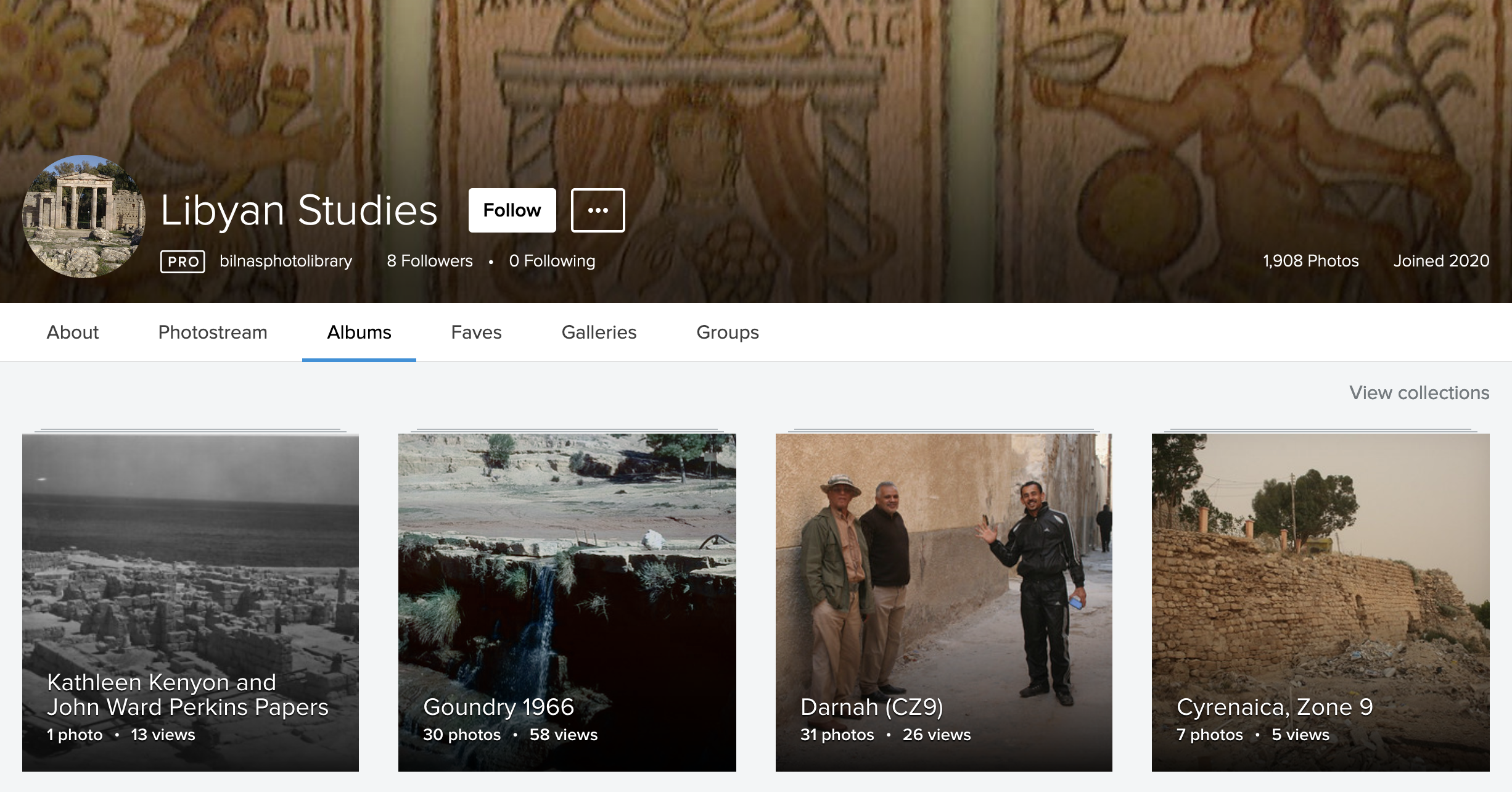
BILNAS has also made an extensive collection of photographs from its archives available online at FLICKR. The photos are historical as well as more recent.

Article: Photography, Media Uses and Emotions during the Italo-Turkish War in Tripolitania (1911–12)

Pierre Schill, The Brutalised Bodies of a Colonial Conquest Before the Court of Global Opinion: Photography, Media Uses and Emotions during the Italo-Turkish War in Tripolitania (1911–12). History of Photography 47 (2023), pp. 315-343

Photographer unknown, ‘French War Reporters in Tripoli’, 23 October 1911 (Montpellier, archives départementales de l’Hérault (Vigné d’Octon papers), 1 E 1149). See the article for full details.
This article analyses the global circulation of around fifty photographs taken at the end of October 1911 at Shar al-Shatt, near Tripoli, by journalists documenting the mass execution of civilians by Italian soldiers. By attending to the interaction of text and image, and to the layouts of visual spreads in the global press, the article demonstrates how photographs of these dead bodies were imbued with a range of political meanings, variously protesting and legitimising such forms of extreme violence. The article explains how the emotions aroused worldwide by these images prompted the Italian authorities to create a visual counter-narrative by publicising photographs of the bodies of their own soldiers mutilated by a ‘bestialised’ enemy. The dissemination of visual evidence of brutality committed by both sides constitutes an early example of a ‘contest of images’ whereby press photography was used to mobilise antagonistic affective communities: variously pan-Islamic, anti-colonial, and trans-imperial. The diversity and inventiveness of the visual politics of persuasion implemented during the conquest of Tripolitania and the intensity of the reactions that this imagery produced reveal the emerging centrality of photojournalists in bearing witness to mass violence in the twentieth century.

Essay: Ein Meer überreifer Kirschen

A nice essay on observing the Libyan revolution entitled “Ein Meer überreifer Kirschen [A Sea of Overripe Cherries]” by Ghady Kafala appeared, translated from Arabic to German, in the collected volume In der Zukunft schwelgen: Von Würde und Gerechtigkeit und dem Arabischen Frühling. Essays aus Nahost und Nordafrika [To bask in the future: Of Dignity and Justice and the Arab Spring. Essays from the Near East and North Africa], edited and translated by Sandra Hetzl (transcript verlag, 2022) The whole volume is freely accessible online.

Excerpt: Seltsam, dieses Libyen. Alle Krankheiten der Welt gibt es dort und jedes Heilmittel dagegen. Hormongesteuert ist es, launisch, da sind wir einander ähnlich.Keiner weiß, was von ihm als Nächstes zu erwarten ist. Etwas Wunderbares, etwas Schlimmes Libyen zu verfluchen oder zu hassen ist schier unmöglich. Seine Sturheit schwächt uns, aber seine Hybris verleiht uns Stärke.

Hessa6’s collaborative new album “Unimported Disc”

The project Hessa6 (حصة سادسة) is “dedicated to unlocking the power of art to bring about social change through a range of activities that include researching, archiving, producing and promoting Libyan art.” With support from the Arab Fund for Culture and Arts, Hessa6 has released a new album entitled دسكة غير مستوردة “Unimported Disc” (click here to listen on Spotify). Described as “an electrifying musical project that brings together an eclectic mix of artists, rappers, and bands from across Libya”, the new album presents diverse, homegrown sounds in multiple genres, with lyrics in Arabic and Amazigh varieties, and incredible cover art for the album and for each track by Moneer Alwerfally.

The tracks and their descriptions as provided by Hessa6 on their Instagram page are below:

Continue reading

Book: Jewelry and Adornment of Libya

Hala Ghellali’s long-awaited book on Libyan jewelry is finally in print! An account based on the author’s own collections and her long personal experience and interaction with artisans of bygone generations, this will be the resource on the topic for a long time. Cover photo by Sasi Harib.

Publisher’s description: Hala Ghellali was eighteen years old when her father first took her to the suq to buy her first silver bracelets. They visited traditional jewelers in the madina al-qadima, the old walled city of Tripoli. This single event in 1975, ignited her lifelong passion for traditional jewelry and costume items and she has been collecting objects and stories ever since. Her unique stories, personal observations, research and firsthand information about jewelry design and silversmithing fill this book. ‘Jewelry and Adornment of Libya’ aims to share with its readers a lifetime passion for the jewelry made in Tripoli. It includes a section dedicated solely to the role of jewelry and costume in Tripoli with narratives of traditional weddings, and traditions linked to jewelry gifting in the city. The book is dedicated to the local jewelers and masters of weaving and embroidery who have almost all disappeared, their art and skills not being passed on to the present generation.

Essay: Identity, Displacement, and Coming of Age

An essay entitled “Identity, Displacement, and Coming of Age with Banat Collective” by Farrah Fray, author of the poetry chapbook The Scent of My Skin, appeared in the Journal of Middle East Women’s Studies back in 2019.

Excerpt: Somehow summer is the least peaceful time of year. The summer of 2018 was no exception. I had just finished writing my dissertation two weeks before boarding a flight to Libya to visit family. Leading up to my trip, a sense of uncertainty about the future began to loom over my head. After I completed my degree, would my family pressure me to return to Libya? If so, what were the best options for my well-being? Most important, how would I cope or fit in? The last time I had lived in Libya for more than a few weeks was in 2007, when my parents decided that we would settle down in Zawiyah after spending more than ten years in the United Kingdom. Four years later, after the uprisings of 2011, we returned to London. I have been in the British capital since then, save the annual visit to Libya….