Category Archives: Resources

Article: ‘Ghibli’, A Libyan Desert Wind

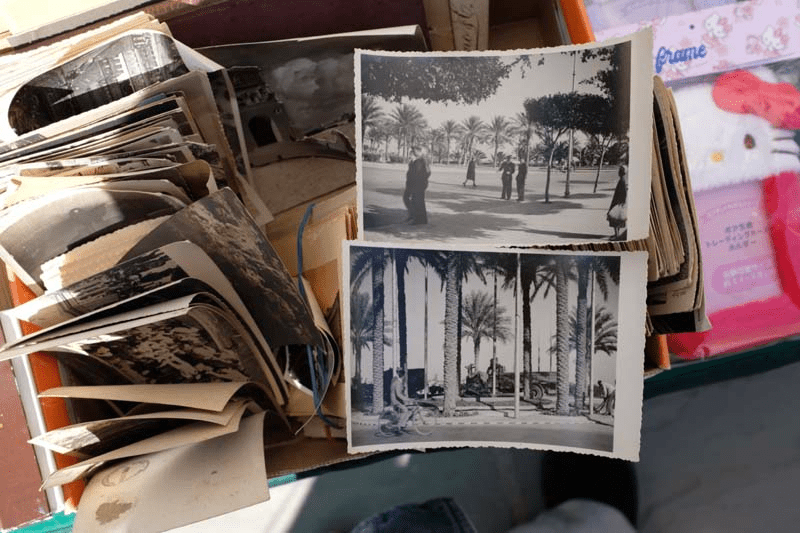
Photograph found in Mercantino depicting ‘Fontana della Gazella’ in Tripoli (Libya), Piazza Luigi Orlando, Livorno, Italy

Libyan scholar Amalie Elfallah recently wrote a really interesting travel report on her 2025 Society of Architectural Historians fellowship, entitled ‘Ghibli,’ a Libyan ‘Desert Wind,’ Lost in Translation Among Stone, Steel, and Speed.

In Libya, ‘ghibli’ (غبلي) is known as a “sandstorm” or a “desert wind blowing from the south.” Across some parts of the Sahara, ‘ghibli’ also refers to the “wind coming from Mecca,” deriving from the classical Arabic word ‘qibla’ (قبلة), meaning “direction.” By the late 1930s, ‘ghibli’ was Latinized—rather, Italianized—when the name was affixed to a military aircraft engineered by Gianni Caproni. The Caproni ‘Ca. 309‘ Ghibli, according to Italy’s aeronautical military archives, was a “reconnaissance and liaison” aircraft utilized in Italy’s “North African colonies.” A word once referring to a natural atmospheric phenomenon was appropriated and attached to an instrument of war, transforming wind into steel and returning its name as a weaponized gust. Was Studio Ghibli’s title drawn from the wind itself, or from the machine that carried its name?
Short Story Collection “The Magic Lanterns of Libyan Literature” (2006)

I recently re-came across Words Without Borders’ translated Libyan short story collection “The Magic Lanterns of Libyan Literature” published all the way back in 2006, when most people didn’t even know where Libya was and when people like Khaled Mattawa, who wrote the introduction this collection, were pretty the only ones interested in shining a light on contemporary Libyan literature. It features some of the (now-)standardly translated Libyan writers, like Ibrahim al-Koni, Ahmed Ibrahim al-Fagih, and so forth. The title, though, I find rather awkward.

Like a bottled genie, Libya’s literature whispers to us mysteriously, until those moments when its container is buffed properly, its luster blazes and the spirit within reveals marvels and wonders beyond the imagination. It happened when Libya discovered oil in the 60s, and it struck a well of poetry, prose, and press that its fearful master soon bottled up.

Libyan storytellers have conjured literary styles and strategies to outwit dull-minded and tin-eared bureaucrats, revealing the magic words of free artistry. Ibrahim Al-Koni’s “Right Course” shows the downside of desert-style finance. In Sadiq Neihoum’s “The Sultan’s Flotilla,” the nail-biting ruler of a city fears its coming doom and manifold misfortunes, and in Ahmed Ibrahim Al-Fagih’s “The Locusts,” villagers join forces against a horde of insects while they sleep. And Mohammed Al-Asfar addresses life and loss in “Wet Sleeves,” where elderly men observe the cycles of mourning, and in his “Mint Flavored Hiccups,” where a fugitive’s family revisits the past while awaiting the future.

Our poets echo the oral tradition while venerating the personal, in the intimacy of Salem el-Okli’s love lyrics, Laila Neihoum’s wry notes on modern life, and Ashur Etwebi’s snapshot of a spot of time at a café.

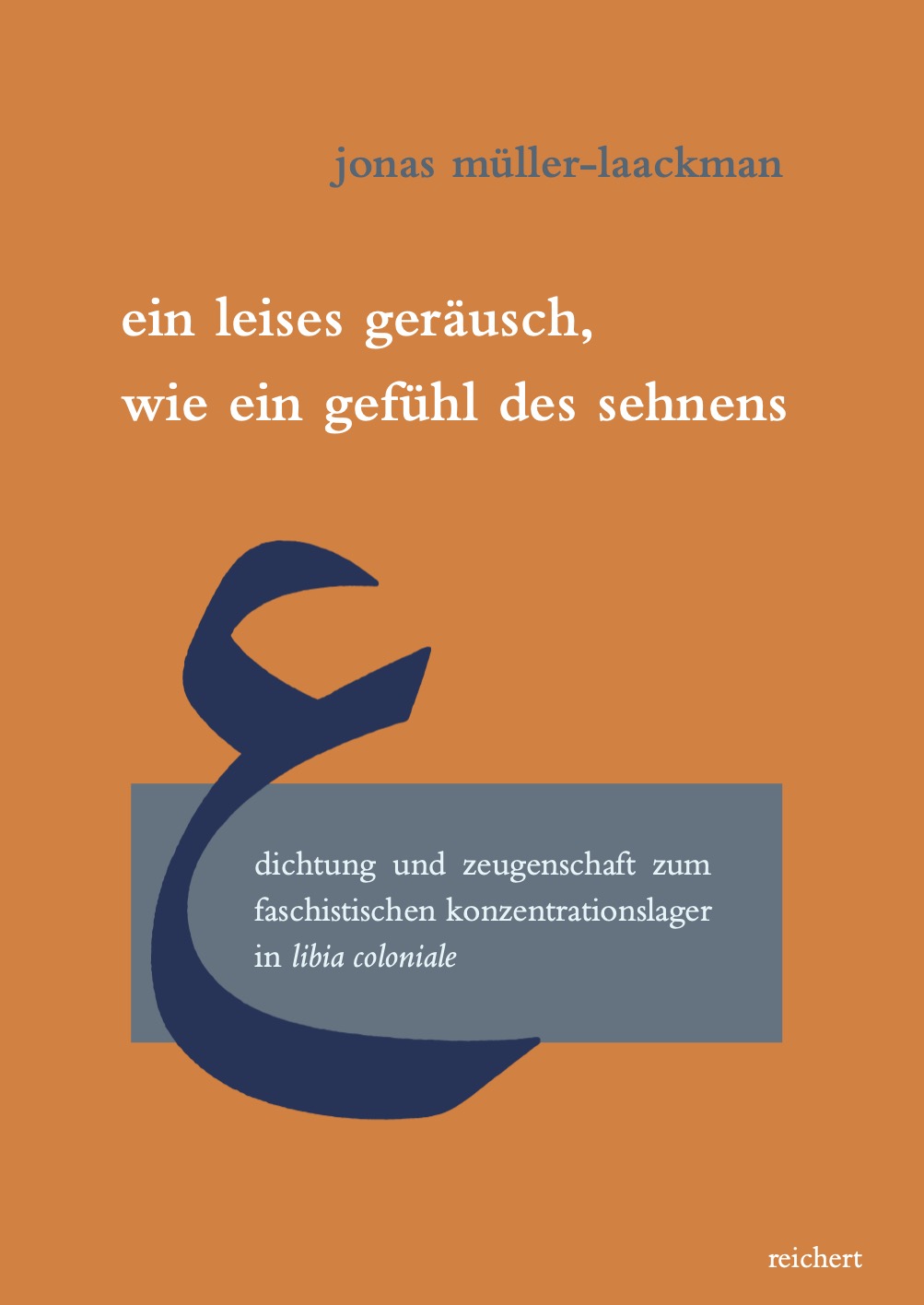
Book: Ein leises Geräusch wie ein Gefühl des Sehnens

Müller-Laackman, Jonas. 2021. Ein leises Geräusch wie ein Gefühl des Sehnens: Dichtung und Zeugenschaft zum faschistischen Konzentrationslager in Libia Coloniale [A soft sound like a feeling of longing: Poetry and Testimony of the fascist concentration camp in “Libia Coloniale”] (Literaturen im Kontext. arabisch – persisch – türkisch Band 46). Reichelt.

Available in open-access, the only Western academic study of Libyan poetry from the colonial period that I know of, though written in German. The book also has an appendix with the Arabic text and German translation of four poems, including the famous Ma bi maraḍ. The publisher’s description below:

"A soft sound, like a feeling of longing": these are the words a poet uses to describe the sounds of a ship as he and many other deportees are gathered on deck en route to the infamous al-ʿAgīla camp. A portion of the story of the Italian concentration camps in the colony of Libya is told through the poetry about these camps passed down by survivors, which has been archived and partially published in postcolonial Libya.

Historical research on these camps often aims to break away from Eurocentric colonial historiography and confront the myth of Italian fascism as more benign. The collected poems play a central role in this revision by representing original Libyan voices that form a counter-narrative against the European perspective. Yet their literary significance as moving narrations of the suffering in concentration camps often remains unrecognized. There is also little reflection on the implications of the potential trauma of being interned, the sometimes unclear chains of transmission, archival practices, and the understanding of these poems as historical descriptions of factual events.

Against the background of theoretical discussions of the phenomenon of the concentration camp, their potential as sites of trauma, and how European camp literature is dealt with in scholarly and literary debates, the author shows the extent to which these Libyan poems represent much more than mere descriptions of facts and how a critical distance to what is reported does not necessarily mean doubting the credibility of the poets. Rather, the poems represent literary works in the tradition of nomadic poetry; they are Arabic camp literature and thus offer subjective descriptions of suffering and the state of exception in the concentration camp.

Rather than interpreting this poetry as a basis for the formation of an anti-colonial nationalist narrative, the author aims to recognize the poetry as a testimony to suffering. Camp literature as a global phenomenon shows how differently trauma and suffering were and still are negotiated. In this respect, poems about Italian concentration camps are impressive testimonies that, embedded in the Arabic nomadic poetic tradition, show the specific ways in which the poets dealt with their experiences. In this way, first-person perceptions of suffering were captured that can be confronted with European colonial historiography and bias.

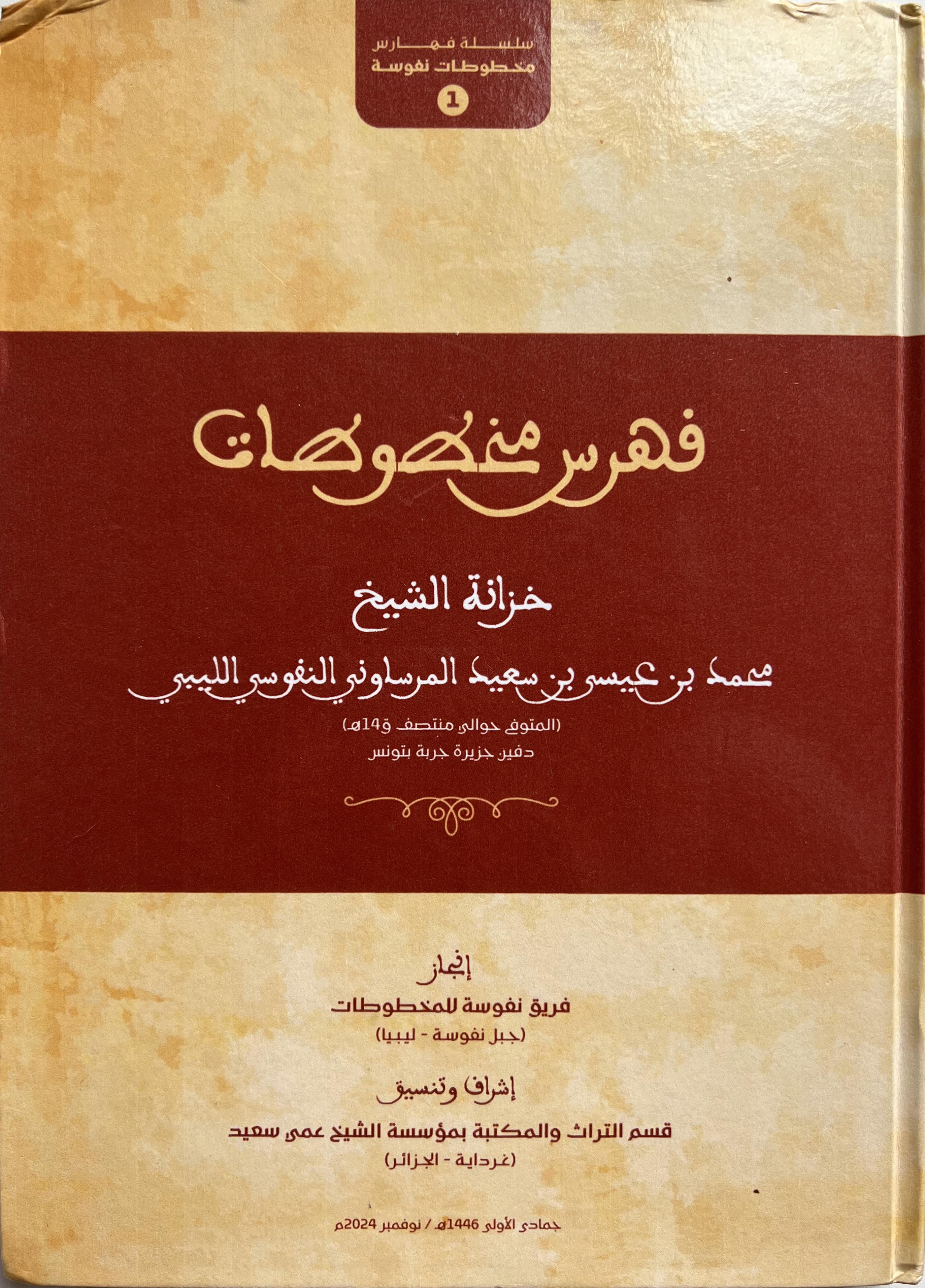
Book: فهرس مخطوطات خزانة الشيخ محمد بن عيسى بن سعيد المرساوني

A new series entitled سلسلة فهارس مخطوطات نفوسة “Catalogs of Nafusa Manuscripts” has been launched by the Library and Heritage Department of the Shaykh ‘Ammi Sa‘id Foundation in Ghardaïa, Algeria. The first book of that series is a catalog of the collection (خزانة) of Shaykh Muḥammad ‘Isa Sa‘id al-Marsawani al-Nafusi al-Libi (who died in the early 1900s and was buried in Jerba) prepared by the “Nafusa Manuscripts Team”.

فهرس مخطوطات خزانة الشيخ محمد بن عيسى بن سعيد المرساوني النفوسي الليبي (المتوفي حوالي منتصف ق١٤ه دفين جزيرة جربة بتونس)، انجاز فريق نفوسة للمخطوطات، اشراف وتنسيق قسم التراث والمكتبة بمؤسسة الشيخ عمي سعيد، 2024

Sheikh Marsawani was originally from a village near al-Rheybat in the Nafusa Mountains, was educated in Egypt, and eventually fled to Jerba after the Italian conquest of Libya (for more on which see this recent article), bringing with him manuscripts from Egypt, manuscripts he copied himself, and a number of other texts and documents. This catalog includes a number of interesting manuscripts, including poetry by and about local sheikhs, as well as a variety of documents.

Many thanks to colleague Soufien Mestaoui for sharing a copy with me!

Book: Libyan Judeo-Arabic

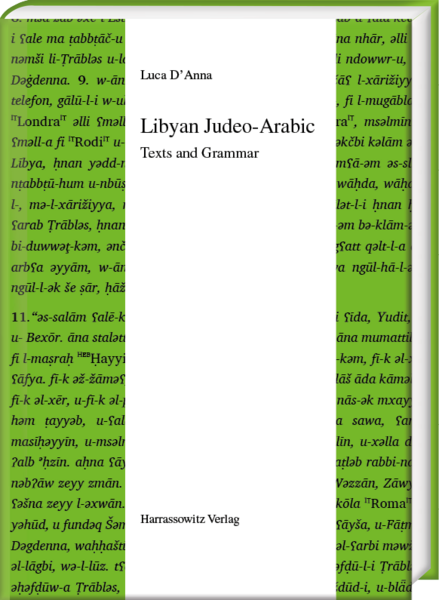
D’Anna, Luca. 2025. Libyan Judeo-Arabic. Texts and Grammar (Semitica Viva 69). Wiesbaden: Harrassowitz.

Libyan Judeo-Arabic provides the first comprehensive account of Libyan spoken Judeo-Arabic dialects, based on fieldwork conducted in Israel and Italy between 2019 and 2023. Before 1967, there were a rich variety of spoken Judeo-Arabic dialects in Libya that coexisted and interacted with the Muslim versions of Libyan Arabic, while remaining typologically distinct. Historically, Jewish communities existed in Tripoli, Zawia, Zanzur, Khoms, Msellata, Gharyan, Yefren, Misrata, Marj, Benghazi, and Derna. After the final expulsion of Libyan Jews in 1967, the dialects they spoke have been subject to erosion and are now severely endangered, especially in the case of smaller communities, where only a few speakers remain.
Luca D’Anna offers an overview of Libyan Judeo-Arabic dialects and includes a rich selection of ethnographic texts, a grammatical survey of their dialectal bundle and a comprehensive glossary. The texts cover different aspects of Jewish life in Libya, Italy and Israel, while the grammatical survey provides a phonological and morphological description, with notes on syntax and sociolinguistics. By presenting linguistic examples from most of the communities historically represented in Libya, D’Anna also offers the first classification of Libyan Judeo-Arabic, knowledge of which was previously restricted to the Judeo-Arabic of Tripoli.

Article: Sonic Techniques of Colonization and Resistance: Libya 1911–12

McMurray, Peter. 2025. Sonic Techniques of Colonization and Resistance: Libya 1911–12. Nineteenth-Century Music Review 22(3), 412-440.

Abstract: In 1911, Italy invaded the region now known as Libya, then part of the Ottoman Empire, as part of a larger Italian colonizing foray into northern Africa. Many scholars have pointed out in recent years how intense the sonic environments of war can be, and the Italo-Turkish War of 1911–12 was no exception. Not only was the war itself full of sound and sonic media such as gramophones and telephones, the narration of the war, including most (in)famously that of Futurist author F.T. Marinetti, focused from the outset on the sonic intensities of the conflict. In addition, the war became a site for the cultivation of sonic media: Guglielmo Marconi not only deployed his radio technology for the Italian cause, he personally travelled to Libya to test and refine radio in the unique geographies there. In this article, I consider these Italian-centric narratives of war alongside accounts of the sonic experiences of the Arab and Ottoman Turkish forces in their resistance to the Italian occupation, considering the sonic techniques deployed both for and against Italian colonialism. I focus on three particular sonic techniques of that resistance: first, ‘counterlistening’, or ways of listening that subvert empire’s auralities; second, ululation (mostly by women) on the battlefield and beyond; and third, jihad, especially its sonic articulations as a set of declarations, battle cries, religious chanting, and even poetry. For both sides, sound played a much greater role in the war than just being a by-product of activity; these sonic techniques both shaped the war and were shaped by it, producing new forms of sonic experience that played important roles in constituting the colonial and anticolonial in Libya.

Conference: Patrimoine matériel et immatériel en Libye et dans les pays voisins

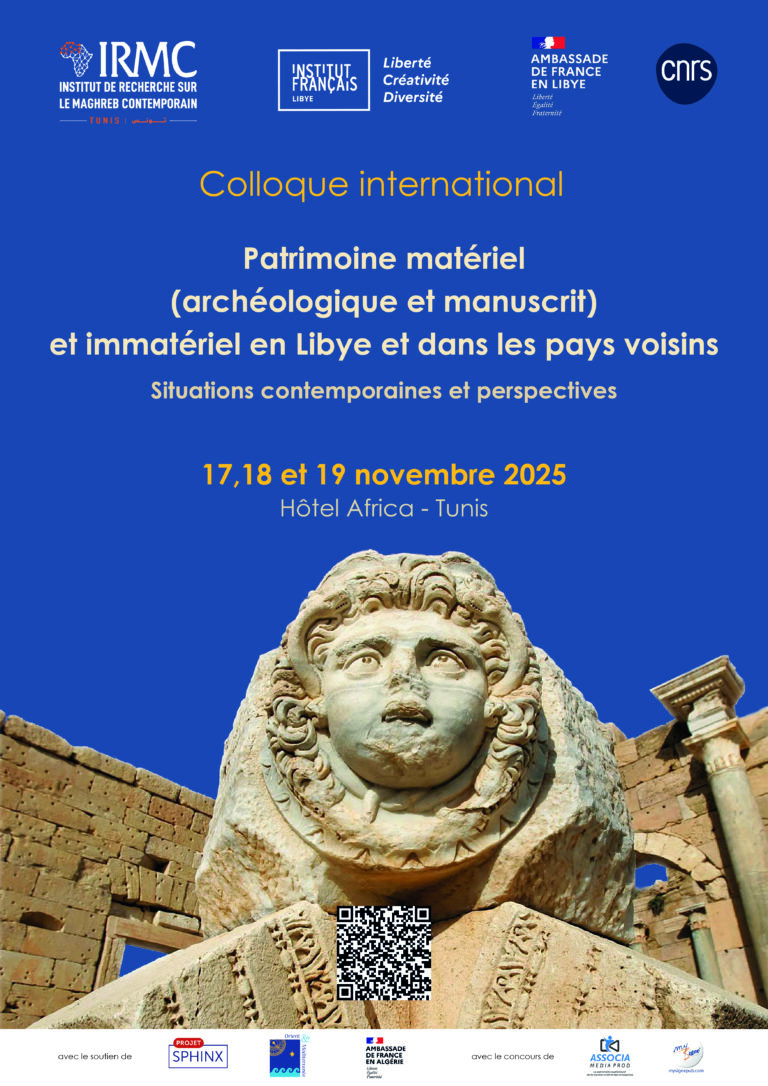
Last month the Institut de recherche sur le maghreb contemporaine (IRMC) in Tunis hosted an international conference entitled Patrimoine matériel (archéologique et manuscrit) et immatériel en Libye et dans les pays voisins. The conference featured quite a number of presentations, and fortunately, the live-streams are available online on the IRMC’s youtube channel, in French and in Arabic, for those interested in hearing some of the presentations.

The program is at this link.

Article: Migration from Ottoman Trablus al-Gharb to Djerba

A recent (open-access!) article by our colleague Paul Love of Ibadi Studies based on local and colonial archives as well as fieldwork with the community:

Love, Paul M. 2025. M’addibs and Migrant Laborers: Migration from Ottoman Trablus al-Gharb to Djerba, Tunisia in the Early 20th Century. International Journal of Middle East Studies 57(2). 294–312.

Abstract: This article follows the history of migration from the mountain villages of the Jebel Nafusa in Ottoman Trablus al-Gharb (in today’s northwestern Libya) to the southern Tunisian island of Djerba in the early 20th century. It situates this local history of migration within the broader framework of Maghribi migration both before and during the colonial era in Libya (1911–43), while tracing the histories of two categories of migrants, in particular, manual laborers and Qur’an teachers (m’addibs). The article makes three claims: (1) Nafusi migration was as much the result of local historical circumstances as it was a response to colonialism; (2) the historical experience of migration of Nafusis differed according to social class; and (3) local circumstances shaped the dynamics of migrant integration in the Maghrib. In doing so, I demonstrate how Nafusi migration to Djerba both conforms to and diverges from the larger history of late Ottoman and colonial-era migration in Tunisia. By shifting the focus away from the colonial moment, I make the case for foregrounding longer-term regional connections and migrations that linked different spaces across the Maghrib and also attend to local histories and what they offer in the way of caveats and exceptions.

Report: Libya’s Imazighen: Identity Formation During Conflict

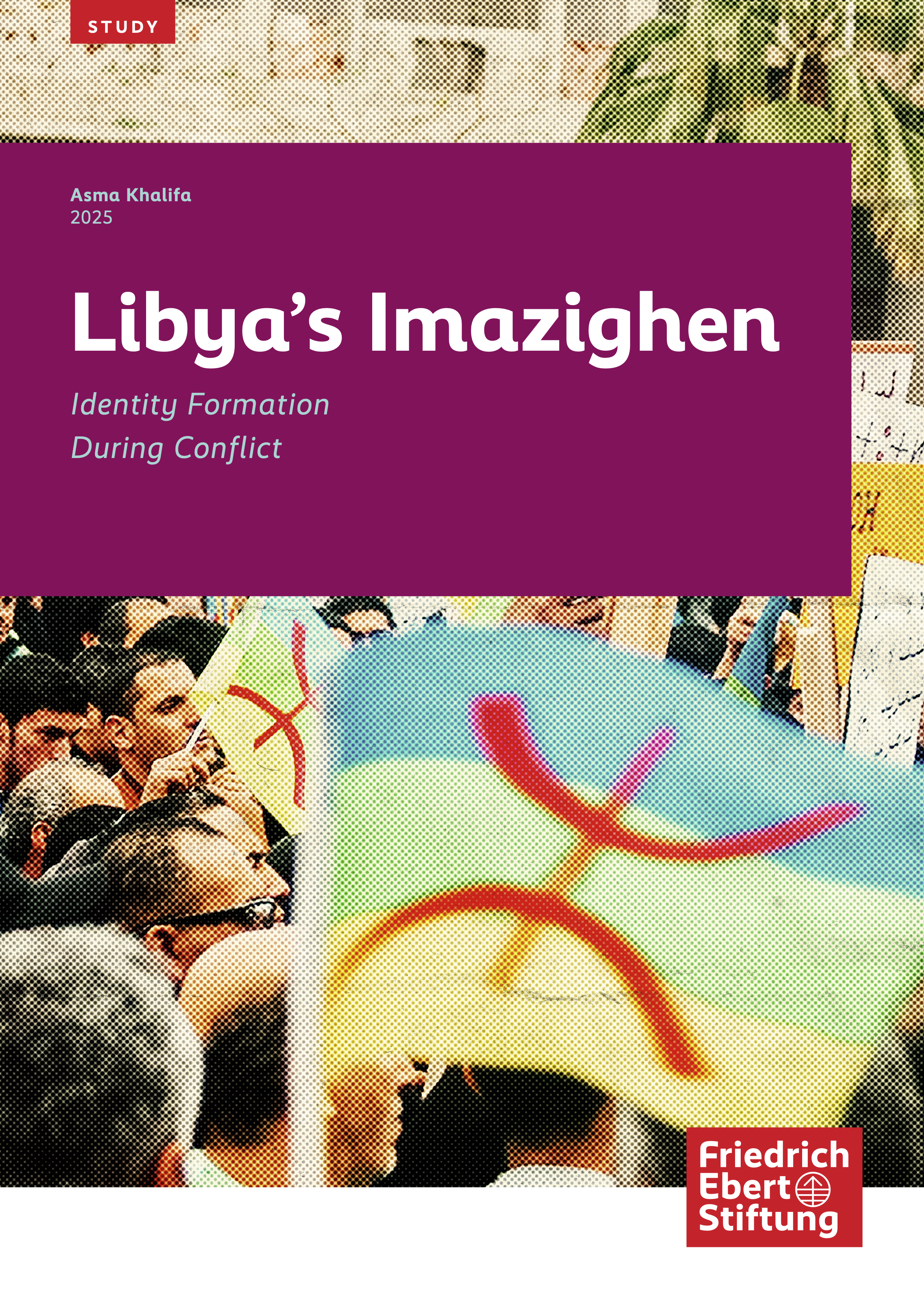
The Friedrich-Ebert-Stiftung’s Libya office has published a report by Asma Khalifa entitled Libya’s Imazighen: Identity Formation During Conflict.

Abstract: This paper explores the trajectory of Libya’s Amazigh population from systemic repression under the Gaddafi regime to their cultural and political resurgence following the 2011 uprising. It examines the deliberate erasure of Amazigh identity through state policies and the subsequent reassertion of their cultural and political presence during the post-revolutionary period, commonly referred to as the “Amazigh Renaissance.” Despite notable advancements, Amazigh communities continue to face exclusion within a fragmented and volatile political environment. The study argues that meaningful recognition and autonomy for the Amazigh are contingent upon an inclusive constitutional framework, resolution of national conflicts, and internal community cohesion. Their inclusion is presented as crucial for sustainable peacebuilding and the broader democratic transformation of Libya.