Category Archives: Blogposts

The oldest book printed in Libya?

Thanks to a social media post by Baddredin Mukhtar I came across a source previously unknown to me: the Swedish diplomat Jacob Gråberg’s eyewitness account of the Austrian siege of French-occupied Genoa in 1800. Apparently published in Tripoli in 1828, it is certainly one of the oldest books printed in Libya. Though it is quite hard to know if it is the oldest, it is, as Mukhtar proposes, so far the oldest we have a clear evidence for.

Gråberg (1776–1847) was a Swedish scholar and diplomat who served as consul in Tripoli from 1823 to 1828, and had previously held positions in Genoa and Tangiers. He observed and wrote copiously throughout his travels, for example, a report on the 1818 plague epidemic in Morocco or notes on the language of Ghadames.

The book in question, Dag-bok öfver blockaden af Genua år 1800 (Diary on the Siege of Genoa in 1800), was published in 1828 at the press of Mohhammed Es-Swid in “Tripoli I Vester”, that is, Trâblus Gârb (طرابلس الغرب) in Ottoman nomenclature.

The contents have nothing to do with “Tripoli I Vester” at all, but rather are Gråberg’s observations of the Austrian siege of French-occupied Genoa in spring and summer 1800, when he was an officer in the Genoa National Guard after having held bureaucratic roles at the Swedish mission in the then-Ligurian Republic. It seems he only got around to publishing them almost three decades later, and published them wherever he was at the time—in this case, Tripoli—as he did with many of his other writings. The diary was later, in the 1890s, translated into Italian by a historian of Liguria (G. Roberti, “Due diari inediti dell’assedio di Genova nel MDCCC”, Atti della Società Ligure di Storia Patria, 1890 No. XXIII).

As for the press itself, so far I know nothing about “Mohhammed Es-Swid”. It bears remarking that during this period European/Christian converts to Islam, whether as hostages, or conscripts, or other, often simply took (or were referred to using) their country of origin as a family name—e.g. the notable and still extant Libyan family الصويد, which may well be connected with the Mohhammed Es-Swid of our early 19th-century press.

But whether his press printed any other books is not known, and so Gråberg’s Genoese diary may or may not have been the first. Still, I know of no Ottoman or Jewish press operating in Tripoli at this time. The Ottoman newspapers published in Libya got started a bit later, around the mid-1800s. A French newspaper (called المنقب الافريقي) was apparently published in Tripoli in 1827, although I can find no real information about it so far. Jewish presses, publishing both religious texts and newspapers, seem to have gotten going around the end of the 19th century (e.g. the houses of Abraham Tesciuba, Clementi Zard, or Solomon Tesciuba that continued into the colonial period); earlier, the Jewish community seems to have printed predominantly in Livorno or other locations outside of what is now Libya.

More information would be appreciated!

Evaluating “understudied”

So often many of us use the word “understudied” to describe Libya as a topic in different fields of research. I myself have done so on this blog (probably quite often) and I hear colleagues do the same. In this post, I want to make one kind of attempt to quantify this. Not to complain (more than I already do), or propose any particular solution, and certainly not to validate the idea that quantity of research on a topic somehow indicates better, more useful research. Rather, just as an informal exercise, get some more precision about what “understudied” might really mean, as a complement to the (rather vague) impression many of us have. To do this, I’ve decided to look at general venues of research in which a Libyan-related topic might be reasonably expected to appear, and make a rough calculation about what percent of work in those venues relates to Libya. I focus on early-modern to contemporary Libya here (ancient Libya already has good coverage through several dedicated journals).

Continue reading

A Call for Independence from Tripoli and Benghazi, 1917

I recently stumbled upon an extremely interesting pamphlet from 1917 entitled “Aspirations and National Ideals of the Population of Tripoli of Africa and Benghazi” (“Aspirations et idéal national de la population de Tripoli d’Afrique et de Benghazie”). Written by Youssouf Chetvan and Mouhammed Salih Chérif, it was published in French, in Stockholm, Sweden. It is the earliest text I know of that was written by Libyans calling for independence in a European venue. More generally, the text connects the aspirations of people in Tripoli and Benghazi with the struggle of colonized Muslims the world over, framing itself as an “appeal in the name of the oppressed Muslims populations”. I wonder how widely it circulated…

I do not know anything about the authors, except that Youssouf Chetvan (يوسف بن شتوان؟) was likely a Benghazi notable, as that family has been prominent there for a long time. The other author, Mouhammed Salih Chérif (محمد صالح الشريف؟), credited as “one of the Senussi sheikhs”, could plausibly have been a member of the Senussi family or a ranking member of the Senussi order.

19th-century Letters between Bornu and Tripoli (sources for the study of early modern Libya iii)

Previous posts on early modern sources for Libyan history include: i) Early Modern Libyan Manuscripts in the Bibliothèque Nationale de France and ii) European Journals and Correspondence from early modern Libya.

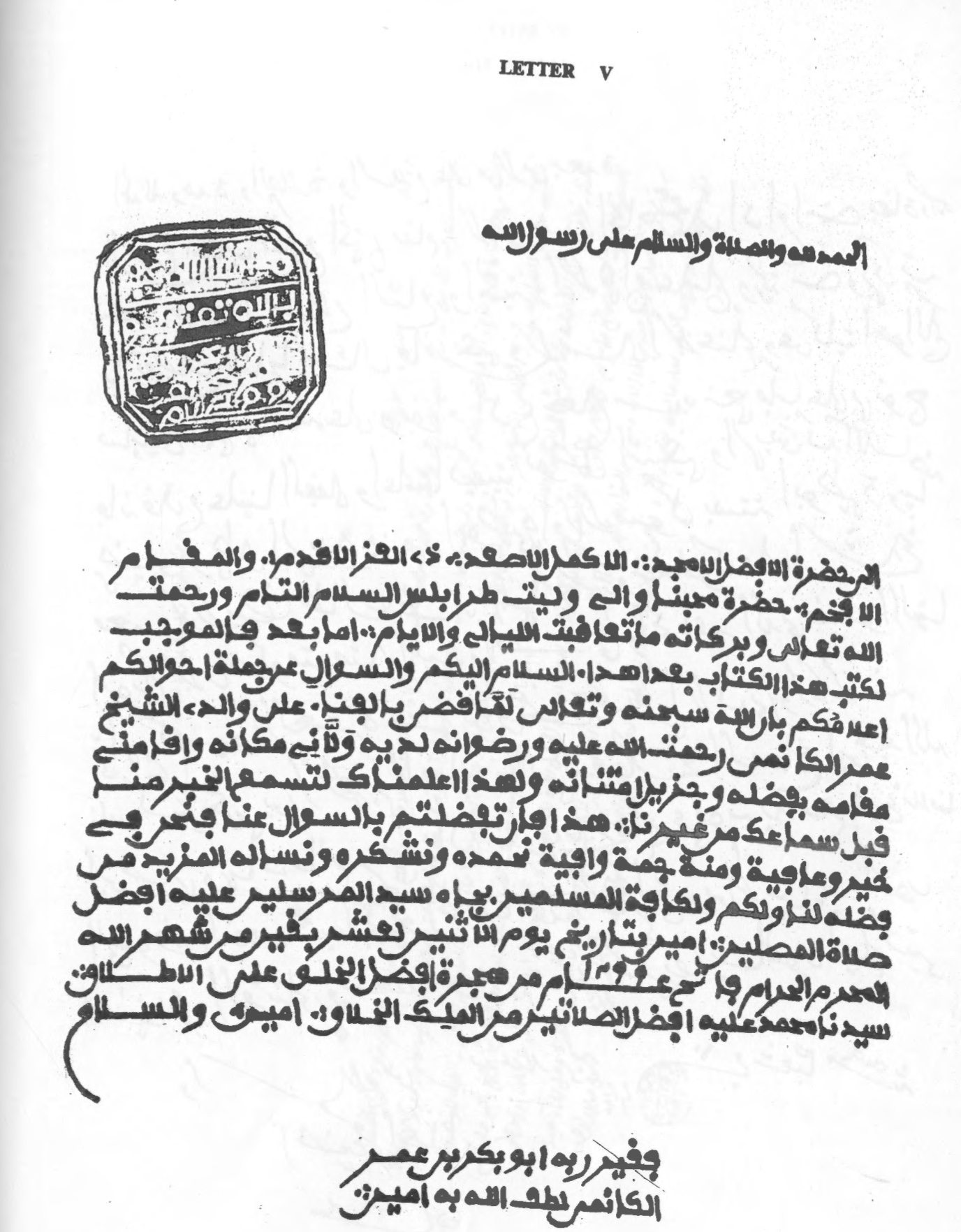
The Libyan National Archives (دار المحفوظات التاريخية) held in the Red Castle (السرايا الحمراء) of Tripoli contain, or used to contain, a number of letters sent between rulers of Bornu and officials in Tripoli dating to around the mid-1800s. Two editions of these letters appeared in the 1960s, but the archives became less accessible to outside scholars after 1969 because of the regime and little has been published on or about these primary sources since. I haven’t even been able to find if a more extensive Arabic edition exists, although I imagine that there is at least one such publication in Libya.

Letter from Abu Bakr ibn Umar al-Kanami to Nazif Basha, Wali of Tripoli, dated 12 Dec. 1881 (Gwarzo Letter #5)

Continue reading

A note on varieties of Arabic in eastern Libya

Though very little research has been done on the varieties of Arabic in eastern Libya, recent work which cites the existing studies continue to get some basic and important facts wrong. In particular, the two main and most frequently cited sources for Arabic in eastern Libya do not discuss one and the same variety.

T. F. Mitchell, carrying out fieldwork in eastern Libya in the late 1940s, worked primarily in Benghazi and Shahhat. His two published pieces on Arabic in eastern Libya, which have been frequently referenced in subsequent linguistic literature of various kinds, are “The active participle in an Arabic dialect of Cyrenaica” (1952) and “The language of buying and selling in Cyrenaica” (1957). Both of these are based on data from Shahhat, which Mitchell, following the colonial nomenclature of the time, calls Cyrene. A later work (Mitchell 1960) includes data from the same dialect in a comparative study. As he notes:

Material for the present article was obtained before and during a recent period of study-leave in Cyrenaica. My particular informant, who also accompanied me during the tour, was Mr. Idris ‘Abdallah, from Cyrene, a member of the Hasa tribe. The dialect illustrated may be termed the Bedouin dialect of the Jebel. (1952:11)

During a period of seven months spent in Cyrenaica in 1949 with the special purpose of investigating the Bedouin Arabic of the Jebel, I selected for particular attention the language of buying and selling. Accompanied by my research assistant [fn: in the Jebel village of Cyrene]… (1957:31)

Jonathan Owens, carrying out fieldwork in the late 1970s, worked in Benghazi. Although he published some later studies which re-analyzed the data Mitchell published in the above two articles (Owens 1980, 1993), his book-length grammar, somewhat broadly titled A Short Reference Grammar of Eastern Libyan Arabic (1984) is actually a description of (one type of) Benghazi Arabic. He notes:

Our analysis differs on some points of detail from Mitchell’s (some due to dialectical differences, cf. 1.2), though it does not necessarily supersede his (p. 1).

This study is based for the most part on the dialect of Mr. Salah Busafha, translator at Garyounis University in Benghazi, a 25-year resident of Benghazi who comes from Sulug, a small town about 50 kilometers south of Benghazi. It has been supplemented in places by work with various students (from Benghazi) in the English Department at Garyounis University, where I taught between September 1977-July, 1979. The title of the book is in fact broader than the data warrants for two reasons. First, it does not take into account dialect differences within Eastern Libyan Arabic. In comparing my data with Mitchell’s, which was collected mainly in the rural areas (I will call it rural/Bedouin) east of Benghazi (particularly, around El-Bedha) in the late 1940’s, three major differences are apparent. [My summary: 1) Diphthongs, 2) Imala, 3) raising of the ending -a(h) to -i(h)]. Secondly, the study tries to be representative of colloquial dialects and I have tended to ignore Modern Standard Arabic usage, the Arabic of journalism for instance. In doing this I ignore an important aspect of modern Libyan dialects, for the speech of many Libyans, particularly the literate, has incorporated aspects of Modern Standard Arabic. (p. 2-3)

Based only on these two groups of studies, there are a number of phonological differences between the two varieties—that of Benghazi and close environs, and that of rural eastern Libya—which one can note, if one reads the introductions and footnotes carefully. Owens, coming later, takes care to explain that his data is different than Mitchell’s. So in our studies now, we should obviously not mix the two under the same label, or else we will introduce problems, such as unexplainable phonological variation, where there aren’t any.

For more on rural eastern Libyan Arabic, see Laria 1993, 1996, which are also based on a variety from near Shahhat. For more on Benghazi Arabic proper, see Benkato 2014, 2017. Unpublished PhD theses with data from various places in eastern Libya include Abdunnabi 2000 (Jabal Akhdar region), Aurayieth 1982 (Derna), and Bobaker 2019 (Tobruk). For complete references, see the bibliography of Libyan languages.

European Journals and Correspondence from early modern Libya (sources for the study of early modern Libya ii)

Previous posts in this series on historical sources for the study of early modern Libya:
i. Early Modern Libyan Manuscripts in the Bibliothèque Nationale de France

The present post gives references to journals and correspondence written by English observers, mostly diplomats of some kind, who lived in the region for a period of time. Travel accounts, which are far more numerous, will be dealt with separately. Fortunately, several of the most extensive collections of correspondence have been collected and published—those are the ones detailed here, with a few references thrown in to unpublished material; this post is not necessarily exhaustive.

17th century

Thomas Baker, English consul in Tripoli between 1677 and 1685 (then part of the Ottoman Empire and a key base of the “Barbary pirates”), kept a detailed journal during his time in the city-state. Though English consuls had been in Algiers and Tunis for some time, one was only sent to Tripoli from 1658, primarily for dealing with pirates, rather than trade. Baker’s journal, now preserved in the Bodleian Library at Oxford, is an intriguing early record at a time for which hardly any historical sources exist.

  • Piracy and Diplomacy in Seventeenth-Century North Africa: The Journal of Thomas Baker, English Consul in Tripoli, 1677-1685, edited by C.R. Pennell (Rutherford: Fairleigh Dickinson University Press, 1989)

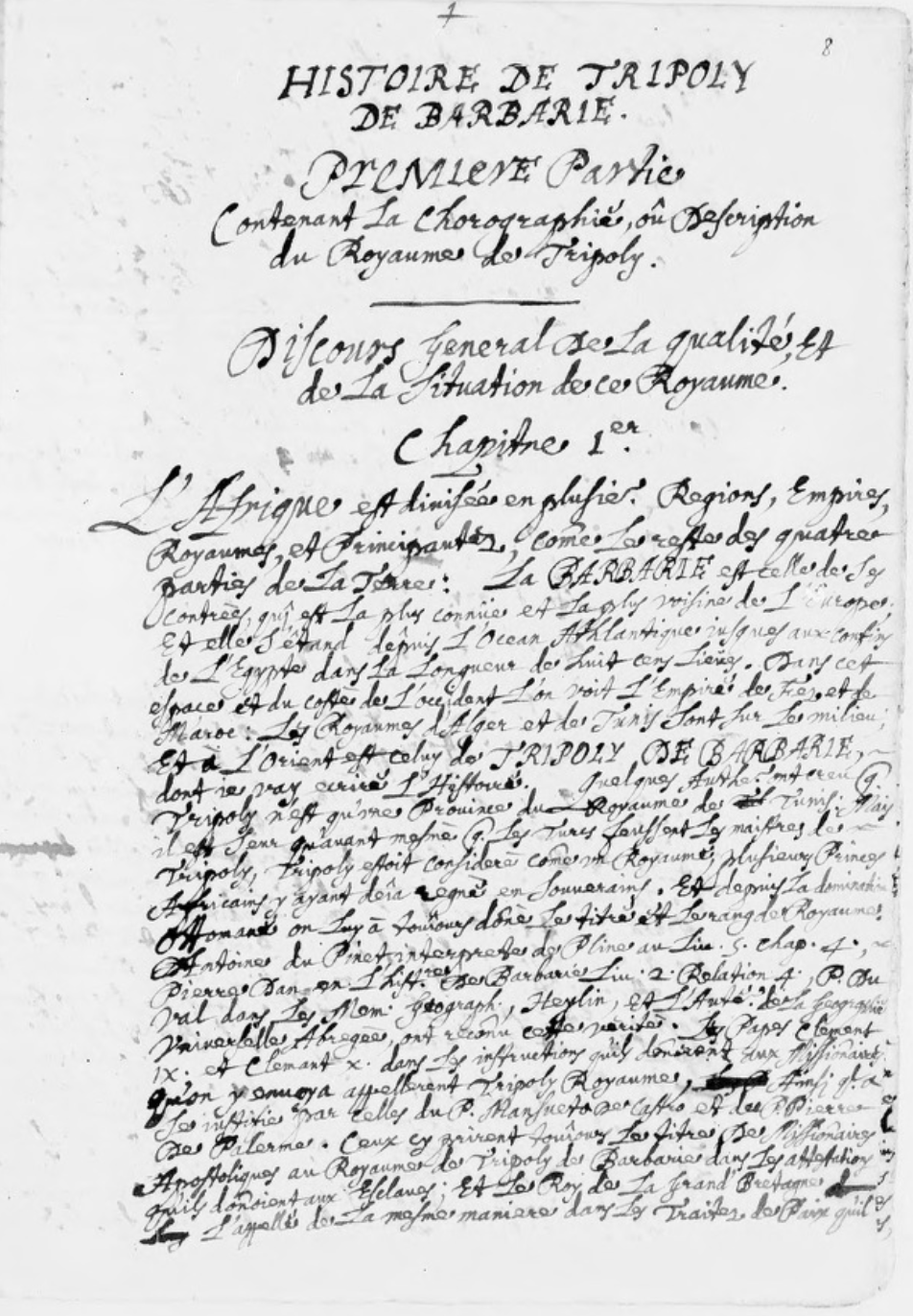
In the late 1600s, Dominique Girard, a Provençal surgeon captive in Tripoli between 1668 and 1675, composed a lengthy (over 1,000 pages) chronicle-diary, known as the Histoire chronologique du royaume de Tripoly de Barbarie. It is now held in the Bibliothèque nationale de France as BNF ms. fr. 12219 & 12220. It seems to have been little studied, excepting a recent PhD thesis.

  •  (al-Gawhari) Bushreida, Amal. 2017. Le Manuscrit de « L’Histoire chronologique du royaume de Tripoli de Barbarie ». Université de Poitiers Thèse de doctorat.
  • Laronde, André. 2006. Dominique Girard et la Cyrénaïque : le regard d’un captif français en Barbarie au XVIIe siècle. Bulletin de la Société nationale des Antiquaires de France 2001(1). 120–127.

Continue reading

ياللي حررت البشمرقة / You who freed the Peshmergeh

Sent around privately or posted on diaspora websites in the early 2000s, a poem entitled ياللي حررت البشمرقة / You who freed the Peshmergeh used the American invasion of Iraq and subsequent overthrow of Saddam Hussein to mockingly call for the same to happen in Libya. It addresses the American forces who overthrew Saddam’s regime in Iraq, thereby freeing the autonomous Kurdish army, the Peshmergeh, and requests they come and do the same in Libya. Of course, calling for regime change in Libya at that time was punished harshly, and if it were known who had composed such a poem, that person would no doubt have been imprisoned, or worse. So the poem circulated anonymously then, and apparently remained anonymous even within the poet’s own family, until Suleyman al-Sahli publicly revealed in 2012 that it was actually composed by Abdelsalam al-Hurr. Though usually known as a master of shitawa in eastern Libya, al-Hurr also composed a few qasa’id. And indeed, after the 2011 revolution and subsequent regime change, the public recitation of the poem and its attribution to a well-known eastern Libyan poet finally became possible.

Above, you can listen to Suleyman al-Sahli, then Minister of Education and son of the great Libyan folklorist and diwanist Ali al-Sahli, recite the poem. Below, I’ve provided the Arabic text and my own English translation and some notes. Continue reading

The Librarian of the Desert

In 1906, Harry Lyman Koopman wrote a lengthy speculative poem about the transfer of the Senussi library from Jaghbub to Kufra some ten years earlier, part of the removal of the entire Senussi headquarters. A librarian at Brown University, Koopman (1860-1937) seemed captivated by the Senussi center of learning deep in the Sahara: the library was supposed to be so vast that, he relates, it required hundreds of camels to transport. Reflecting on this feat as a librarian himself, Koopman’s poem takes the perspective of the hypothetical Senussi librarian at Kufra. This fictitious narrator expounds on the history of Islam, the trajectories of Islamic learning, and finally the removal of the library from one oasis in the Sahara to another even more deep in the desert.

One might characterize the poem as Koopman’s attempt to describe the library job he might have enjoyed having, in an alternate universe. Appropriately, it was first published in The Library Journal, the official organ of American library associations, where it probably enjoyed a favorable reception among other librarians of venerable Anglophone educational institutions. It was then included two years later in a collected volume of Koopman’s poetry, his fifth, entitled The Librarian of the Desert and other poems (Boston, 1908). Since readers at that time may have been rather unfamiliar with the topic and its background, Koopman provided the poem with a “prefatory note”: Continue reading

Early Modern Libyan Manuscripts in the Bibliothèque Nationale de France (sources for the study of early modern Libya i)

A great deal of historical writing on early modern Libya depends on sources written by Westerners, whether colonial archival documents, or travelogues and journals written by travellers, British diplomats’ relatives, and so forth. Only recently are local documentary archives coming to light (e.g. the ones in Ghadames). But there are also Libyan historical texts from before the colonial era scattered in collections in Libya and elsewhere. Here and in some upcoming posts I’ll try to post some brief guides to these resources, many of which still require study and publication.

The Bibliothèque Nationale de France in Paris has a few interesting Libyan historical manuscripts (described in William MacGuckin de Slane’s Catalogue des manuscrits arabes, pp. 339-340). Fortunately, several of the manuscripts have been digitized and are freely available to download and read. Here is a brief description of each manuscript. Continue reading

Ahmed Shawqi’s Elegy for Omar al-Mukhtar

Omar al-Mukhtar, the leader of the Libyan resistance to the Italian colonial forces was executed in Sullug outside of Benghazi by the Italians on this day 89 years ago— September 16, 1931—after having finally been captured a few days before. Below is the photograph from the time of his detention prior to execution that has now become iconic.By the early 1930s the Libyan resistance, although increasingly unable to hold back the Italian advances, had become known around the Arab world and Omar al-Mukhtar had become a symbol of resistance to colonialism in the Middle East more generally. His execution prompted the famous Egyptian poet Ahmed Shawqi (1868-1932), the “Prince of Poets” (أمير الشعراء) to write an elegy (رثاء) in his honor, written not long before Shawqi himself passed away in Cairo. (A clear recitation is here for those who’d prefer to listen to it being read aloud.)

Continue reading