Tag Archives: sociolinguistics

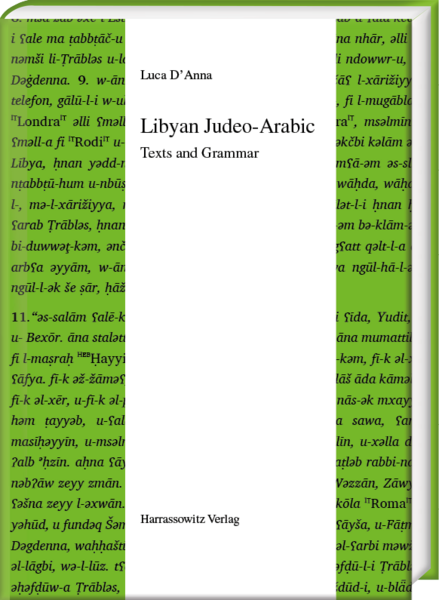
Book: Libyan Judeo-Arabic

D’Anna, Luca. 2025. Libyan Judeo-Arabic. Texts and Grammar (Semitica Viva 69). Wiesbaden: Harrassowitz.

Libyan Judeo-Arabic provides the first comprehensive account of Libyan spoken Judeo-Arabic dialects, based on fieldwork conducted in Israel and Italy between 2019 and 2023. Before 1967, there were a rich variety of spoken Judeo-Arabic dialects in Libya that coexisted and interacted with the Muslim versions of Libyan Arabic, while remaining typologically distinct. Historically, Jewish communities existed in Tripoli, Zawia, Zanzur, Khoms, Msellata, Gharyan, Yefren, Misrata, Marj, Benghazi, and Derna. After the final expulsion of Libyan Jews in 1967, the dialects they spoke have been subject to erosion and are now severely endangered, especially in the case of smaller communities, where only a few speakers remain.
Luca D’Anna offers an overview of Libyan Judeo-Arabic dialects and includes a rich selection of ethnographic texts, a grammatical survey of their dialectal bundle and a comprehensive glossary. The texts cover different aspects of Jewish life in Libya, Italy and Israel, while the grammatical survey provides a phonological and morphological description, with notes on syntax and sociolinguistics. By presenting linguistic examples from most of the communities historically represented in Libya, D’Anna also offers the first classification of Libyan Judeo-Arabic, knowledge of which was previously restricted to the Judeo-Arabic of Tripoli.

Two recent studies on Libyan Tuareg

Adam, Salah A. 2022. Multiple attitudes and shifting language ideologies: a case of language shift among Libyan Tuaregs. International Journal of the Sociology of Language. 278, 229–258. [paywall]

Abstract: This paper examines the pivotal role of ideologies in a case of language shift from Targia to Libyan Arabic among Libyan Tuaregs in the south–western region of Libya. I argue that foundational ideologies, the opposed and hierarchical linguistic relationship between Arabic and Targia, a southern Amazigh variety, and ideological elision, the process of shifting the meanings associated with Classical and Modern Standard Arabic (CA, MSA) to Libyan Arabic (LA) (e.g., religious piety), eventually have driven the changes in the linguistic behavior of the Tuareg people towards the attachment to Libyan Arabic and at the expense of Targia. The data is drawn from a fieldwork conducted on two Libyan Tuareg communities, Ghat and Barkat. The former is a multi-ethnic town while the latter is a village composed of only Tuaregs. The sample is comprised of 221 participants (114 from Brakat and 107 from Ghat), balanced by gender and divided into three age groups. A combination of qualitative and quantitative approaches was employed for data collection and analysis. The statistical analysis showed that age group has the most significant effect on the reported use of Targia, followed by type of community and the interactive effect of both variables.


de Lange, Yentl. 2022. Understanding drivers of migration: a preliminary case study of Libyan Tuareg. The Journal of North African Studies. Online [paywall].

Abstract: In this preliminary case study, the aspirations capabilities model is applied to interviews conducted with Libyan Tuareg to confirm and develop ongoing theories on migration drivers. This article examines both migration theory, as well as the social, economic, and legal situation of Tuareg in Libya. Within the context of problems to achieve citizenship among some Libyan Tuareg, the notion of statelessness is assessed as an aspiration and capability that influences migration outcomes. This study confirmed that the general life ambitions of an individual are at the basis of aspirations to migrate and that migration functions as a vehicle to fulfil personal ambitions. The article stresses that the connection to the homeland is a factor that influences migration decision-making, which should be understood outside of citizenship. Moreover, this study observed the awareness of the aspirations and capabilities of acquaintances as a factor that influences migration aspirations.

*If anyone would like a copy of these articles, please feel free to contact me.*