Previous posts in this series on historical sources for the study of early modern Libya:
i. Early Modern Libyan Manuscripts in the Bibliothèque Nationale de France
The present post gives references to journals and correspondence written by English observers, mostly diplomats of some kind, who lived in the region for a period of time. Travel accounts, which are far more numerous, will be dealt with separately. Fortunately, several of the most extensive collections of correspondence have been collected and published—those are the ones detailed here, with a few references thrown in to unpublished material; this post is not necessarily exhaustive.
17th century
Thomas Baker, English consul in Tripoli between 1677 and 1685 (then part of the Ottoman Empire and a key base of the “Barbary pirates”), kept a detailed journal during his time in the city-state. Though English consuls had been in Algiers and Tunis for some time, one was only sent to Tripoli from 1658, primarily for dealing with pirates, rather than trade. Baker’s journal, now preserved in the Bodleian Library at Oxford, is an intriguing early record at a time for which hardly any historical sources exist.
- Piracy and Diplomacy in Seventeenth-Century North Africa: The Journal of Thomas Baker, English Consul in Tripoli, 1677-1685, edited by C.R. Pennell (Rutherford: Fairleigh Dickinson University Press, 1989)
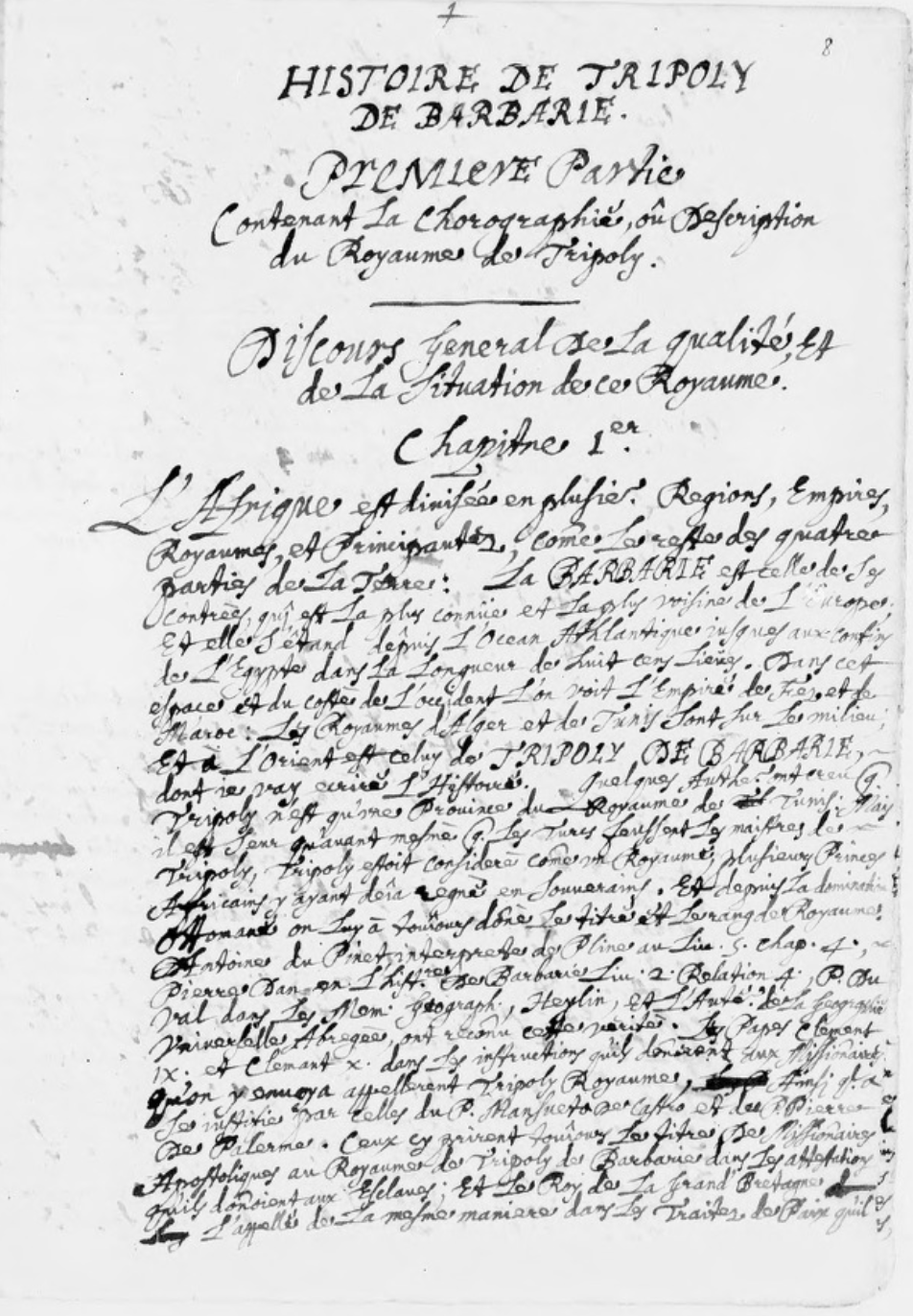
In the late 1600s, Dominique Girard, a Provençal surgeon captive in Tripoli between 1668 and 1675, composed a lengthy (over 1,000 pages) chronicle-diary, known as the Histoire chronologique du royaume de Tripoly de Barbarie. It is now held in the Bibliothèque nationale de France as BNF ms. fr. 12219 & 12220. It seems to have been little studied, excepting a recent PhD thesis.
- (al-Gawhari) Bushreida, Amal. 2017. Le Manuscrit de « L’Histoire chronologique du royaume de Tripoli de Barbarie ». Université de Poitiers Thèse de doctorat.
- Laronde, André. 2006. Dominique Girard et la Cyrénaïque : le regard d’un captif français en Barbarie au XVIIe siècle. Bulletin de la Société nationale des Antiquaires de France 2001(1). 120–127.
Late 18th – early 19th centuries
Sources from Europeans living in Tripoli do not appear for another hundred years, until the correspondence of the enigmatic “Miss Tully”, who was either the sister or sister-in-law of Richard Tully, English consul in Tripoli from 1783 to 1793. Her “narrative” is actually a collection of the numerous detailed letters she sent back home to England, recording information about the slave trade, a plague outbreak in the 1780s, and political intrigues, in addition to detailed “ethnographic” observations. As Sherif Dhaimish pointed out in a review, the work has largely flown under the radar of historians.

- Miss Tully, Narrative of a Ten Years’ Residence at Tripoli in Africa: From the Original Correspondence in the Possession of the Family of the Late Richard Tully, Esq., the British Consul: Comprising Authentic Memoirs and Anecdotes of the Reigning Bashaw, His Family and Other Persons of Distinction: Also, an Account of the Domestic Manners of the Moors, Arabs, and Turks (London: Henry Colburn, 1816, 2nd ed. 1817; republished by DARF: London, 1983)
The Wellcome collection has a nicely-digitized version, where the full-color illustrations which accompanied the work can be seen (it’s unclear whose work they were).
Immediately following the informal correspondence of Miss Tully during Richard Tully’s appointment, the diplomatic correspondence and reports of the subsequent English consuls to Tripoli, Simon Lucas (1793–1801), William Wass Langford (1804–1812) and Hanmer George Warrington (1814–1846), have also been preserved. These are now edited in a volume by Sara ElGaddari, which also includes material from the short stint of William à Court in 1813.
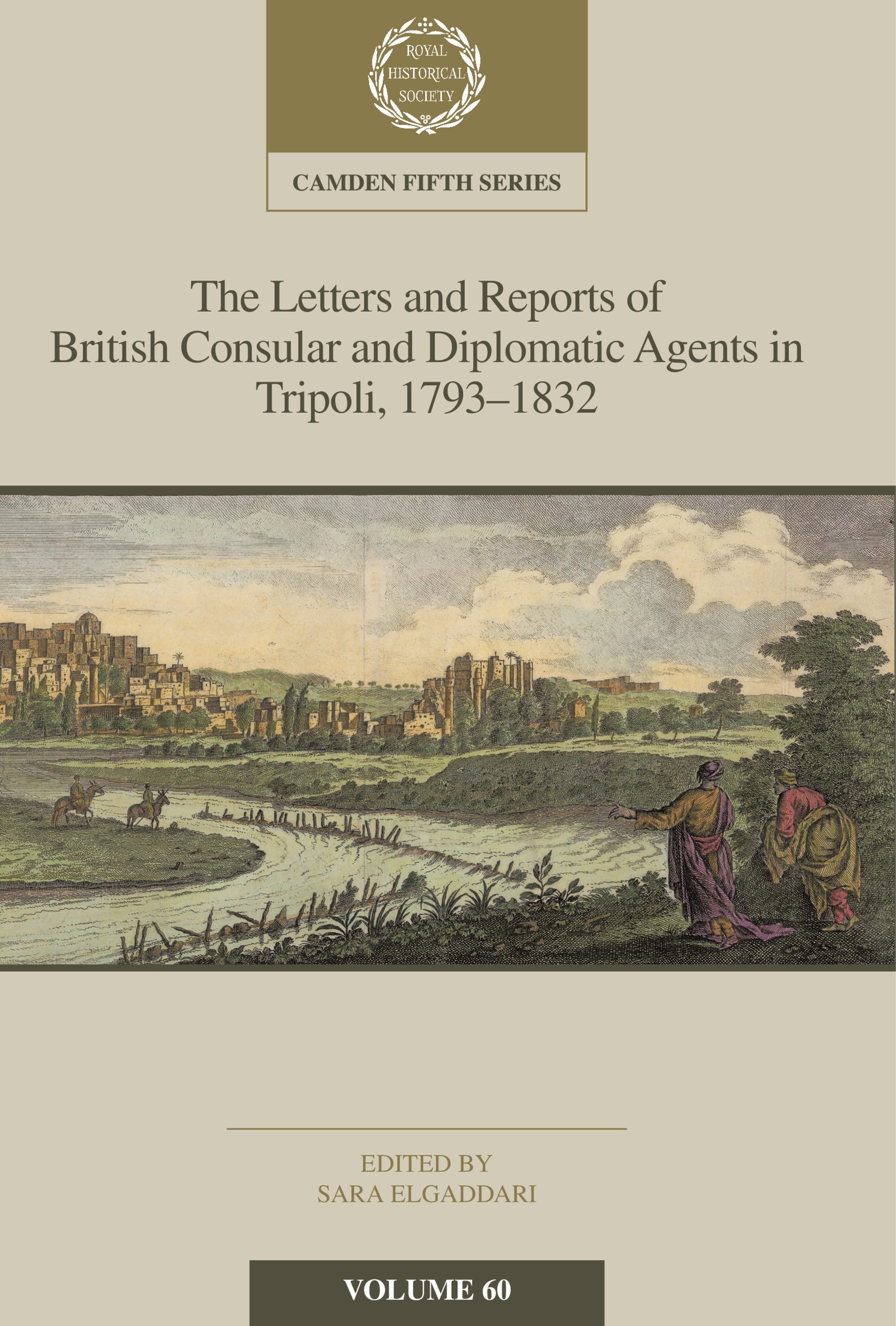
- Sara ElGaddari, The Letters and Reports of British Consular and Diplomatic Agents in Tripoli, 1793-1832 (London: Royal Historical Society, 2020)
As ElGaddari writes in her introduction to the volume, “In the first half of the nineteenth century, the British consul in North Africa held a broad and not always explicitly defined portfolio of responsibilities. The ‘peculiarity’ of the job in the Regencies of Tripoli, Algiers and Tunis (as described by the Colonial Office) was rooted in the historical exceptionalism of the management of the consuls in Ottoman provinces by the Levant Company…The British consul in Tripoli’s responsibilities continued to encompass political-diplomatic matters as well as the everyday consular caseload, well after the termination of the Levant Company in 1825 and efforts to reform the consular establishment in the 1820s and 1830s.” ElGaddari has also written several studies of the activities of these consuls. There is also an interesting blogpost overviewing the buildings used by English consuls in Tripoli, including the main consular building where consuls from Tully to Warrington would have stayed.
For documentation from around the same time, the unpublished papers of James L. Cathcart, American Consul in Tripoli in the 1790s and early 1800s, are held at the Library of Congress.
 The Silphium Gatherer | مجمّع سلفيوم
Pingback: 19th-century Letters between Bornu and Tripoli | The Silphium Gatherer | مجمّع سلفيوم
Good day,
About the Histoire chronologique du royaume de Tripoly de Barbarie, I would like to mention two other scholars who extensively worked on Girard, whose name is not Dominique, but Pierre:
Dewière, Rémi. 2023. “The Slave and the Scholar: Representing Africa in the World from Early Modern Tripoli to Borno (N. Nigeria)”, Journal of Early Modern History, 27, 1-27.
Dewière, Rémi. 2020 « “Le Pays des Garamantes est celuy la mesme quî est dessus de la ville de Fessan”. Pierre Girard et l’histoire antique du Sahara au XVIIe siècle. » in Stéphanie Guédon (ed.), Vivre, circuler et échanger sur la bordure septentrionale du Sahara (Antiquité-époque moderne), Bordeaux, Ausonius éditions, 2020, 285-310.
Weiss, Gillian 2018. “A Huguenot Captive in ‘Uthman Dey’s Court: Histoire chronologique du royaume de Tripoly (1685) and its Author,” in Piracy and Captivity in the Mediterranean: 1550–1810, ed. Mario Klarer (London, 2018).
Dewière, Rémi. 2013 « Le Discours historique de l’estat du royaume de Borno, genèse et construction d’une histoire du Borno par un captif de Tripoli au XVIIe siècle », Afriques [En ligne], 04 | 2013, mis en ligne le 24 mai 2013. URL : http://afriques.revues.org/1170.
Weiss, Gillian, 2011. Captives and Corsairs. France and Slavery in the Early Modern Mediterranean, Stanford
LikeLike