Monthly Archives: September 2023

Article: Reluctant Militants: Colonialism, Territory, and Sanusi Resistance on the Ottoman‐Saharan Frontier

Jonathan Lohnes. 2021. Reluctant Militants: Colonialism, Territory, and Sanusi Resistance on the Ottoman‐Saharan Frontier. Journal of Historical Sociology 34(3), 466-478. [paywall]

Abstract: Libya's enigmatic Sanusi brotherhood has been the subject of perennial debate since its emergence in Ottoman Cyrenaica in the mid nineteenth century, becoming a screen upon which apologists and detractors could project their own political anxieties and desires. For European critics, the brotherhood embodied the irrationality and fanaticism of the Islamic East. Its networks in North and Central Africa constituted an obstacle to their expansionist designs, while Sanusi prestige throughout the Muslim world rendered the brotherhood a threat to the entire colonial order of things. Nationalist historiography has generally endorsed this view, albeit with a positive valence, characterizing the Sanusiyya as an anticolonial social movement. Meanwhile, modern critical scholarship has tried to impose order on the chaos of the turn-of-the-century Sahara by assigning to the fraternity the role of a “proto-state.” This article proposes a new framework for understanding the history and sociology of the Sanusi. Drawing on theorists of subaltern resistance such as James Scott and Michael Adas—alongside Ottoman, British, French, and Italian primary sources—I demonstrate that the brotherhood began its life as an inward-looking Islamic social justice movement with little evident interest in state building or the geopolitical controversies of the moment. I coin the term “reluctant militants” to describe its mercurial trajectory from frontier evangelism to armed struggle in response to French and Italian colonial encirclement. This process culminated in the Long War of 1911–1931, during which the Sanusiyya played a critical part in the struggles over post-Ottoman reconstruction, from the Maghreb to Anatolia.

Article: Whose Memory Is Lost?

Spadaro, Barbara & Najlaa El-Ageli. 2023. “Whose Memory Is Lost? Languages, Spaces, Diasporic Implications and the Memory of Libya: A Conversation between Najlaa El-Ageli and Barbara Spadaro”, in Brioni, S., Polezzi, L, Sinopoli, F. (eds.) Creativita Diasporiche. Dialoghi transnazionali tra teoria e arti (Rome: Mimesis). Open access.

Diasporic Creativity is a bilingual volume made up of thirteen conversations between humanities scholars and artists whose work focuses on the theme of migration and identity. The contributions in the collection embrace forms of production ranging from literature to visual arts, from cinema to theatrical performance, from podcasts to rap music, while among the recurring themes emerge debates on identity, language, migration, memory and citizenship. This volume is also an invitation to rethink creative and academic work, in the humanities area, as intrinsically linked to dialogue and collaboration. Each conversation focuses on Italy understood as a catalyst of meanings and artistic practices that develop in different and often unexpected directions, rather than as a geographically and culturally specific, homogeneous and delimited place. Similarly, the notion of Italian culture that emerges from these conversations is open, dynamic and intrinsically linked to the belief that research and creativity have a central role in imagining and building more just and inclusive societies.

Evaluating “understudied”

So often many of us use the word “understudied” to describe Libya as a topic in different fields of research. I myself have done so on this blog (probably quite often) and I hear colleagues do the same. In this post, I want to make one kind of attempt to quantify this. Not to complain (more than I already do), or propose any particular solution, and certainly not to validate the idea that quantity of research on a topic somehow indicates better, more useful research. Rather, just as an informal exercise, get some more precision about what “understudied” might really mean, as a complement to the (rather vague) impression many of us have. To do this, I’ve decided to look at general venues of research in which a Libyan-related topic might be reasonably expected to appear, and make a rough calculation about what percent of work in those venues relates to Libya. I focus on early-modern to contemporary Libya here (ancient Libya already has good coverage through several dedicated journals).

Continue reading

Publications of the Instituto Agronomico per l’Oltremare on Colonial Libya

Thanks to the generosity of our colleague (and fellow archive diver) Amalie for sharing the below resources.

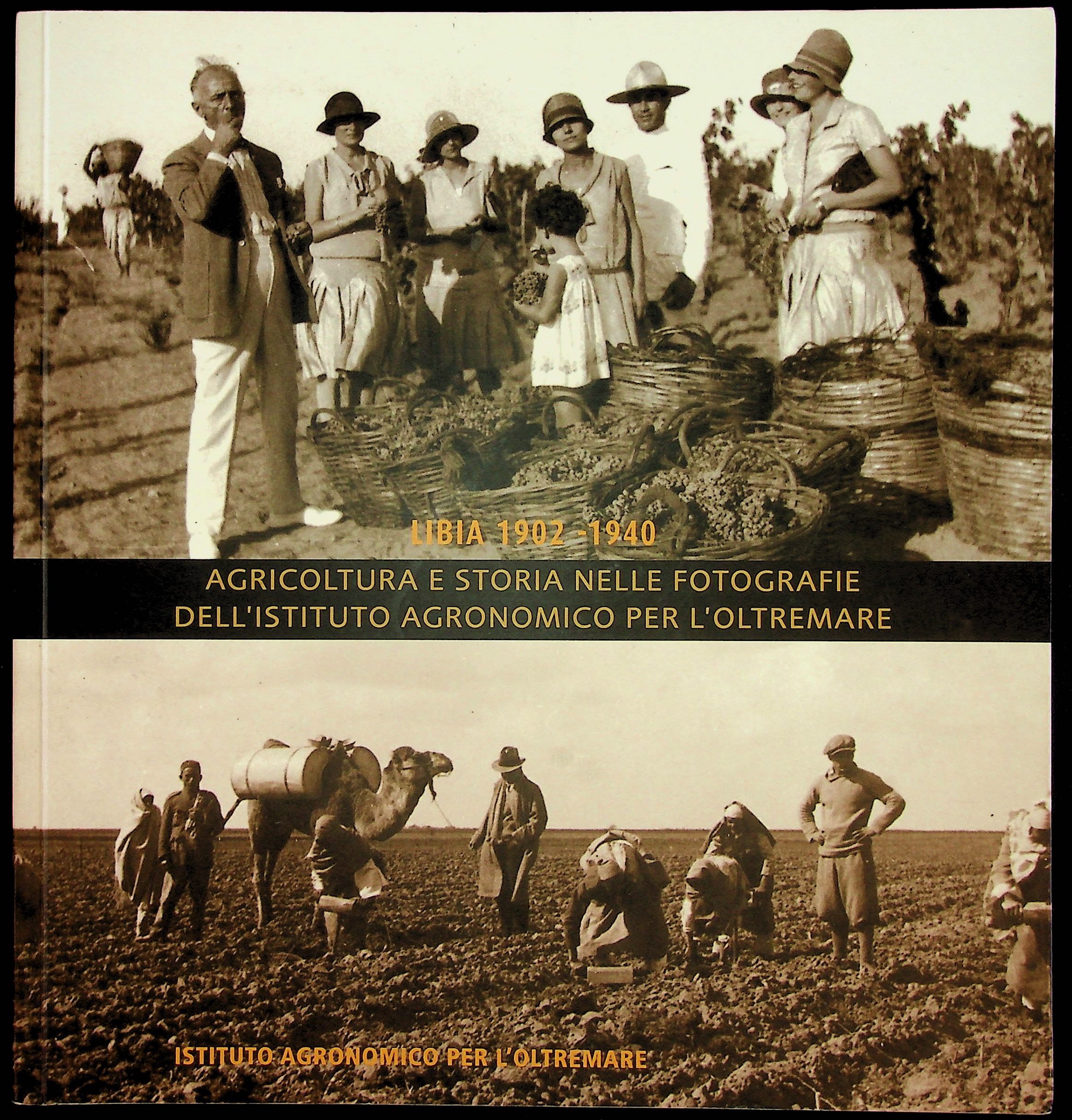
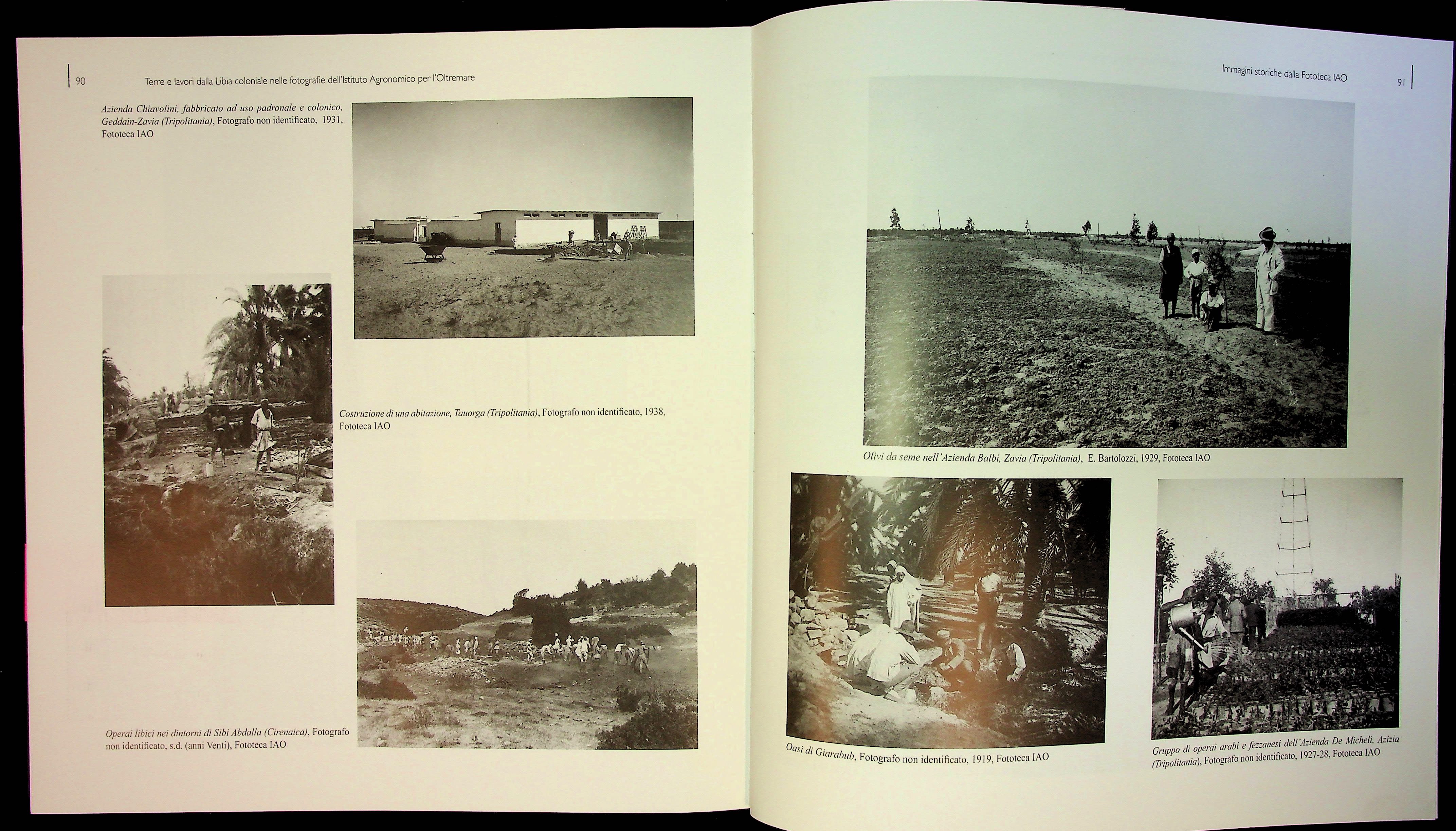
The Istituto Agronomico per l’Oltremare (now part of the Agenzia italiana per la cooperazione allo sviluppo) in Florence, Italy—itself a fairly major actor in Italian colonial expansion in north and east Africa—compiled some interesting documentation on Italian settler colonial agriculture and land development efforts in Libya based on its own archives.

Libia 1902-1940: Agricoltura e storia nelle fotografie dell’Istituto Agronomico per l’Oltremare, a cura di Massimo Battaglia e Fabrizia Morandi (IAO, 2015)

Terre e lavori dalla Libia coloniale nelle fotografie dell’Istituto Agronomico per l’Oltremare, a cura di Nicola Labanca (IAO, 2015)