I recently re-came across Words Without Borders’ translated Libyan short story collection “The Magic Lanterns of Libyan Literature” published all the way back in 2006, when most people didn’t even know where Libya was and when people like Khaled Mattawa, who wrote the introduction this collection, were pretty the only ones interested in shining a light on contemporary Libyan literature. It features some of the (now-)standardly translated Libyan writers, like Ibrahim al-Koni, Ahmed Ibrahim al-Fagih, and so forth. The title, though, I find rather awkward.
Like a bottled genie, Libya’s literature whispers to us mysteriously, until those moments when its container is buffed properly, its luster blazes and the spirit within reveals marvels and wonders beyond the imagination. It happened when Libya discovered oil in the 60s, and it struck a well of poetry, prose, and press that its fearful master soon bottled up.
Libyan storytellers have conjured literary styles and strategies to outwit dull-minded and tin-eared bureaucrats, revealing the magic words of free artistry. Ibrahim Al-Koni’s “Right Course” shows the downside of desert-style finance. In Sadiq Neihoum’s “The Sultan’s Flotilla,” the nail-biting ruler of a city fears its coming doom and manifold misfortunes, and in Ahmed Ibrahim Al-Fagih’s “The Locusts,” villagers join forces against a horde of insects while they sleep. And Mohammed Al-Asfar addresses life and loss in “Wet Sleeves,” where elderly men observe the cycles of mourning, and in his “Mint Flavored Hiccups,” where a fugitive’s family revisits the past while awaiting the future.
Our poets echo the oral tradition while venerating the personal, in the intimacy of Salem el-Okli’s love lyrics, Laila Neihoum’s wry notes on modern life, and Ashur Etwebi’s snapshot of a spot of time at a café.
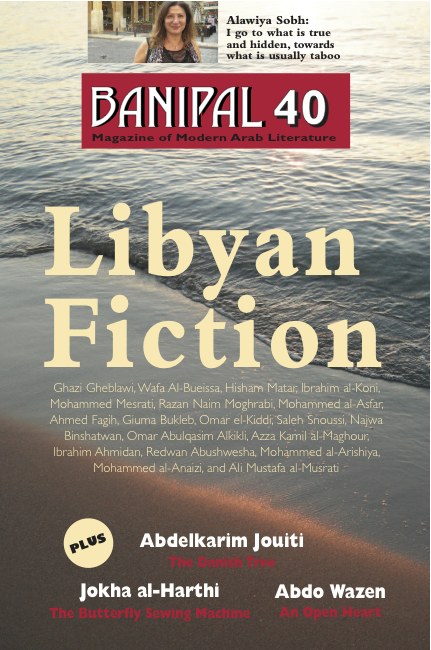 Banipal, the UK-based magazine of modern Arabic literature in English translation, published an issue dedicated to Libyan Fiction back in 2011. The print edition is reasonably priced and well worth having, but issue 40 also happens to be available online at
