Category Archives: Resources

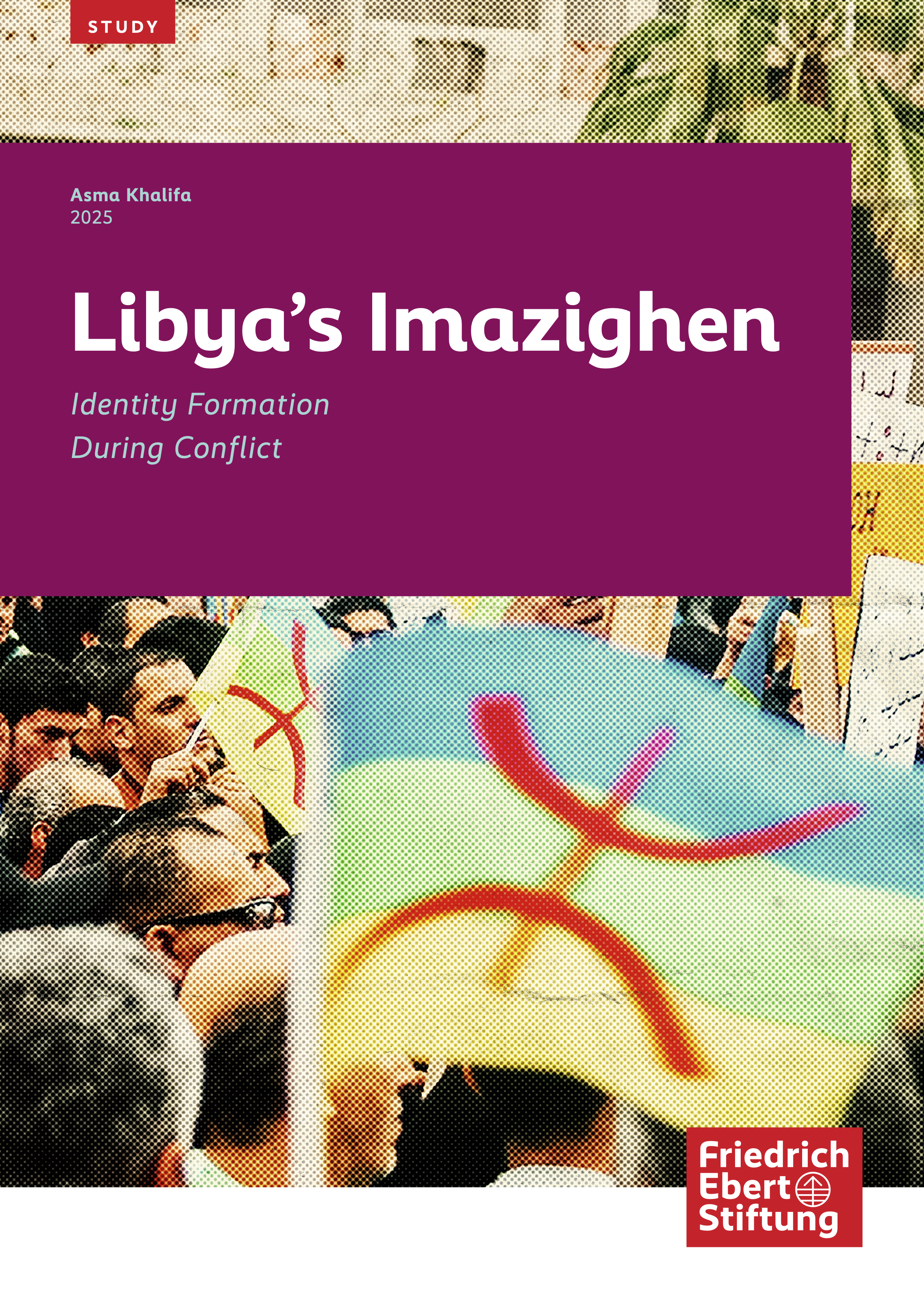
Report: Libya’s Imazighen: Identity Formation During Conflict

The Friedrich-Ebert-Stiftung’s Libya office has published a report by Asma Khalifa entitled Libya’s Imazighen: Identity Formation During Conflict.

Abstract: This paper explores the trajectory of Libya’s Amazigh population from systemic repression under the Gaddafi regime to their cultural and political resurgence following the 2011 uprising. It examines the deliberate erasure of Amazigh identity through state policies and the subsequent reassertion of their cultural and political presence during the post-revolutionary period, commonly referred to as the “Amazigh Renaissance.” Despite notable advancements, Amazigh communities continue to face exclusion within a fragmented and volatile political environment. The study argues that meaningful recognition and autonomy for the Amazigh are contingent upon an inclusive constitutional framework, resolution of national conflicts, and internal community cohesion. Their inclusion is presented as crucial for sustainable peacebuilding and the broader democratic transformation of Libya.

Articles: Afro-Asian Reactions to the Italo-Ottoman War, 1911-1912

A dossier entitled “Responding to Invasion: Afro-Asian Reactions to the Italo- Ottoman War, 1911-1912” edited by Carlotta Marchi and Massimo Zaccaria has appeared in the journal Africa. Rivista semestrale di Studi e Ricerche (VI/2, 2024). The dossier’s abstract states:

This dossier provides a comprehensive examination of the social, cultural, and material consequences of the Italo-Ottoman War (1911–1912) within a global historiographical perspective. It explores how the Italian invasion of Tripolitania and Cyrenaica sparked widespread solidarity across non-European regions. While the historiography of the conflict has hitherto focused on its European ramifications, this dossier investigates the unexplored reactions from non-European societies, particularly in those regions connected to the Ottoman Empire, such as North Africa, the Horn of Africa, the Arabian Peninsula, and the Indian Ocean. The articles examine global opinion and transnational networks of anti-imperialist and pan-Islamist activists, as well as alternative perspectives supporting Italy. By conducting such an analysis, the articles unveil intricate dynamics that supersede the conventional colonial dichotomy, emphasising collaborative endeavours and mediation initiatives.

Articles

Vanda Wilcox, “Towards a Global History of the Italo-Ottoman War”

Though often overshadowed by the events of the First World War, the Italo- Ottoman War deserves closer attention. Its study might be revitalized by drawing on recent historiographical trends within First World War studies, which emphasize both global perspective and a re- evaluation of chronological boundaries. Future studies might also draw on diverse methodological approaches, including military, social, political, and cultural histories, to deepen our understanding of the war’s multifaceted dimensions. The fields of African and colonial history can suggest further possible future avenues of approach, as can the Second Italo- Ethiopian War. The article calls for a nuanced re-evaluation of the Italo-Ottoman War that transcends Eurocentric perspectives and acknowledges its significance as a pivotal moment in global history, and concludes with a short evaluation of the war’s impact in British India.

Carlotta Marchi, “‘Arab Voices’: Press, Public Opinion and the Intellectual Response in Egypt on the Italo-Ottoman War”

During the Italo-Ottoman conflict of 1911-1912, Egypt played an important moral and material role. It was the scene of a series of manifestations and reactions of solidarity that took place in the press, in public opinion, and in literary and intellectual production. This response reflected the circulation of shared sentiments and ideals, of which Egypt became one of the centres of reference, based on a tangible trans-colonial perspective. In this sense, this paper aims to analyse the construction of awareness of the Italo-Ottoman war in Egypt, focusing on the role of “Arab voices” in promting a common sense of Ottoman, Arab and Islamic identity and solidarity, and a shared critique of Western “civilisation”. The study of newspapers, poems, discourses, reactions, and their impact and circulation favour a broader analysis of the expansion of anti-colonial solidarity, both geographically and temporally.

Massimo Zaccaria, “Courting African Public Opinion: Echoes of the Italo-Ottoman War along the Red Sea and the Indian Ocean”

The Italo-Ottoman war played an important role in mobilising public opinion. In the Americas as well as in Asia, the war aroused a great deal of participation, generated polemics and protests and, to a much lesser extent, gathered support. The study of the reactions to the Italian aggression in Africa has mainly concerned the northern part of the continent. Sub-Saharan Africa remains the great absentee, implicitly conveying the message that this region’s involvement in the conflict was minimal. Indeed, the area was not short of reactions, but one has to use the right sources and look beyond the newspapers. This is the only way to understand the profound impact that the war between Italy and the Ottoman Empire had on the Horn of Africa. Reactions were not clear-cut: the article explains why Pan-Islamism was not the only option available and why in some areas the Ottoman appeal was deliberately ignored.

Çiğdem Oğuz, “Beyond the Nationalist Propaganda: Rethinking Ottoman Literary Production on the Italo-Ottoman War of 1911”

As the last African territory of the Ottoman Empire, Tripolitania was of great importance to the Ottoman government in maintaining its prestige in the Muslim-Arab world. This paper examines the short stories mostly published in the new genre of “national literature” at the time of the Italo-Ottoman War of 1911. The stories provide insights into Ottoman-Turkish perspectives on Turkish-Arab solidarity, especially around the figure of the Caliph, as an Ottomanist strategy. While most of the stories aimed to illustrate the economic and social struggles of the empire and to evoke a sense of voluntarism to save the crumbling empire, they also served the practical purpose of responding to Italian claims of a “civilizing mission” that reduced the Ottoman Empire to colonial status, despite its recent attempt at political reform in 1908 with the Young Turk Revolution.

Silvia Pin, “The Reaction to the Italo-Ottoman War in the Hebrew Press of Jerusalem: A Reading of the Newspapers Ha-’Or and Ha-Ḥerut, October-November 1911″

The Italo-Ottoman war of 1911-1912 sparked bitter reactions in the contemporary press across the Ottoman Empire, as well as indignation and mobilisation against Italy. Amongst the Ottoman press, the Hebrew language newspapers of Jerusalem broadly covered the war, providing local Jewish perspectives on this much-debated event. This article aims to analyse the initial press coverage of the Italo-Ottoman war in two Zionist Hebrew-language newspapers of Jerusalem, the Ashkenazi Ha-’Or and the Sephardi Ha-Ḥerut. In the first months of war, the two Hebrew journals strongly though with some contradictions condemned the Italian invasion of Tripolitania, professed – and promoted – Jewish loyalty to the Empire and in so doing defended the harmless ends of Zionism. They denied that Jews in Tripoli supported the Italians and, in covering pro-Ottoman demonstrations in and out of Palestine, notably in Egypt, Ha-Ḥerut also took note of a burgeoning pan-Islamic sentiment triggered as a reaction to the Italian assault.
Book: La politica berbera nella Libia coloniale

Chiara Pagano, La politica berbera nella Libia coloniale. Identità, reti e conflitti (1835-1924) (Carocci, 2025).

“A seguito del crollo del regime di Gheddafi l’etnicità berbera/amazigh ha fornito un efficace dispositivo di affermazione politica ad alcuni gruppi libici che si sono mobilitati in aperta polemica con il paradigma panarabo dominante. L’attivismo amazigh ha ricercato nel passato gli argomenti per legittimarsi nel presente, riaffermando un legame originario con il territorio per rivendicare il riconoscimento come popolo indigeno, più che come minoranza. Eppure, come l’identità nazionale, anche l’identità etnica è un prodotto storico contingente, plasmato da specifici processi politici. Il volume ricostruisce in chiave critica la (ri)produzione dell’etnicità amazigh nella storia della Libia contemporanea, focalizzandosi sul periodo tra la metà dell’Ottocento e l’avvento del fascismo. Vengono così analizzate le rivendicazioni avanzate da attori locali definiti come “berberi” nei confronti delle autorità ottomane prima e coloniali poi. Da queste emerge come la politica berbera promossa dalle autorità italiane, e fatta propria da alcuni notabili tripolitani, individuò nell’etnicità uno strumento privilegiato per l’organizzazione gerarchica della società coloniale. Fu allora che vennero poste le basi delle dinamiche identitarie che, ancora oggi, naturalizzano l’opposizione tra gruppi arabi e berberi proiettandone le origini in un passato indefinito.”

Archive: Jan Vansina and Libya

Jan Vansina was a Belgian historian who taught in the US for many years and is considered by many to one of the major figures of African history in the 20th century, pioneering the use of local oral traditions as important historical sources.

In the 1970s he became involved with Libyan scholars and played an important role in setting up what is now the Libyan Studies Center and designing its large-scale project to collect oral histories from participants in the resistance to Italian colonial rule and survivors of the Italian concentration camps. The connection to Libya was undoubtedly through his being on the PhD committee of Mohamed Jerary, one of the founders and long-term director of the Center (thanks to a comment on this post for the tip).*

Although Vansina did not end up writing much or anything about his work with the Libyan oral histories projects and time in Tripoli, the Jan Vansina Papers, held at Northwestern University, contain notes and information about his participation, including some interview designs and trainings he offered to Libyan historians:

Research Notes Libya: Oral History of the Italo-Libyan war (1911-1933)-boxes 2-3: This section contains research methods, procedures, and the interview tool used to collect the oral histories. Also included are maps, general information on the Libyan Studies Centre, and related essays on Libya.

The archive also contains lots of other material about his teaching and research, and exploring it may shed some light on how he became connected with the fledgling Center and helped shape their field research program.

There are also some photos from Libya taken by Vansina held in the University of Wisconsin-Madison Libraries Digital Collections.

*Jerary’s PhD thesis was on the ancient history of Libya, not on oral traditions.

Translation: Excerpts from novels by three Libyan women

Words Without Borders just published a short collection entitled Political Fictions: Contemporary Novels by Libyan Women, with translated excerpts from three recent novels—Box of Sand by Aisha Ibrahim, The Colonel by Kawther Eljehmi, and Concerto by Najwa Bin Shatwan.

The traditional stereotypical narrative about the Arab world tends to exclude the participation of women in the progression of the nation’s politics. This collection presents excerpts from three novels by women writers grounded in Libyan political history.

Film: The Colonel’s Stray Dogs

I have been meaning to post for a while about this documentary, as The Colonel’s Stray Dogs is one of the most insightful and moving documentaries about Libya. Made by Khalid Shamis and released in 2021, it follows the trajectory of Ashur Shamis (the father of the filmmaker), one of the leaders of the resistance against the Gaddafi regime and one of its most serious enemies, and the regime’s efforts to hunt down and assassinate opponents both within Libya and abroad. It is really worth finding and watching, especially given that the various Libyan resistance movements against the regime are so little documented.

The film also has a great score by Tiago Correia-Paulo, available on Bandcamp and worth listening on its own.

Article: No-Fly Zone: In and out of Libya in the Sanctions Century

Leila Tayeb, “No-Fly Zone: In and out of Libya in the Sanctions Century,” Journal of Middle East Women’s Studies 20/3 (2024), pp. 382–387.

In 2011 I traveled by bus from Cairo northward to the Mediterranean coast and across the land border from Egypt into Libya. Sometime later, I flew the cross-country distance from Benghazi into Tripoli. A few weeks after that, my cousins drove me west through the Ras Jdir border crossing into Tunisia, from Ben Guerdane all the way up into the capital city. These circumstances were extraordinary, in a period of revolution, and to deal with the burdens of long-distance land travel struck me as unsurprising. I was unaware at the time that the impossibility of air travel during this period echoed the early and mid-1990s, when international flights could not land in Libya. I could not have known that, as the result of the ongoing war, this year would preview the decade to come.

Article: Italy, Libya and the EU: Co-dependent systems and interweaving imperial interests at the Mediterranean border

Alessandra Ferrini, “Italy, Libya and the EU: Co-dependent systems and interweaving imperial interests at the Mediterranean border”, in The Entangled legacies of empire Race, finance and inequality, edited by Paul Gilbert, Clea Bourne, Max Haiven & Johnna Montgomerie (Manchester University Press, 2023), 197–207. Open Access.

Abstract: The picture at the opening of the chapter portrays former Italian Prime Minister Silvio Berlusconi greeting Libyan President Muammar Gaddafi as he arrives in Rome in 2009. The meeting celebrated the Treaty on Friendship, Partnership and Cooperation between Italy and Libya and the signing of the Bilateral Agreements that have led to the current racialization of the Mediterranean border (through Italy’s right to send migrants arriving by sea back to Libya, where they are incarcerated in detention camps that severely violate human rights). Pinned to Gaddafi’s chest was a photograph of the Libyan anticolonial leader Omar al-Mukhtar in chains, taken before he was executed by Mussolini’s army in 1931. This gesture sparked outrage in Italy, as it was perceived as a mockery of Berlusconi’s earlier visits to Libya where he presented formal apologies and reparations for the Italian occupation of Libya (1911–43) as part of the Treaty. Yet, Berlusconi’s politics of apology was motivated by Italy’s need to reach agreements with Gaddafi on the control of migration across the Mediterranean, as well as agreements on commercial deals – from the supply of oil and gas to the creation of a free market zone in Libya for Italian companies. Thus, colonial reparations were accompanied by a reinforcement of neocolonial relations.

Book: Confronting the Archive of Coloniality Across Italy and Libya

A new book by artist Alessandra Ferrini, entitled Like Swarming Maggots: Confronting the Archive of Coloniality Across Italy and Libya with contributions from a number of artists and writers (including yours truly), has just been published by Berlin-based Archive Books.

Featuring Ferrini’s long-term research on the colonial and neo-colonial relations between Italy and Libya through a critical engagement with the Italian ‘archive of coloniality’ and its structural violence. The book includes documentation of Ferrini’s major project Gaddafi in Rome, whose last iteration is currently exhibited at the 60th International Art Exhibition of La Biennale di Venezia curated by Adriano Pedrosa, as well as a series of works reflecting on positionality, censorship, and the erasure of the genocide perpetrated by the Italians in Libya.

Building on the artist’s interest in writing, translation, and collaboration as forms of resistance practice, it brings together different voices and visual materials, putting forward a reflection on the ethical dimension of cultural work. As a result, the book includes original contributions, reprints, and translations by writers, scholars, curators, and practitioners pivotal to the development of Ferrini’s work and thinking.

Like Swarming Maggots: Confronting the Archive of Coloniality Across Italy and Libya includes a preface by Bassam El Baroni and contributions by: Tewa Barnosa, Adam Benkato, NiccolòAcram Cappelletto, Chiara Cartuccia, Sarri Elfaitouri, Amalie Elfallah, Khaled Mattawa, Maaza Mengiste, Barbara Spadaro, Daphne Vitali.