Category Archives: Resources

Book: The Arabic dialect of the Jews of Tripoli | لهجة يهود طرابلس العربية

The city of Tripoli in western Libya was home to a thriving Jewish community until about the early 1970s, when various political and social factors pushed the remaining members of the community to emigrate, completing the process of Libya losing its Jewish communities begun several decades earlier. Now, Jewish Libyan communities are still thriving, but in the diaspora, principally in Italy and Israel.

Since many members of the community still speak their Arabic dialect at home, it is still possible to do linguistic fieldwork and describe Jewish Libyan dialects. However, so far no dialects except that of Tripoli have received attention.

The most important study of Jewish Libyan Arabic is The Arabic dialect of the Jews of Tripoli (Libya) by Sumikazu Yoda (Harrassowitz, 2005). Yoda’s work is the only detailed description of a Libyan Jewish dialect that exists. Although written for a linguistic audience, it also contains the transcription and translation of a fairy tale (“The Sultan and the three sisters”) as well as a glossary, both of which are useful for the non-linguist reader who might want to get an idea of what the Jewish dialect of Tripoli was like.

Fortunately, Yoda also made his recording of that fairy tale available online, which you can listen at this link. It was narrated by Mere Hajjaj Liluf (میري حجاج ليلوف), who was born in Tripoli in 1925, and recorded in Israel in the 1990s.

For those who speak Libyan Arabic, the main differences to note are that t ت becomes ch چ, h ه disappears, and q ق is pronounced q and not g. So for example انتا is pronounced انچا and تعالى sounds like چَعْلا che3la. Or instead of hada هدا you hear ada ادا. I’d be interested to know how much is understandable!
Book: Misurata, a market town in Tripolitania

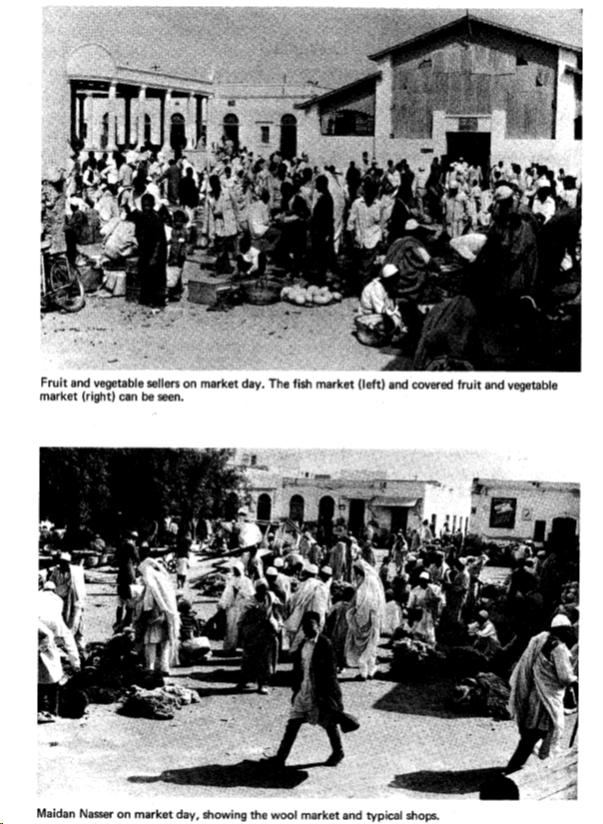
misrata-market-picA small booklet published by the Durham Dept. of Geography in 1968, Misurata: a market town in Tripolitania by G. H. Blake is one of the few (=2 or 3) studies available on Misrata (مصراتة‎) in a western language. The brief introduction is below, and a PDF of the entire booklet is available by clicking here.

“The small towns of the Middle East and North Africa have received so little attention from geographers hitherto that there is a need for case-studies of this kind if only as prologomena for intensive future investigations. Several factors combined to permit little more than a superficial study of Misurata in the summer of 1966; the paucity of statistics, the lack of large scale maps and air photographs while fieldwork was being carried out, and above all the limited time available. In spite of these difficulties an attempt was made to examine the functions and morphology of a market town which is still strongly traditional in character, with a high proportion of the population deriving their living from the sale of goods and services in the market. Some of the results of this work are presented in the following pages. While there may not be much that is methodologically exciting, it is hoped that its publication will be fully justified by its timing, for in 1966 it was already clear that the cultural ethos and economic functions of Misurata are on the threshold of great changes.

Libya’s immense oil revenues have touched every aspect of national life and in Misurata have resulted in a spate of public and private building which is beginning to transform the ancient skyline of minarets, palm trees and low, flat-roofed houses, bringing into being an essentially European-type architecture and ground plan. In the next few years the town will develop from being a regional market to a genuine regional centre with significant functions in serving through traffic. The projected North African highway will pass nearby; Casr Ahmed is to be revived as a naval and military base; and there are plans to develop and settle the vast ex-Italian estates to the south and west. The people of Misurata are famous for their commercial enterprise and will not be slow to make good use of the opportunities thus presented, just as they have been quick to establish light industries in response to the building boom.

The promise of rapid modernisation makes Misurata a town of particular interest since it epitomises the problems of renewal and development in larger cities of cultures. It remains to be seen whether the Master Plan of the town, now being prepared in Rome, will succeed in preserving what is good in the old while creating a town capable of discharging its ever-growing social and economic responsibilities to the surrounding region.” (p. 1)

PhD thesis: Najah Benmoftah on Tripoli Arabic

Warmest congratulations to Najah Benmoftah, who has just completed her Ph.D. at the Université Sorbonne Nouvelle in Paris with the following thesis:

Benmoftah, Najah. Des ligateurs de cause: étude contrastive entre le français parlé à Paris et l’arabe parlé à Tripoli (Libye). Propriétés syntaxiques et fonctionnements pragmatico-discursifs. Université Sorbonne Nouvelle – Paris 3 (2016).

Abstract: This contrastive linguistic thesis describes and contrasts the syntactic properties and the pragmatic-discursive function of parce que in spoken French in the seventh district of Paris and some of its Arabic equivalents in spoken Arabic of Tripoli (Libya) : liʔǝnna, ʕlēxāṭǝṛ , māhu and biḥkum.

Regarding the spoken Arabic of Tripoli, these ligators may belong to two different grammatical classes : they may be conjunctional ligators and / or prepositional ligatorrs. It depends on their degree of grammaticalization. While liʔanna and māhu are conjunctional ligators that introduce causal clauses organized around verbal or non-verbal predicates, ʕlēxāṭǝṛ and biḥkum can be used as prepositional ligators and introduce circumstantial complements or be grammaticalized as conjunctional ligators and introduce causal clause.

In addition, these ligators can occupy a canonical position when the ligator follows a main clause and introduces a causal clause, or a non-canonical position for which there are two cases : either the utterance begins with the causal which is introduced by the ligator of cause and is followed by the main clause, or the utterance begins with the main clause which is followed by the causal not introduced by a ligator of cause ; the latter is found at the end of the causal and closing the utterance. From a pragmatic point of view, changing the order of the constituents when ligators and causal clauses are not in canonical position allows the focalization of the causal clause.

Unlike the spoken Arabic of Tripoli, the examination of the Corpus “Français Parlé Parisien des années 2000 (CFPP2000)” shows that parce que is conjunctional ligator. It introduces a causal clause organized around verbal predicate, rarely non-verbal. parce que can occupy a canonical position when the ligator follows a main clause and introduces a causal clause, and a non-canonical position when parce que follows “c’est” and introduces a causal clause. However, it can not be postponed and it does not accept either suffix. When parce que introduces several causal clauses, it may be taken but in reduced form “que”, giving a series of “que”. In addition, from a pragmatic point of view, when the utterance begins with “c’est parce que” this structure allows to focalisation of the causal clause.

Book: Libya between Ottomanism and Nationalism

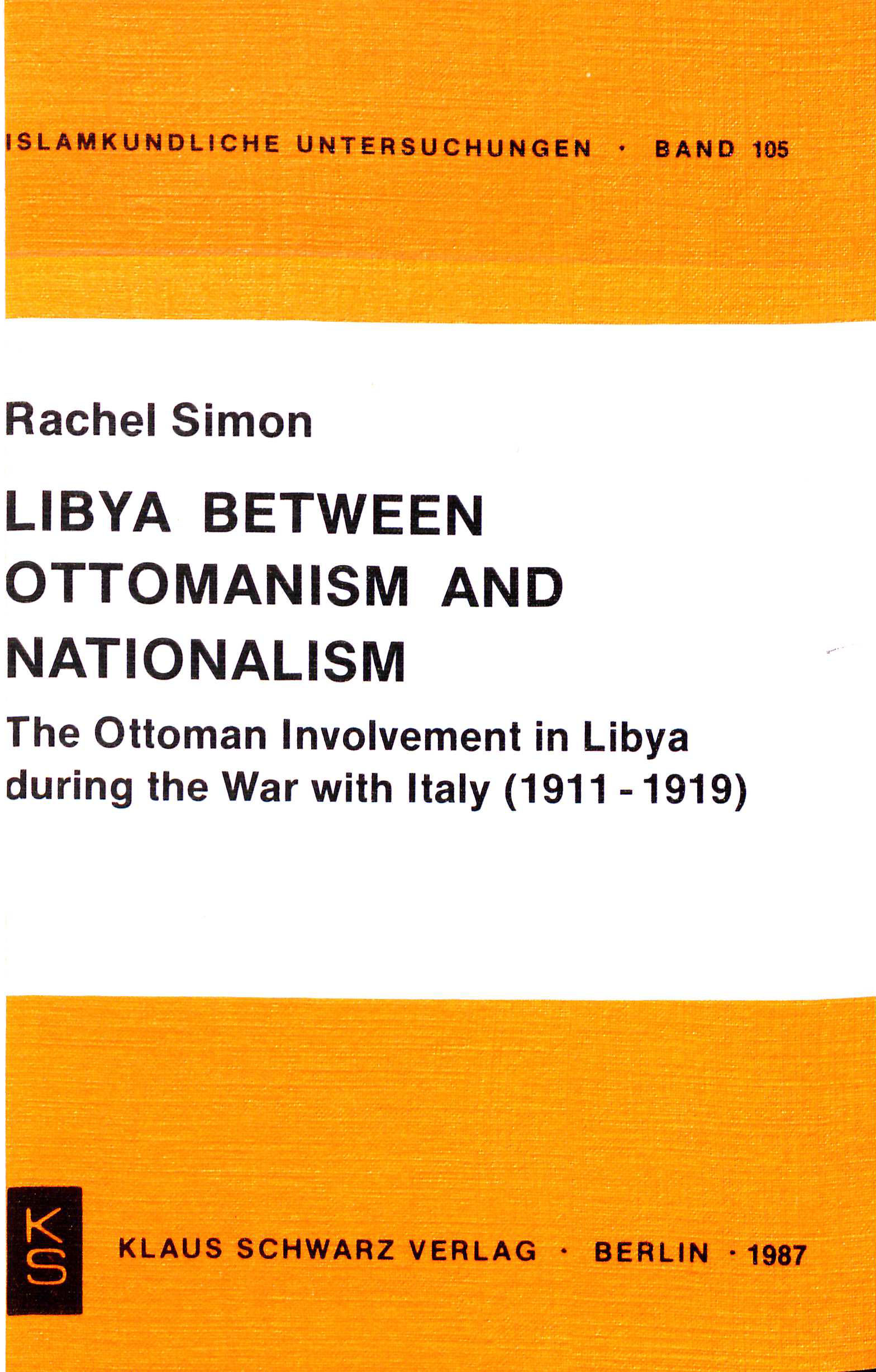
simon-libya-ottomanism-nationalismRachel Simon, Libya between Ottomanism and Nationalism: The Ottoman involvement in Libya during the War with Italy (1911–1919). Klaus Schwarz: Berlin (Islamkundliche Untersuchungen, vol. 105), 1987.

Libya between Ottomanism and Nationalism is a historical study dedicated to a period which saw the Ottoman empire’s control of North Africa wane while Italy attempted to establish a colony in Tripoli and Cyrenaica. It surveys the political makeup of the late Ottoman provinces that became Libya, the Ottoman involvement in Italy’s conquest of those territories, and chronicles the resistance against colonization in Libya, looking at both Tripoli and Cyrenaica as well as Libyan resistance movements and the Ottoman support thereof.

Since this title has been out of print for many years, the publisher (Klaus Schwarz Verlag in Berlin) has kindly given permission to put a PDF of the entire book on this blog. You can find it here.

A review of the book by Lisa Anderson can be found at this link.

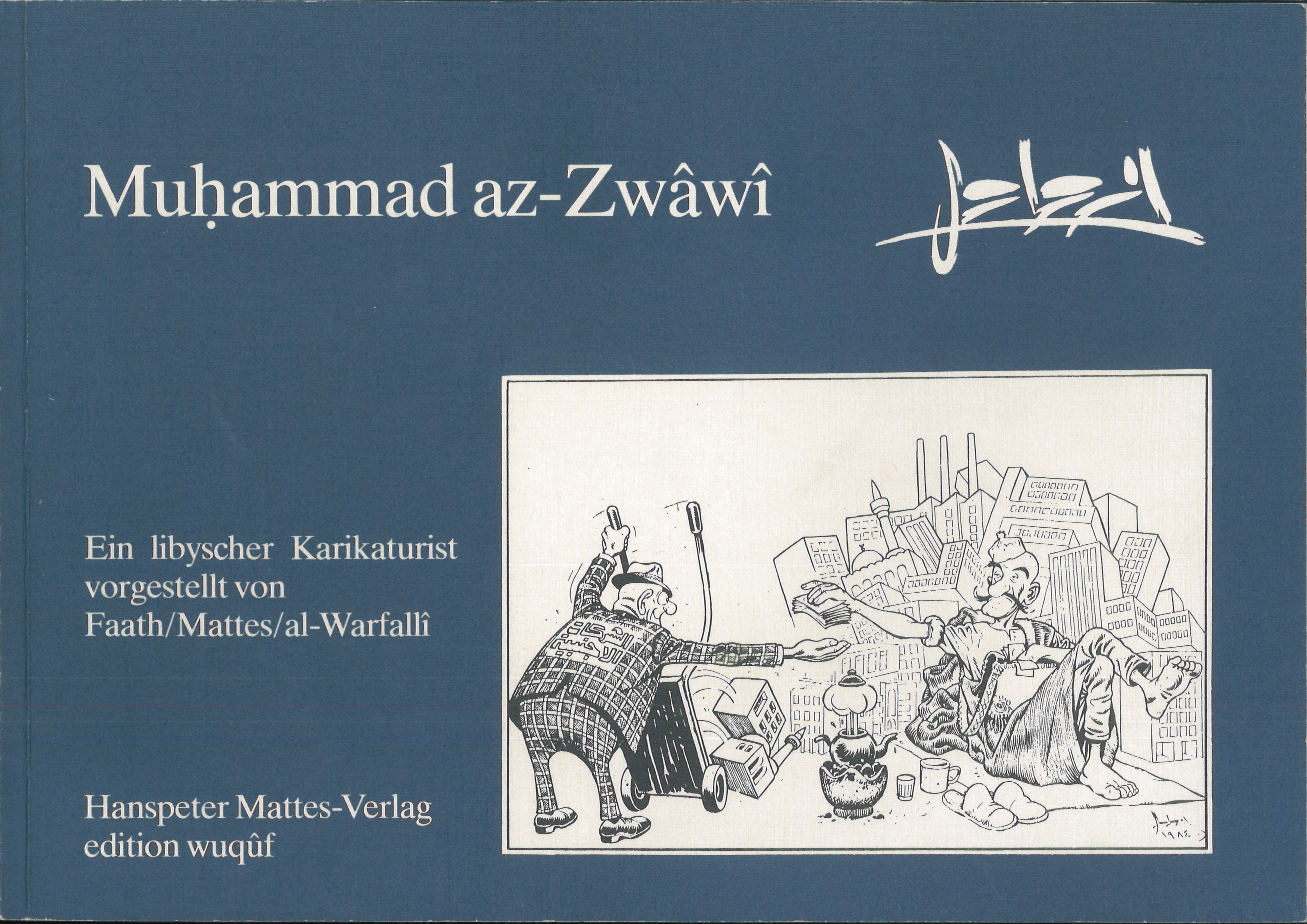
Book: Caricatures of Muhammad az-Zwawi | كاريكاتير محمد الزواوي

Muhammad al-Zwawi (محمد الزواوي) was a Libyan caricaturist who lived from 1936 to 2011. Over a long career mainly in Libya, he produced a vast number of caricatures which commented on everything from social and political life in Libya, to Libya’s relationships with other countries, to politics in the world at large. His relationships with the powers-that-were were often complicated, as he critiqued a wide range of social and political issues. But his caricatures concerning Libya’s politics with other Arab nations were regularly published in the regime’s main newspapers, especially in the 1970s and 1980s.

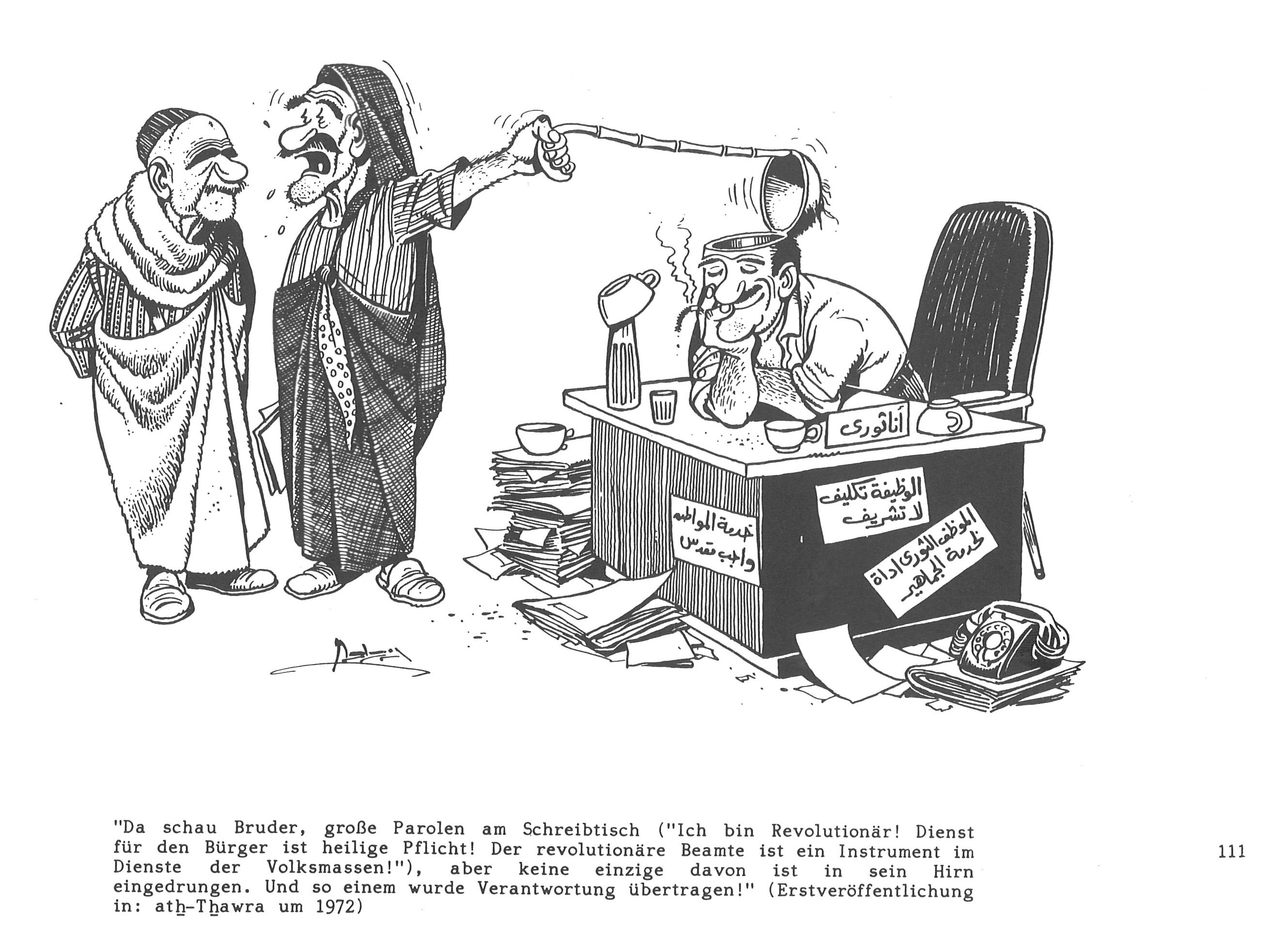
zwawi-1The only publication of, or on, al-Zwawi’s work in the West that I know of is a little-known book produced in German in 1984 by a small imprint called Edition Wuqûf, in collaboration with al-Zwawi himself. The book is divided into two parts. Part One includes three main chapters: I. Overview of the the history and present situation of caricature in Arab lands, II. Caricature in Libya, III. Remarks on the historical and social background of al-Zwawi’s caricatures. Part Two contains something like over a hundred caricatures with German captions (original Arabic text within the caricature is left as is). Here is an example:

zwawi-3

“Look at the big words on the desk (I am a revolutionary! Serving the citizen is a sacred duty!), none of which have made it into his head.”

The main Arabic language publication of his work is an album with over 300 of his caricatures entitled الوجه الاخر ‘The Other Face’ that appeared in Libya in 1973.

wajh-akhr

The Other Face. Social and Political (Drawings) 1966-1972.

Online galleries of his work can be found here and here.

Journal: Archaeological Horizons | افاق اثرية

Archaeological Horizons (افاق اثرية) is the name of an Arabic-language periodical about Libyan archaeology, archaeological sites, museums, and all other related matters. It was founded in July 2011, during an explosion of print media that occurred once cities like Benghazi were free of the regime, and its most recent issue appeared in September 2014. All 19 issues of the periodical are available for free download as PDFs at the following site: http://afaqatherya.com/

The periodical is full of all sorts of interesting information—there are articles about numerous different sites in Libya (from ancient to early modern), news about digs and expeditions, calls for action regarding antiquities lost during the regime or during the revolution, and even the occasional publication (and translation into Arabic if necessary) of Islamic grave inscriptions or pre-Islamic ones. Foreign works on Libyan archaeological matters are also taken into notice; for example, in Issue 19 (2014), the 2013 volume of the journal Libyan Studies is reviewed.

For those who are interested in the entire gamut of Libyan archaeology — from the perspective of Libyan writers(!) — this periodical provides great starting points as well as up-to-date news. Given recent upheavals in Libya, its publication has no doubt had to take a break, but here’s hoping we see Issue 20 in the near future…

Article: An Oil Boom, Women, and Changing Traditions

Fikry, Mona. 1978. “An Oil Boom, Women, and Changing Traditions: A study of Libyan women in Benghazi.” In Folklore in the Modern World, ed. R. Dorson. Mouton: The Hague, pp. 65–76. [PDF]

This is an article about the modernization of Libya after the discovery of oil and its effects on the lives and roles of women in Benghazi. The article discusses in particular the suppression of the social and cultural lives of women in connection with modernizing forces, such as mass media, and draws attention to the declining visibility of, and place for, folklore and oral literature–which except for traditional poetry was mostly transmitted and performed by women. Fikry notes, for example, that:

“Tale-telling, called khurrafat in Libya, used to be an essential part of family entertainment in towns, villages, and tents, but in the city it has now all but disappeared to be replaced by television. The time that young children spent listening to tales is now spent studying, reading magazines, or watching television. Rare are the occasions when tales are told and few are the young urban women who know any tales to tell. Even the special night devoted to tale-telling during the wedding celebration is now firmly linked with the past.”


Article: Prolegomena to the study of the Libyan Isawiyya | معلومات تمهيدية لدراسة العيسوية الليبية

One of the few anthropologists to carry out work in Libya in the past decade, and the only one working on Libyan Sufis, Igor Cherstich is currently working on a book based on his fieldwork among the ‘Isawiyya order in Tripoli, Libya. Here is one of his earlier articles on the topic.

Igor Cherstich, “Struggling for a Framework: Prolegomena to the study of the Libyan ‘Isāwiyya”, Libyan Studies 42 (2011), 59–68.

Abstract: As a consequence of the importance of the Sanusiyya in Libyan history, the literature on Sufism has shown a scarce curiosity for other Libyan [Sufi] brotherhoods. One of the reasons for this is the fact that, being characterised by a lack of central authority, these orders were considered unorganised entities that could not sustain the comparison with the Sanusiyya. The article problematises this view by concentrating on the ‘Isawiyya, a Libyan brotherhood constituted by local leaders who do not recognise a common authority. In particular, the paper  relies heavily on the recent re-conceptualisation of the idea of ‘Sufi order’ put forward by Rachida Chih, who suggests that Sufi brotherhoods could be best understood as ensembles of different local patron relationships. The article discusses the weaknesses and strengths of Chih’s framework in an attempt to propose a set of preliminary conclusions for the study of the Libyan ‘Isawiyya.

“بحثا عن هيكل: معلومات تمهيدية لدراسة العيسوية الليبية”

نتيجة لأهمية السنوسية في تاريخ ليبيا أظهرت الأدبيات عن المذهب الصوفي فضولا نادر عن الصوفيات الليبية الأخرى. إحدى أسباب ذلك هو عدم وجود مرجعية مركزية لها واعتبرت هذه الصوفيات كيانات غير منظمة وغير قابلة للمقارنة مع السنوسية.   تتعامل المقالة مع هذه الظاهرة كمشكلة وذلك بالتركيز على العيسوية وهي صوفية ليبية شكلتها مجموعة من القادة المحليين الذين لا يعترفون بمرجعية مشتركة. تعتمد المقالة بثقل على إعادة تنظير تمت مؤخرا لفكرة الصوفية من قبل رشيدة شيح التي تقترح بان الصوفيات يمكن ان تعتبر مجاميع لعلاقات رعوية محلية مختلفة. تناقش المقالة نقاط الضعف القوة في الهيكل الذي وضعته شيح في محاولة لاقتراح مجموعة اولية من الإستنتاجات لدراسة العيسوية الليبية.

You can read a version of the article at this link.

Book: The State and Social Transformation in Tunisia and Libya, 1830-1980

Lisa Anderson, The State and Social Transformation in Tunisia and Libya, 1830-1980. Princeton University Press (1986).

Publisher’s blurb: The book traces growing state intervention in the rural areas of Tunisia and Libya in the middle 1800s and the diverging development of the two countries during the period of European rule. State formation accelerated in Tunisia under the French with the result that, with independence, interest-based policy brokerage became the principal form of political organization. For Libya, where the Italians dismantled the pre-colonial administration, independence brought with it the revival of kinship as the basis for politics.

This is one of the few books (along with this one) about Libyan history to be based on extensive research with primary sources in Libyan, Ottoman, and European archives.

Article: A sketch of the life of Ramadan al-Swayhli | مختصر حياة رمضان السويحلي

Image from Libyanet.com

Ramadan al-Swayhli (رمضان السويحلي) was a major figure of the early Libyan resistance to Italian colonization, and played a role in the formation of the first Arab republic to declare its independence from the Ottoman Empire, but he is practically unknown outside of Libya. In this sketch, Lisa Anderson provides the first (and so far only) overview of his life in a Western language. Although several books about al-Suwayhli have been written in Arabic, she rightly notes that “it is a reflection of the fate of leaders of unsuccessful efforts to resist European imperialism that there is no account of his life in a Western language.”

Lisa Anderson, “Ramadan al-Suwayhli: Hero of the Libyan Resistance”, in Struggle and Survival in the Middle East, ed. E. Burke (1993), pp. 114-128.