Category Archives: Resources

Documentary: Libya’s Revolutionary Musicians

A new documentary,  Stronger Than Bullets by filmmaker Matthew Millan, about music during the Libyan revolution is now available through Al-Jazeera English:

Amidst the bloody revolution to overthrow Muammar Gaddafi, a defiant music scene emerged from the dust of war. After 42 years of non-Arabic music being banned, Benghazi suddenly resounded with a melodic fury, with hip-hop, heavy metal, rock, blues, and even country music echoing around the city.

“Stronger than Bullets” introduces the musicians who are free to play at last, and follows them as they stand shoulder-to-shoulder, guitar to rifle, alongside rebel fighters.

After months of war, Gaddafi’s death paved the way for the musicians to celebrate their victory with a triumphant music festival. Yet when the tyrant fell, shadowy elements emerged to halt the festival at the 11th hour, as victory descended into conflict and chaos.

Soon the situation came full circle back to the days of the tyrant, and the musicians had to scatter to the four winds. Will the music scene thrive once again, or will it remain mired in post-revolutionary blues?
http://players.brightcove.net/665003303001/SJg0bzqkZ_default/index.html?videoId=5178293746001&autoplay

Annotated recordings in the Tripoli dialect | تسجيلات مشروحة في لهجة طرابلس العربية

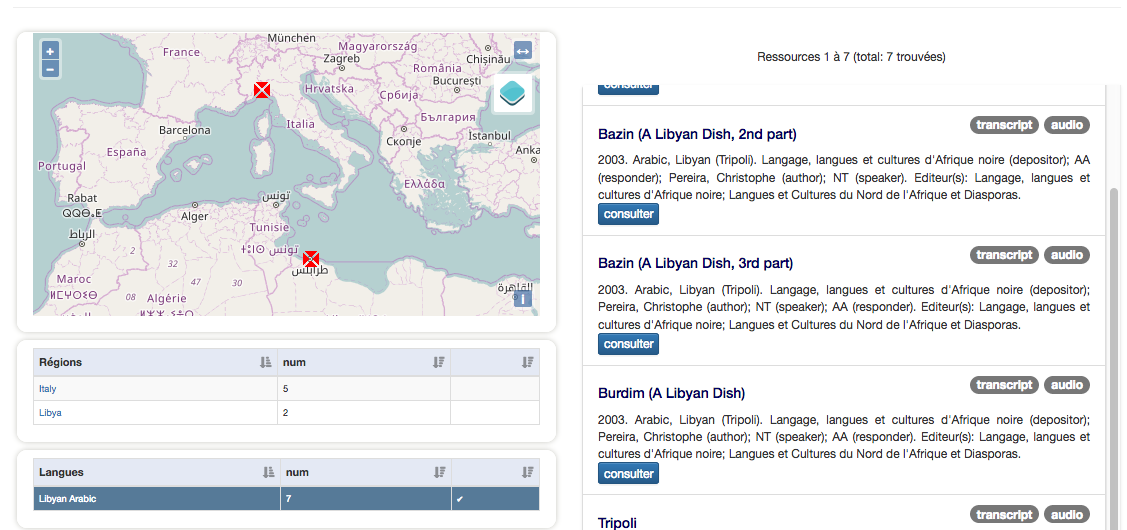
Several recorded texts in the Arabic dialect of Tripoli are available freely online as part of the database COCOON (“collection of digital oral corpora” in English), originally from CorpAfroAs (“Corpus of Afro-Asiatic Languages”), a France-based project for the description of languages of the Afro-Asiatic language family.

screenshot-cocoon

The recordings were made by Christophe Pereira, a specialist in Libyan Arabic, whose linguistic annotations and translations are also available.

These recordings are useful for linguists who want an idea of how Tripoli Arabic sounds or need a few transcriptions for comparative research, as well as for those teaching courses about Arabic dialects who could benefit from some material from Libya (of which there is not enough!).

Documentary: La Pionnières

La Pionnières (“The Pioneers”) is a documentary depicting Libya’s first democratic elections in 2012, the first after four decades of dictatorship, through the eyes of two women. It is produced by Vanessa Rousselot and presented by La Huit. I have yet to see the film, and would welcome comments and thoughts from those who have. The description is as follows:

“In July 2012, Libyans experienced their first national democratic elections after 42 years spent under the dictatorship of Qaddafi, 6 months of civil war, and more than 20,000 deaths. For the first time, women could participate in elections. They 625 to try their luck. “Pionnières” depicts a country at a historic moment through the struggle of two women. During the revolution, Myriam El-Tayab, in resistance against her own family, was beaten while pregnant. She wanted to build a country in which both supporters of the regime and revolutionaries could live together in peace. Layla El-Sounoussi traverses 400km of the desert region of Mourzouk, in the south-west of Libya, to go speak to men as they leave mosques in order to teach them what democracy is all about and why women should participate in political life. This rare document captures the short period when Libya seemed headed along the path of democracy before sinking again into chaos.”

“En juillet 2012, les Libyens vivent leurs premières élections démocratiques nationales, après 42 ans passés sous la dictature de Kadhafi, 6 mois de guerre civile et plus de 20 000 morts. Pour la première fois, les femmes peuvent se présenter aux élections. Elles sont 625 à tenter leur chance. « Pionnières » donne à voir un pays dans un moment historique, à travers le combat de deux femmes. Pendant la révolution, Myriam El-Tayab, s’est battue, enceinte, en première ligne de front contre sa propre famille. Elle veut construire un pays dans lequel supporters de l’ancien régime et révolutionnaires vivraient ensemble, en paix. Layla El-Sounoussi arpente les 400km de désert de la région de Mourzouk, au sud-est de la Libye, et va parler aux hommes à la sortie des Mosquées pour leur dire en quoi consiste la démocratie et pourquoi les femmes doivent participer à la vie politique. Un document rare faisant état de cette courte période où la Libye semblait emprunter le chemin de la démocratie. Avant que le pays ne sombre dans le chaos”

PhD Thesis: Tripolitanian traditional song 1960-2010

Another PhD thesis by a Libyan student has come to our attention, this time in the field of musicology. It can be accessed online at the following link.

Abdelmonam Ben Hamed, La tradition citadine libyenne et son acculturation: Etude du chant tripolitain (1960-2010) [The urban Libyan tradition and its acculturation: study of Tripolitanian singing (1960-2010)]. PhD thesis, Université de Nice Sophia Antipolis, 2014.

Abstract: “The goal of this thesis is to study in particular the repertoire of Tripolitanian traditional song at the core of the Libyan musical tradition with a method that brings to light both the melodic and rhythmic models which characterize this singing as well as the compositional structures which they exemplify. Specific attention is given to the evolution / acculturation of Tripolitanian traditional song.”


Book: The Ibadite Mosques of Jabal Nafusa

The newest publication of the Society for Libyan Studies’ monograph series is a much-anticipated study of the Ibadite mosques in the Nafusa mountains of western Libya by Virginie Prevost, a scholar of the Ibadites in North Africa.

Virginie Prevost (2016) Les mosquées ibadites du Djebel Nafūsa: Architecture, histoire et religions du nord-ouest de la Libye (VIIe-XIIIe siècle). [The Ibadite Mosques of the Jabal Nafūsa: Architecture, history and religion of North West Libya (7th-13th centuries)]. London.

From the publisher’s description: “The mosques of the Djebel Nafūsa, little known and under threat, personify the continuity of traditions and faith of the Ibadites, who have retained their grip over the centuries on this rugged landscape, despite their many trials and tribulations. This book is the result of a mission carried out in 2010 with the photographer Axel Derriks and examines twenty or so mosques, bringing to light their architectural features and linking them to medieval Ibadite texts.” The book features over 150 full-color photographs, maps, and plans.

Article: La transformation administrative des espaces septentrionaux Libyens

With apologies for the long silence on this blog, we get back on track with this article:

Tomaso Palmieri, “La transformation administrative des espaces septentrionaux Libyens au lendemain de la répression de l’Italie fasciste (1934-1940)” [The administrative transformation of the northern Libyan spaces on the eve of the fascist Italian repression], In Le rôle des villes littorales du Maghreb dans l’histoire, RM2E – Revue de la Méditerranée édition électronique 3/1 (2016), pp. 101–114.

Happily, the article (in French) is freely available online at the following link: http://www.revuedelamediterranee.org/index_htm_files/Palmieri_2016-III-1.pdf

Book: Benghazi Through the Ages | بنغازي عبر التاريخ

The Libyan historian Hadi Bulugma produced a series of books in Arabic on the history of Benghazi entitled بنغازي عبر التاريخ. He also made an abbreviated English version, the first volume of which (I am not sure that the second and third volumes were ever finished) concentrates on the geography and geographical history of the city. Here is a PDF of the book.

Bulugma, Hadi. 1968. Benghazi through the Ages. Volume I. Dar Maktabat al-Fikr, Tripoli.

Book: A Bibliography of Libyan Sociologists

As a research aid, the Libyan sociologist Mustafa al-Tir (مصتفى عمر التير) published a bilingual English-Arabic bio-bibliography of sociologists and anthropologists in Libya in the early 1980s. In it, he writes:

“Producing bibliographies and indexes, whether general or specialised, is an important concern of those organising or propagating knowledge in society…Bibliographies and indexes are, of course, essential for the development of scientific research…

I have noticed on more than one occasion that many Libyan planners and scholars ignore sociological studies which have been carried out in their own society…and that some planners seek the help of specialised experts in social sciences from abroad while native experts, no less competent and probably much more so, because of their knowledge of the language, values and systems of this society, are available…The wrong lies in their complete negligence of the works of their native colleagues.

I believe that the negligence on the part of many students, planners and specialists of the works of Libyan researchers in social sciences is due, partly at least, to their failure to recognise the availability of local experience and their ignorance of the works of Libyan researchers.”

Attir, Mustafa O. 1980(?). The Libyan Sociologists, anthropologists and social works and their scientific research. Arab Development Institute: Tripoli.

 مصتفى عمر التير. 1980. المتخصصون الليبيون في علوم الاجتماع و الانسان و الخدمة الاجتماعية و نشاطهم العلمي. معهد الانماء العربي: طرابلس

A PDF of the work can be found here.

Book: Libyan Fairytales | خراريف ليبية

Perhaps the only such collection to be published in Libya in recent years, خراريف ليبية (Libyan Fairytales) is an anthology of fairytales collected in the Jabal Akhdar region of eastern Libya by the folklorist and short-story writer Ahmad Yusuf ‘Agila.

The book presents thirty-four fairytales, many of which— such as ام بسيسي or نقارش or عويشة بنت السلطان—are well-known to Libyans. ‘Agila also includes a lexicon of the more unusual words used in the tales; some are truly uncommon, while some (such as شرز for سرج ‘saddle’) are simply the local pronunciation of a common word.

Many younger-generation Libyans, or those who grew up in the diaspora, may not have heard many fairytales as children. This book is particularly useful for those groups, who may want to familiarize themselves with the tales their parents grew up hearing but no longer remember. Also, because ‘Agila attempts to render the eastern Libyan dialect as accurately as possible, the tales can be read aloud to friends and family members—thus keeping at least some Libyan fairytales alive.

‘Agila’s introduction to the book, as well as samples of some of the fairytales can be found at this link.

Article: Attrition and revival in Awjila Berber

Marijn van Putten & Lameen Souag, “Attrition and revival in Awjila Berber”, Corpus 14 (2015), pp. 23-58.

Abstract: Awjila Berber is a highly endangered Berber variety spoken in the East of Libya. Only minimal material is available on the language. This is unfortunate, as that material reveals that the language is in some respects very archaic and in others grammatically unique, and as such is of particular comparative and historical interest. Fieldwork has been impossible for decades due to the political situation, leading to uncertainty about whether the language was even still spoken. With the rising popularity of Facebook, however, more and more Berber speakers are taking to Facebook to converse in their own language. Several inhabitants of Awjila have accordingly set up a Facebook page Ašal=ənnax “our village” where they communicate with one another in the Awjila language. The authors have collected a corpus of the conversations on this Facebook page, which have been transcribed and translated. Analysis of this corpus adds substantially to our knowledge of Awjili and its situation. The posters’ discussion of their motivations for using the language cast light on the language’s prospects for survival, while the posts themselves yield many previously unattested words. At the same time, the corpus provides a case study in language contact. Examination of the grammatical and lexical features of this “Facebook-Awjili” language reveals that these speakers’ usage is heavily influenced by Arabic, showing extensive language attrition absent from earlier data. The resulting constructions show parallels with other contact-heavy varieties, notably Siwi. In both respects, this study casts light upon the uses and limits of social media as a source of linguistic material.

The article is not yet available online, only in the print version, but we will link to a PDF as soon as one is available.