An old article about Tawargha

tawarghan-women

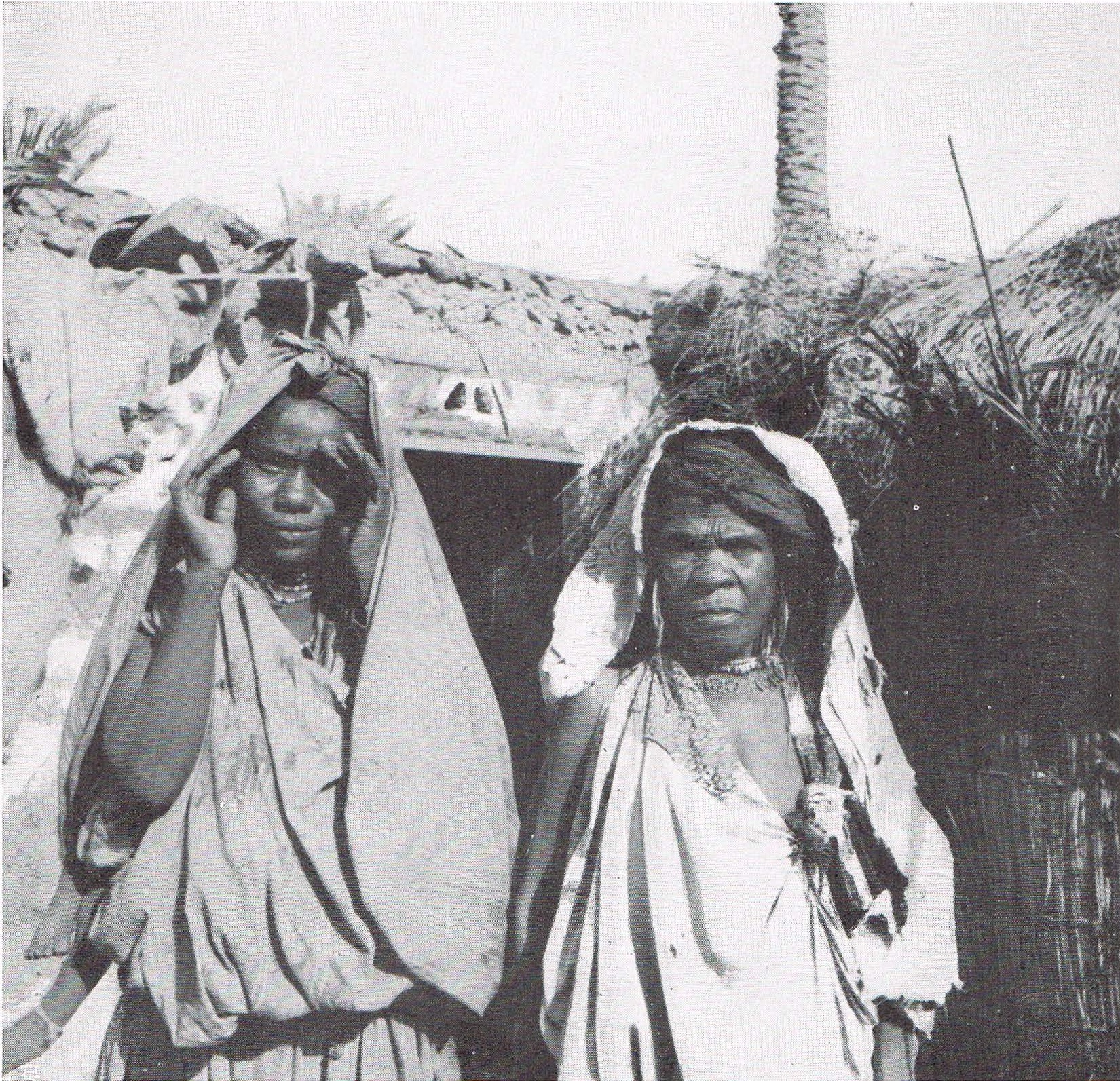
Tawarghan Women (Photo U. Paradisi, 1950s)

The inhabitants of the small oasis of Tawargha (تورغاء) outside of Misrata have suffered a great deal as a result of recent conflicts in Libya. The majority of Tawarghans are people often referred to in Libyan society as “black Libyans”, in order to draw attention to their sub-Saharan African ancestry (I prefer the term “Libyans”, since they are Libyans like everyone else). Unfortunately, most people make little effort to understand them or their history.

Tawarghan Man (Photo U. Paradisi, 1950s)

Tawarghan Man (Photo U. Paradisi, 1950s)

This being the case, I thought it important to share an article written about Tawargha fifty years ago by the linguist Umberto Paradisi, known mainly for his work on Libyan Berber. He also apparently noticed that  many Tawarghans were Black (about 4600 of a population of 5100 in 1936, apparently), and wrote an article for the popular magazine Le Vie del Mondo about it (he also wrote popular articles for this magazine about Tripoli, Ghadames, and other places in Libya). That this particular social situation was the case fifty years ago, and goes back even long before the colonial period, further shows that the recent forced displacement of Tawarghans by local militias is based on scapegoating and racism—they have been a part of society for as long as the concept of ‘Libya’ has existed. The reason for the unique demographic of Tawargha goes back to an unfortunate, but inescapable, part of Libyan history: the slave trade. This much is implied by the pejorative term shushan (plural shawāshna) used in the article, and even sometimes now, to refer to the Tawarghans and other Libyans ultimately descended from enslaved people. We need to understand these histories and work to rectify, rather than repeat, them.

Here is a scan of the article (in Italian), entitled “I sudanesi di Tauórga” and published in Le Vie del Mondo (February 1956). It uses the dated and inaccurate way of referring to Black people in Arab societies as “Sudanese”, though this is unsurprising given the era and the colonial venue it was published in. It also has several photographs showing various aspects of life in Tawargha such as date cultivation and textile making.

Book: Voices of the Arab Spring

In Voices of the Arab Spring, edited by Asaad al-Saleh (Columbia, 2015), there are sections devoted to personal stories from the revolutions in different Arab countries. The section on Libya contains several essays:

  • My Mission in the Libyan Revolution by Mohammed Zarrug
  • Fighting Qaddafi: More Determination Than Weapons by Khairi Altarhuni
  • The Dark Night on the Tripoli Front by Abdulmonem Allieby
  • Fighting for Freedom by Ehab Ibrahim al-Khinjari
  • From School to the Battlefield by Yusef Mohamed Benruwin
  • Living Through the Libyan Uprising by Gay Emmaya Tongali
  • Benghazi, My Love by Adel el-Taguri
  • My Work in Revolutionary Libya by Annabelle Veso Faller
  • The Days of My Life by Ezedin Bosedra Abdelkafi
  • Blood for My Country by Aisha A. Nasef

Article: “Sokna re-examined”

A new article discussing some old materials about the Berber (Amazigh) language of Sokna, an oasis in central Libya:

Souag, Lameen, “Sokna re-examined: Two unedited Sokna Berber vocabularies from 1850”. Quaderni di Studi Berberi e Libico-Berberi 4 : La lingua nella vita e la vita della lingua. Itinerari e percorsi degli studi berberi. Naples: UNIOR, pp. 179-206, 2015 [actually appeared 2016].

Abstract: “The Berber variety of Sokna, in west-central Libya, is rather unusual and not very well described. In 1915 it already had only five fluent speakers, and today only the old still remember a few words. The two vocabularies gathered by the English traveller James Richardson in 1850, previously unpublished, are thus important for the study of this variety, and by extension for the study of Libyan Berber more broadly. This article presents them for the first time, with transcription, commentary, and comparisons with the few previously published materials.”

(Anyone interested in a copy of the article, please contact the author)

Article: Italian colonisation and the walled city of Tripoli

An article on the Italian period and its impact on the old city of Tripoli, available online:

Mia Fuller (2000), “Preservation and self-absorption: Italian colonisation and the walled city of Tripoli, Libya,” The Journal of North African Studies 5/4, pp. 121-154.

“Scholars periodically return to the study of how French administrators and architects handled the urban settings of North Africa – the ones they found and the ones they founded – beginning with the occupation of Algiers in 1830. Italian occupation of Libya began much later, in 1911, but in the 32 years of their effective rule, Italians had sufficient time to be both destructive and constructive in significant ways. Nonetheless, only a handful of scholarly efforts have been devoted to Italian architectural and urban policies in Tripoli;
and very few of those have been concerned with the walled city at all…”

Book: Organization and Social Structure in Libyan Oases

ghadames-chart-eldblom1968

Organization of cultivated land in Ghadames (pull-out chart from Eldblom, Structure foncière, 1968).

In the late 60s, the Swedish scholar Lars Eldblom published an extremely detailed study of the socio-economic life in the three Libyan oases of Ghadames, Ghat, and Mourzouk. Since life in Libya has changed dramatically since then, his work undoubtedly documents pheno-mena of oasis life that hardly or no longer exist. It is also full of detailed maps and figures, based on painstaking research. Because of its high level of detail it certainly deserves to be better known. The book is:

Eldblom, Lars. 1968. Structure foncière. Organisation et structure sociale. Une étude comparative sur la vie socio-économique dans les trois oasis libyennes de Ghat, Mourzouk et particulièrement Ghadamès. Lund.

He also published an English summary of the book, under the following title (available freely online):

Eldblom, Lars. 1971. Land tenure – social organization and structure: a comparative sample study of the socio-economic life in the three Libyan oases of Ghat, Mourzouk and Ghadamès. Uppsala University: Nordic Africa Institute.

And finally, I have also found an earlier study of his focusing especially on irrigation in the oases of Brak, Ghadames, and Mourzouk:

Eldblom, Lars. 1961. Quelques points du vue comparatifs sur les problèmes d’irrigation dans les trois oasis Libyennes de Brâk, Ghadames et particulièrement Mourzouk. Lund (Lund Studies in Geography 22).

Article: The second Ottoman period in the writing of Libyan history | العهد العثماني الثاني في كتابة التاريخ الليبي

هنا نقدّم مقالةً عربيةً للمرة الاولى و هي مقالة “العهد العثمان الثاني في كتابة التاريخ الليبي” من الباحث الالماني ياكوب كرايس.

في مجال تاريخ الولايات العربية تحت السيطرة العثمانية تحتل ليبيا مكانة خاصة بالماقرنة مع البلدان الاخرى في شمال افريقيا لأنه كان ارتباطاً وثيقاً بين اعادة الاحتلال العثماني لليبيا و اعادة التنظيم للامبراطورية الشاملة. اذا من الممكن، في مشاريع التحديث العثمانية في ليبيا، اكتشاف التناقد بين التطور الاضطهاد. و لذلك يعتبر تيار من البحث التاريخي الدولة العثمانية كقوة استعمارية كغيرها، بينما يشير بعض العلماء الى اهمية التراث العثماني في العالم العربي. اما المؤمرخون الليبيون المعاصرون فلهم ايضاً وجهات نظر مختلفة: هناك باحثون مهتومون بالتأثيرات السلبية للاصلاحات العثمانية، من جهة اخرى ينوه مؤرخون اخرون بنتائجها اليجابية و في نفس الوقت هناك اتفاق بين التيارين بالنسبة الى التضامن الاسلامي ضد الغزو الاستعماري الايطالي.

Abstract: “In the history of the Ottoman Empire’s Arab provinces Libya occupies a special place, compared to the other North African countries, insofar as the Ottoman reoccupation of Libya went hand in hand with the reorganization of the empire as a whole. It is thus possible to trace, in the Ottoman reform projects, an opposition between development and repression. That is why one strand in historical research considers the Ottoman Empire as a regular colonial power, while some scholars, on the other hand, emphasize the importance of the Ottoman heritage in the Arab world. The contemporary Libyan historians, for their part, have also different points of view: there are those researchers who are interested, above all, in the negative influences of Ottoman reforms, whereas others stress the positive outcomes. At the same time, there exists a consensus as far as the Islamic solidarity against the Italian colonial aggression is concerned.”

Essay: How Long Have You Been With Us? by Khaled Mattawa

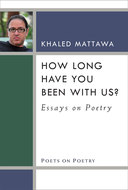
How Long Have You Been With Us? Essays on Poetry by Khaled Mattawa has just been published by the University of Michigan Press.

“Khaled Mattawa, an American poet of Libyan origin, explores various dynamic developments shaping American poetry as it is being practiced today. Arising from an incredibly diverse range personal backgrounds, lyric traditions, and even languages, American poetry is transforming into a truly international form. Mattawa, who also translates Arabic poetry into American English and American poetry into Arabic, explores the poetics and politics of cross-cultural exchange and literary translation that fostered such transformation. The essays in this collection also shed light on Mattawa’s development as a poet and provide numerous portraits of the poets who helped shaped his poetry.”

Libia 1911-1912: Immaginari coloniali e italianità

Gabriele Proglio, Libia 1911-1912: Immaginari coloniali e italianità, Mondadori (2016).

From the publisher: “L’Italia va alla guerra per conquistare il suo ‘posto al sole’ senza realmente sapere cosa troverà sull’altra sponda del Mediterraneo. Il volume analizza la propaganda coloniale e, in particolare, la stretta relazione tra la costruzione narrativa della colonia libica e le trasformazioni dell’italianità. All’iniziale studio degli immaginari sulla Libia precedenti il 1911, segue una disamina di quelle voci che si mobilitarono a favore della guerra, partendo dai nazionalisti di Enrico Corradini con i riferimenti all’Impero romano, al Risorgimento, al mito della ‘terra promessa’. L’archivio coloniale è indagato anche attraverso lo studio delle omelie funebri per i soldati caduti durante la guerra, con immagini che vanno dal buon soldato al figlio della patria. Un altro campo d’analisi è quello dell’infanzia: i discorsi dei docenti sul conflitto, del «Corriere dei Piccoli» e della letteratura per ragazzi lavorano per «costruire» i corpi dei piccoli italiani. Non manca, infine, lo studio della letteratura interventista: Gabriele D’Annunzio, Giovanni Pascoli, Filippo Tommaso Marinetti, Matilde Serao, Ezio Maria Gray, Umberto Saba, Ada Negri, Giuseppe Bevione.”

Article: The Sanusi Letters: a checklist | قائمة رسائل السنوسية

From “The Sanusi Letters: A checklist”, by Knut S. Vikør. Available freely online.

“The obvious importance of the Sanūsī order has made it one of the better studied movements of nineteenth-century Islam. Traditionally, however, the movement has been known mostly from external sources, in particular French colonial observers, and from overviews such as those of E.E. Evans-Pritchard and Nicola Ziadeh. There exists, however, a rich body of material from inside the order. They include the scholarly works of its masters, but also non-literary material such as letters of various types. In recent years, more and more of these have been published in various works on the Sanusiyya. They are, however, spread throughout many publications and it may be hard to obtain an overview of them. The present list is a survey of known letters to and from the Sanūsī order.”