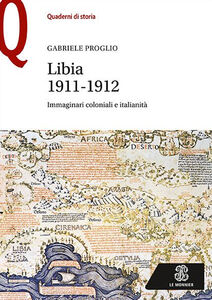
Libia 1911-1912: Immaginari coloniali e italianità

Gabriele Proglio, Libia 1911-1912: Immaginari coloniali e italianità, Mondadori (2016).

From the publisher: “L’Italia va alla guerra per conquistare il suo ‘posto al sole’ senza realmente sapere cosa troverà sull’altra sponda del Mediterraneo. Il volume analizza la propaganda coloniale e, in particolare, la stretta relazione tra la costruzione narrativa della colonia libica e le trasformazioni dell’italianità. All’iniziale studio degli immaginari sulla Libia precedenti il 1911, segue una disamina di quelle voci che si mobilitarono a favore della guerra, partendo dai nazionalisti di Enrico Corradini con i riferimenti all’Impero romano, al Risorgimento, al mito della ‘terra promessa’. L’archivio coloniale è indagato anche attraverso lo studio delle omelie funebri per i soldati caduti durante la guerra, con immagini che vanno dal buon soldato al figlio della patria. Un altro campo d’analisi è quello dell’infanzia: i discorsi dei docenti sul conflitto, del «Corriere dei Piccoli» e della letteratura per ragazzi lavorano per «costruire» i corpi dei piccoli italiani. Non manca, infine, lo studio della letteratura interventista: Gabriele D’Annunzio, Giovanni Pascoli, Filippo Tommaso Marinetti, Matilde Serao, Ezio Maria Gray, Umberto Saba, Ada Negri, Giuseppe Bevione.”
Article: The Sanusi Letters: a checklist | قائمة رسائل السنوسية

From “The Sanusi Letters: A checklist”, by Knut S. Vikør. Available freely online.

“The obvious importance of the Sanūsī order has made it one of the better studied movements of nineteenth-century Islam. Traditionally, however, the movement has been known mostly from external sources, in particular French colonial observers, and from overviews such as those of E.E. Evans-Pritchard and Nicola Ziadeh. There exists, however, a rich body of material from inside the order. They include the scholarly works of its masters, but also non-literary material such as letters of various types. In recent years, more and more of these have been published in various works on the Sanusiyya. They are, however, spread throughout many publications and it may be hard to obtain an overview of them. The present list is a survey of known letters to and from the Sanūsī order.”

Documentary: Libya’s Revolutionary Musicians

A new documentaryStronger Than Bullets by filmmaker Matthew Millan, about music during the Libyan revolution is now available through Al-Jazeera English:

Amidst the bloody revolution to overthrow Muammar Gaddafi, a defiant music scene emerged from the dust of war. After 42 years of non-Arabic music being banned, Benghazi suddenly resounded with a melodic fury, with hip-hop, heavy metal, rock, blues, and even country music echoing around the city.

“Stronger than Bullets” introduces the musicians who are free to play at last, and follows them as they stand shoulder-to-shoulder, guitar to rifle, alongside rebel fighters.

After months of war, Gaddafi’s death paved the way for the musicians to celebrate their victory with a triumphant music festival. Yet when the tyrant fell, shadowy elements emerged to halt the festival at the 11th hour, as victory descended into conflict and chaos.

Soon the situation came full circle back to the days of the tyrant, and the musicians had to scatter to the four winds. Will the music scene thrive once again, or will it remain mired in post-revolutionary blues?

http://players.brightcove.net/665003303001/SJg0bzqkZ_default/index.html?videoId=5178293746001&autoplay

Annotated recordings in the Tripoli dialect | تسجيلات مشروحة في لهجة طرابلس العربية

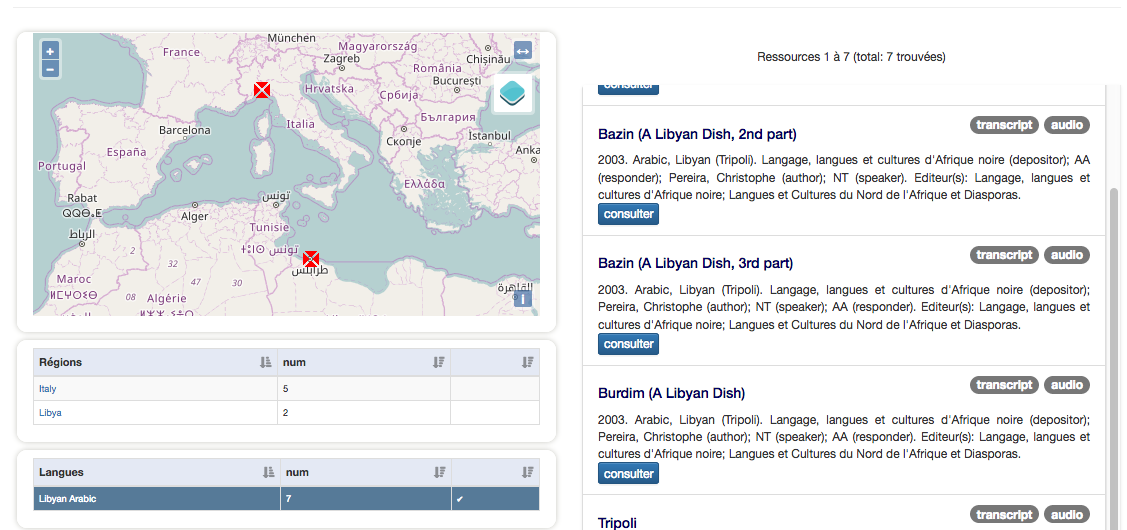
Several recorded texts in the Arabic dialect of Tripoli are available freely online as part of the database COCOON (“collection of digital oral corpora” in English), originally from CorpAfroAs (“Corpus of Afro-Asiatic Languages”), a France-based project for the description of languages of the Afro-Asiatic language family.

screenshot-cocoon

The recordings were made by Christophe Pereira, a specialist in Libyan Arabic, whose linguistic annotations and translations are also available.

These recordings are useful for linguists who want an idea of how Tripoli Arabic sounds or need a few transcriptions for comparative research, as well as for those teaching courses about Arabic dialects who could benefit from some material from Libya (of which there is not enough!).

Documentary: La Pionnières

La Pionnières (“The Pioneers”) is a documentary depicting Libya’s first democratic elections in 2012, the first after four decades of dictatorship, through the eyes of two women. It is produced by Vanessa Rousselot and presented by La Huit. I have yet to see the film, and would welcome comments and thoughts from those who have. The description is as follows:

“In July 2012, Libyans experienced their first national democratic elections after 42 years spent under the dictatorship of Qaddafi, 6 months of civil war, and more than 20,000 deaths. For the first time, women could participate in elections. They 625 to try their luck. “Pionnières” depicts a country at a historic moment through the struggle of two women. During the revolution, Myriam El-Tayab, in resistance against her own family, was beaten while pregnant. She wanted to build a country in which both supporters of the regime and revolutionaries could live together in peace. Layla El-Sounoussi traverses 400km of the desert region of Mourzouk, in the south-west of Libya, to go speak to men as they leave mosques in order to teach them what democracy is all about and why women should participate in political life. This rare document captures the short period when Libya seemed headed along the path of democracy before sinking again into chaos.”

“En juillet 2012, les Libyens vivent leurs premières élections démocratiques nationales, après 42 ans passés sous la dictature de Kadhafi, 6 mois de guerre civile et plus de 20 000 morts. Pour la première fois, les femmes peuvent se présenter aux élections. Elles sont 625 à tenter leur chance. « Pionnières » donne à voir un pays dans un moment historique, à travers le combat de deux femmes. Pendant la révolution, Myriam El-Tayab, s’est battue, enceinte, en première ligne de front contre sa propre famille. Elle veut construire un pays dans lequel supporters de l’ancien régime et révolutionnaires vivraient ensemble, en paix. Layla El-Sounoussi arpente les 400km de désert de la région de Mourzouk, au sud-est de la Libye, et va parler aux hommes à la sortie des Mosquées pour leur dire en quoi consiste la démocratie et pourquoi les femmes doivent participer à la vie politique. Un document rare faisant état de cette courte période où la Libye semblait emprunter le chemin de la démocratie. Avant que le pays ne sombre dans le chaos”

Book: Libyan Twilight: The Story of an Arab Jew

Darf Publishers has recently released the memoir of Raphael Luzon, a member of the Jewish community of Benghazi, entitled Libyan Twilight: The story of an Arab Jew. Luzon is also the co-author of an Arabic collection of interviews with members of the Libyan Jewish community, entitled سالتهم فتحدثوا: دراسة حول يهود ليبيا (I asked, and they answered: A study about Libyan Jews). From the publisher’s blurb:

Libyan Twilight is a short memoir that discusses the forgotten Jewish community of Libya. As a child growing up in Benghazi, Raphael Luzon experienced the pogrom that followed the 1967 Six Day War between Israel and Egypt, Syria and Jordan. The Libyan Jews were forced to abandon their homeland and seek refuge overseas as a result.

The narrative jumps between the present and past, starting in 2012 where Raphael finds himself in a jail cell in post-revolution Libya amidst political chaos. He rewinds 45 years to a time when Libya was his home, just before the Muslim community ousted the ‘Arab Jews’. They spoke in a Libyan dialect of Arabic and had been rooted in North Africa since the destruction of the first temple in Jerusalem in 586 BC right up until 1967.

Left with no choice, the Libyan Jews were forced to flee Benghazi and find settlement elsewhere, leaving a rich culture behind in Saharan sands. Luzon tells the story with an air of dignity rather than resentment. He opens the lid on a box of memories that reflect on the repercussions he and his community experienced over the last 50 years. As a memoir of exile, Libyan Twilight bursts with nostalgia and gives voice to a forgotten tragedy.

Shackled to his Libyan heritage, Luzon relives his life in Italy, Israel and London through a series of charming anecdotes. Sentiments aside, Libyan Twilight is about a man’s quest for justice. On a self-assigned mission, Luzon strives for closure on the deaths of his family in Tripoli during the pogrom. Nobody was convicted, nor were they granted a funeral. Luzon’s honorary pursuit for redemption places revenge aside, as he sets out to achieve a trial, a conviction and a funeral for the lost Libyan Jews.”

The book can be ordered directly from Darf Publishers.

PhD Thesis: Tripolitanian traditional song 1960-2010

Another PhD thesis by a Libyan student has come to our attention, this time in the field of musicology. It can be accessed online at the following link.

Abdelmonam Ben Hamed, La tradition citadine libyenne et son acculturation: Etude du chant tripolitain (1960-2010) [The urban Libyan tradition and its acculturation: study of Tripolitanian singing (1960-2010)]. PhD thesis, Université de Nice Sophia Antipolis, 2014.

Abstract: “The goal of this thesis is to study in particular the repertoire of Tripolitanian traditional song at the core of the Libyan musical tradition with a method that brings to light both the melodic and rhythmic models which characterize this singing as well as the compositional structures which they exemplify. Specific attention is given to the evolution / acculturation of Tripolitanian traditional song.”


Book: The Ibadite Mosques of Jabal Nafusa

The newest publication of the Society for Libyan Studies’ monograph series is a much-anticipated study of the Ibadite mosques in the Nafusa mountains of western Libya by Virginie Prevost, a scholar of the Ibadites in North Africa.

Virginie Prevost (2016) Les mosquées ibadites du Djebel Nafūsa: Architecture, histoire et religions du nord-ouest de la Libye (VIIe-XIIIe siècle). [The Ibadite Mosques of the Jabal Nafūsa: Architecture, history and religion of North West Libya (7th-13th centuries)]. London.

From the publisher’s description: “The mosques of the Djebel Nafūsa, little known and under threat, personify the continuity of traditions and faith of the Ibadites, who have retained their grip over the centuries on this rugged landscape, despite their many trials and tribulations. This book is the result of a mission carried out in 2010 with the photographer Axel Derriks and examines twenty or so mosques, bringing to light their architectural features and linking them to medieval Ibadite texts.” The book features over 150 full-color photographs, maps, and plans.

Article: La transformation administrative des espaces septentrionaux Libyens

With apologies for the long silence on this blog, we get back on track with this article:

Tomaso Palmieri, “La transformation administrative des espaces septentrionaux Libyens au lendemain de la répression de l’Italie fasciste (1934-1940)” [The administrative transformation of the northern Libyan spaces on the eve of the fascist Italian repression], In Le rôle des villes littorales du Maghreb dans l’histoire, RM2E – Revue de la Méditerranée édition électronique 3/1 (2016), pp. 101–114.

Happily, the article (in French) is freely available online at the following link: http://www.revuedelamediterranee.org/index_htm_files/Palmieri_2016-III-1.pdf

Book: Benghazi Through the Ages | بنغازي عبر التاريخ

The Libyan historian Hadi Bulugma produced a series of books in Arabic on the history of Benghazi entitled بنغازي عبر التاريخ. He also made an abbreviated English version, the first volume of which (I am not sure that the second and third volumes were ever finished) concentrates on the geography and geographical history of the city. Here is a PDF of the book.

Bulugma, Hadi. 1968. Benghazi through the Ages. Volume I. Dar Maktabat al-Fikr, Tripoli.