Tag Archives: articles

Article: Migration from Ottoman Trablus al-Gharb to Djerba

A recent (open-access!) article by our colleague Paul Love of Ibadi Studies based on local and colonial archives as well as fieldwork with the community:

Love, Paul M. 2025. M’addibs and Migrant Laborers: Migration from Ottoman Trablus al-Gharb to Djerba, Tunisia in the Early 20th Century. International Journal of Middle East Studies 57(2). 294–312.

Abstract: This article follows the history of migration from the mountain villages of the Jebel Nafusa in Ottoman Trablus al-Gharb (in today’s northwestern Libya) to the southern Tunisian island of Djerba in the early 20th century. It situates this local history of migration within the broader framework of Maghribi migration both before and during the colonial era in Libya (1911–43), while tracing the histories of two categories of migrants, in particular, manual laborers and Qur’an teachers (m’addibs). The article makes three claims: (1) Nafusi migration was as much the result of local historical circumstances as it was a response to colonialism; (2) the historical experience of migration of Nafusis differed according to social class; and (3) local circumstances shaped the dynamics of migrant integration in the Maghrib. In doing so, I demonstrate how Nafusi migration to Djerba both conforms to and diverges from the larger history of late Ottoman and colonial-era migration in Tunisia. By shifting the focus away from the colonial moment, I make the case for foregrounding longer-term regional connections and migrations that linked different spaces across the Maghrib and also attend to local histories and what they offer in the way of caveats and exceptions.

Articles: Afro-Asian Reactions to the Italo-Ottoman War, 1911-1912

A dossier entitled “Responding to Invasion: Afro-Asian Reactions to the Italo- Ottoman War, 1911-1912” edited by Carlotta Marchi and Massimo Zaccaria has appeared in the journal Africa. Rivista semestrale di Studi e Ricerche (VI/2, 2024). The dossier’s abstract states:

This dossier provides a comprehensive examination of the social, cultural, and material consequences of the Italo-Ottoman War (1911–1912) within a global historiographical perspective. It explores how the Italian invasion of Tripolitania and Cyrenaica sparked widespread solidarity across non-European regions. While the historiography of the conflict has hitherto focused on its European ramifications, this dossier investigates the unexplored reactions from non-European societies, particularly in those regions connected to the Ottoman Empire, such as North Africa, the Horn of Africa, the Arabian Peninsula, and the Indian Ocean. The articles examine global opinion and transnational networks of anti-imperialist and pan-Islamist activists, as well as alternative perspectives supporting Italy. By conducting such an analysis, the articles unveil intricate dynamics that supersede the conventional colonial dichotomy, emphasising collaborative endeavours and mediation initiatives.

Articles

Vanda Wilcox, “Towards a Global History of the Italo-Ottoman War”

Though often overshadowed by the events of the First World War, the Italo- Ottoman War deserves closer attention. Its study might be revitalized by drawing on recent historiographical trends within First World War studies, which emphasize both global perspective and a re- evaluation of chronological boundaries. Future studies might also draw on diverse methodological approaches, including military, social, political, and cultural histories, to deepen our understanding of the war’s multifaceted dimensions. The fields of African and colonial history can suggest further possible future avenues of approach, as can the Second Italo- Ethiopian War. The article calls for a nuanced re-evaluation of the Italo-Ottoman War that transcends Eurocentric perspectives and acknowledges its significance as a pivotal moment in global history, and concludes with a short evaluation of the war’s impact in British India.

Carlotta Marchi, “‘Arab Voices’: Press, Public Opinion and the Intellectual Response in Egypt on the Italo-Ottoman War”

During the Italo-Ottoman conflict of 1911-1912, Egypt played an important moral and material role. It was the scene of a series of manifestations and reactions of solidarity that took place in the press, in public opinion, and in literary and intellectual production. This response reflected the circulation of shared sentiments and ideals, of which Egypt became one of the centres of reference, based on a tangible trans-colonial perspective. In this sense, this paper aims to analyse the construction of awareness of the Italo-Ottoman war in Egypt, focusing on the role of “Arab voices” in promting a common sense of Ottoman, Arab and Islamic identity and solidarity, and a shared critique of Western “civilisation”. The study of newspapers, poems, discourses, reactions, and their impact and circulation favour a broader analysis of the expansion of anti-colonial solidarity, both geographically and temporally.

Massimo Zaccaria, “Courting African Public Opinion: Echoes of the Italo-Ottoman War along the Red Sea and the Indian Ocean”

The Italo-Ottoman war played an important role in mobilising public opinion. In the Americas as well as in Asia, the war aroused a great deal of participation, generated polemics and protests and, to a much lesser extent, gathered support. The study of the reactions to the Italian aggression in Africa has mainly concerned the northern part of the continent. Sub-Saharan Africa remains the great absentee, implicitly conveying the message that this region’s involvement in the conflict was minimal. Indeed, the area was not short of reactions, but one has to use the right sources and look beyond the newspapers. This is the only way to understand the profound impact that the war between Italy and the Ottoman Empire had on the Horn of Africa. Reactions were not clear-cut: the article explains why Pan-Islamism was not the only option available and why in some areas the Ottoman appeal was deliberately ignored.

Çiğdem Oğuz, “Beyond the Nationalist Propaganda: Rethinking Ottoman Literary Production on the Italo-Ottoman War of 1911”

As the last African territory of the Ottoman Empire, Tripolitania was of great importance to the Ottoman government in maintaining its prestige in the Muslim-Arab world. This paper examines the short stories mostly published in the new genre of “national literature” at the time of the Italo-Ottoman War of 1911. The stories provide insights into Ottoman-Turkish perspectives on Turkish-Arab solidarity, especially around the figure of the Caliph, as an Ottomanist strategy. While most of the stories aimed to illustrate the economic and social struggles of the empire and to evoke a sense of voluntarism to save the crumbling empire, they also served the practical purpose of responding to Italian claims of a “civilizing mission” that reduced the Ottoman Empire to colonial status, despite its recent attempt at political reform in 1908 with the Young Turk Revolution.

Silvia Pin, “The Reaction to the Italo-Ottoman War in the Hebrew Press of Jerusalem: A Reading of the Newspapers Ha-’Or and Ha-Ḥerut, October-November 1911″

The Italo-Ottoman war of 1911-1912 sparked bitter reactions in the contemporary press across the Ottoman Empire, as well as indignation and mobilisation against Italy. Amongst the Ottoman press, the Hebrew language newspapers of Jerusalem broadly covered the war, providing local Jewish perspectives on this much-debated event. This article aims to analyse the initial press coverage of the Italo-Ottoman war in two Zionist Hebrew-language newspapers of Jerusalem, the Ashkenazi Ha-’Or and the Sephardi Ha-Ḥerut. In the first months of war, the two Hebrew journals strongly though with some contradictions condemned the Italian invasion of Tripolitania, professed – and promoted – Jewish loyalty to the Empire and in so doing defended the harmless ends of Zionism. They denied that Jews in Tripoli supported the Italians and, in covering pro-Ottoman demonstrations in and out of Palestine, notably in Egypt, Ha-Ḥerut also took note of a burgeoning pan-Islamic sentiment triggered as a reaction to the Italian assault.
Article: No-Fly Zone: In and out of Libya in the Sanctions Century

Leila Tayeb, “No-Fly Zone: In and out of Libya in the Sanctions Century,” Journal of Middle East Women’s Studies 20/3 (2024), pp. 382–387.

In 2011 I traveled by bus from Cairo northward to the Mediterranean coast and across the land border from Egypt into Libya. Sometime later, I flew the cross-country distance from Benghazi into Tripoli. A few weeks after that, my cousins drove me west through the Ras Jdir border crossing into Tunisia, from Ben Guerdane all the way up into the capital city. These circumstances were extraordinary, in a period of revolution, and to deal with the burdens of long-distance land travel struck me as unsurprising. I was unaware at the time that the impossibility of air travel during this period echoed the early and mid-1990s, when international flights could not land in Libya. I could not have known that, as the result of the ongoing war, this year would preview the decade to come.

Article: Italy, Libya and the EU: Co-dependent systems and interweaving imperial interests at the Mediterranean border

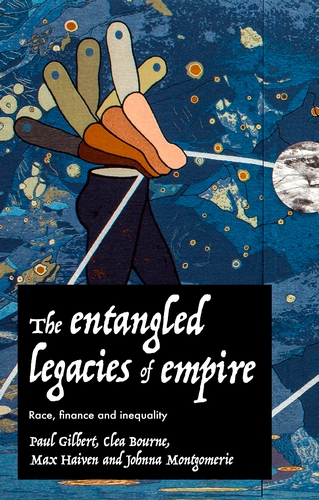
Alessandra Ferrini, “Italy, Libya and the EU: Co-dependent systems and interweaving imperial interests at the Mediterranean border”, in The Entangled legacies of empire Race, finance and inequality, edited by Paul Gilbert, Clea Bourne, Max Haiven & Johnna Montgomerie (Manchester University Press, 2023), 197–207. Open Access.

Abstract: The picture at the opening of the chapter portrays former Italian Prime Minister Silvio Berlusconi greeting Libyan President Muammar Gaddafi as he arrives in Rome in 2009. The meeting celebrated the Treaty on Friendship, Partnership and Cooperation between Italy and Libya and the signing of the Bilateral Agreements that have led to the current racialization of the Mediterranean border (through Italy’s right to send migrants arriving by sea back to Libya, where they are incarcerated in detention camps that severely violate human rights). Pinned to Gaddafi’s chest was a photograph of the Libyan anticolonial leader Omar al-Mukhtar in chains, taken before he was executed by Mussolini’s army in 1931. This gesture sparked outrage in Italy, as it was perceived as a mockery of Berlusconi’s earlier visits to Libya where he presented formal apologies and reparations for the Italian occupation of Libya (1911–43) as part of the Treaty. Yet, Berlusconi’s politics of apology was motivated by Italy’s need to reach agreements with Gaddafi on the control of migration across the Mediterranean, as well as agreements on commercial deals – from the supply of oil and gas to the creation of a free market zone in Libya for Italian companies. Thus, colonial reparations were accompanied by a reinforcement of neocolonial relations.

Article: The Emancipatory Strategies of Black Tunisians and Libyans

Houda Mzioudet, “Yearning for Freedom, Reclaiming Agency: The Emancipatory Strategies of Black Tunisians and Libyans” in Mediterranean Mobilities: Between Migrations and Colonialism ed. Gabriele Montalbano (viella, 2024), pp. 175–184

The history of Black people in Libya and Tunisia remain shrouded in mystery and historical ambiguity; little is know with regards to their origin, movement and settlement in North Africa, and the slavery connection remains the quintessentially legitimate historical reason for this settlement. While more anthropological and historical work has been done since the 1980s by scholars such as Jouili, Bahri, Mrad-Dali, Montana, Jankowsky and Taleb on slavery and post-slave Libyan and Tunisian societies, numerous murky areas remain in the narratives of disenfranchised Blacks, alongside a lack of accounts where Blacks are no longer mere recipients, passive actors who lacked agency in building a Black North African history. In this chapter, I attempt to weave my arguments around Mrad-Dali and Montalbano’s historical and anthropological research on Libyan immigrants to Tunisia and enslaved Black Libyans who developed a web of solidarity to escape slavery in eastern and western Libya, all while stressing these marginalised groups’ activity as agents of change and of self-emancipatory action.

Article: Photography, Media Uses and Emotions during the Italo-Turkish War in Tripolitania (1911–12)

Pierre Schill, The Brutalised Bodies of a Colonial Conquest Before the Court of Global Opinion: Photography, Media Uses and Emotions during the Italo-Turkish War in Tripolitania (1911–12). History of Photography 47 (2023), pp. 315-343

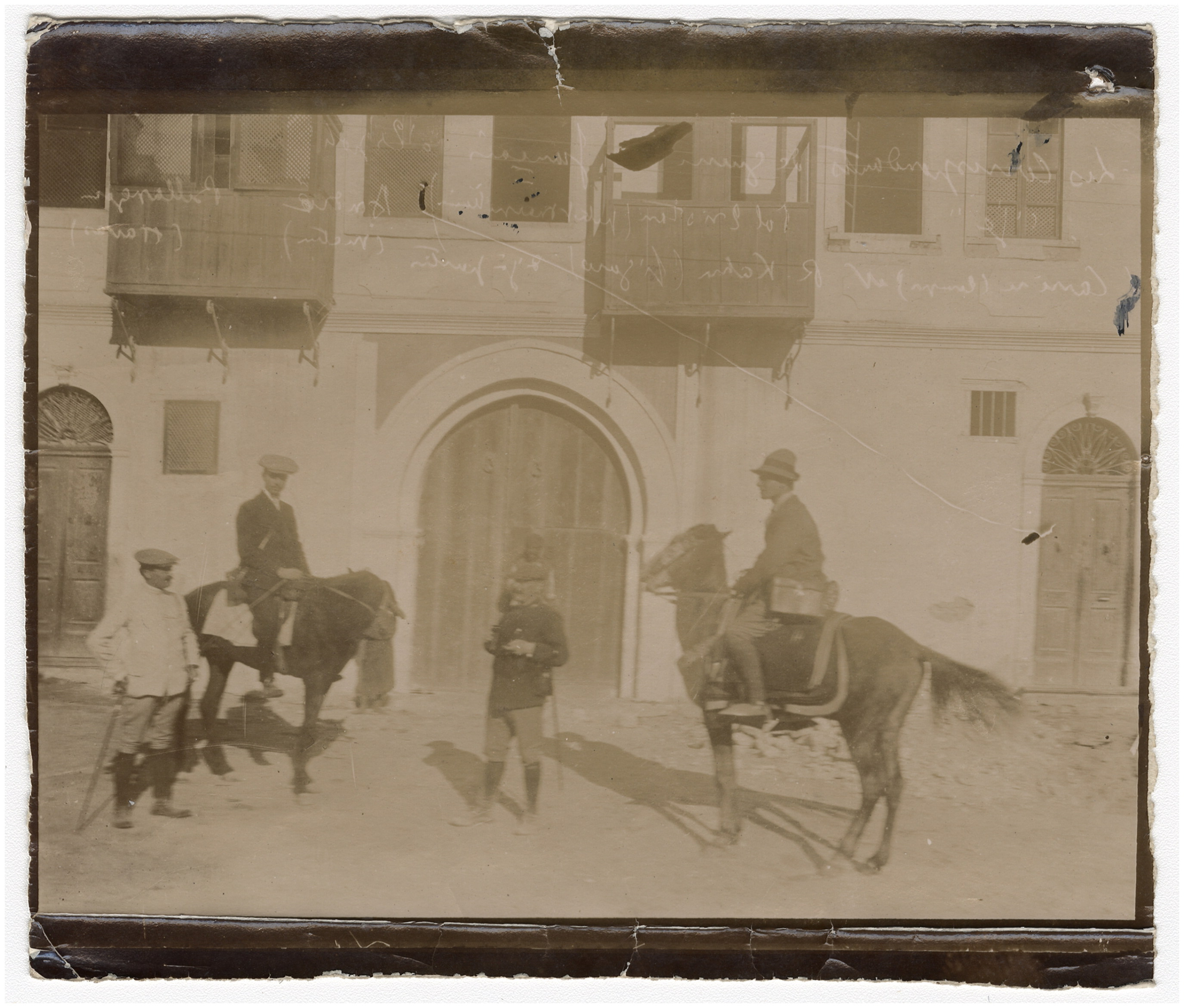
Photographer unknown, ‘French War Reporters in Tripoli’, 23 October 1911 (Montpellier, archives départementales de l’Hérault (Vigné d’Octon papers), 1 E 1149). See the article for full details.
This article analyses the global circulation of around fifty photographs taken at the end of October 1911 at Shar al-Shatt, near Tripoli, by journalists documenting the mass execution of civilians by Italian soldiers. By attending to the interaction of text and image, and to the layouts of visual spreads in the global press, the article demonstrates how photographs of these dead bodies were imbued with a range of political meanings, variously protesting and legitimising such forms of extreme violence. The article explains how the emotions aroused worldwide by these images prompted the Italian authorities to create a visual counter-narrative by publicising photographs of the bodies of their own soldiers mutilated by a ‘bestialised’ enemy. The dissemination of visual evidence of brutality committed by both sides constitutes an early example of a ‘contest of images’ whereby press photography was used to mobilise antagonistic affective communities: variously pan-Islamic, anti-colonial, and trans-imperial. The diversity and inventiveness of the visual politics of persuasion implemented during the conquest of Tripolitania and the intensity of the reactions that this imagery produced reveal the emerging centrality of photojournalists in bearing witness to mass violence in the twentieth century.

Essay: Ein Meer überreifer Kirschen

A nice essay on observing the Libyan revolution entitled “Ein Meer überreifer Kirschen [A Sea of Overripe Cherries]” by Ghady Kafala appeared, translated from Arabic to German, in the collected volume In der Zukunft schwelgen: Von Würde und Gerechtigkeit und dem Arabischen Frühling. Essays aus Nahost und Nordafrika [To bask in the future: Of Dignity and Justice and the Arab Spring. Essays from the Near East and North Africa], edited and translated by Sandra Hetzl (transcript verlag, 2022) The whole volume is freely accessible online.

Excerpt: Seltsam, dieses Libyen. Alle Krankheiten der Welt gibt es dort und jedes Heilmittel dagegen. Hormongesteuert ist es, launisch, da sind wir einander ähnlich.Keiner weiß, was von ihm als Nächstes zu erwarten ist. Etwas Wunderbares, etwas Schlimmes Libyen zu verfluchen oder zu hassen ist schier unmöglich. Seine Sturheit schwächt uns, aber seine Hybris verleiht uns Stärke.

Essay: Identity, Displacement, and Coming of Age

An essay entitled “Identity, Displacement, and Coming of Age with Banat Collective” by Farrah Fray, author of the poetry chapbook The Scent of My Skin, appeared in the Journal of Middle East Women’s Studies back in 2019.

Excerpt: Somehow summer is the least peaceful time of year. The summer of 2018 was no exception. I had just finished writing my dissertation two weeks before boarding a flight to Libya to visit family. Leading up to my trip, a sense of uncertainty about the future began to loom over my head. After I completed my degree, would my family pressure me to return to Libya? If so, what were the best options for my well-being? Most important, how would I cope or fit in? The last time I had lived in Libya for more than a few weeks was in 2007, when my parents decided that we would settle down in Zawiyah after spending more than ten years in the United Kingdom. Four years later, after the uprisings of 2011, we returned to London. I have been in the British capital since then, save the annual visit to Libya….


Some articles on Libyan/Italian entanglements by Italian scholars

Ravelli, Galadriel. 2024. Libyan deportees on the Italian island of Ustica: Remembering colonial deportations in the (peripheral) metropole. Memory Studies. https://doi.org/10.1177/17506980231224759.

In 1911, the Italian liberal government launched the colonial occupation of what is now known as Libya, which was met with unexpected local resistance. The government resorted to mass deportations to the metropole to sedate the resistance, which continued for more than two decades under both the liberal and Fascist regimes. This chapter of Europe’s and Italy’s colonial history has been almost entirely removed from collective memory. The article explores the extent to which colonial deportations are remembered on the Sicilian Island of Ustica, which witnessed the deportation from Libya of more than 2000 people. Currently, the island is home to the only cemetery in Italy that is entirely dedicated to Libyan deportees. I argue that the visits of Libyan delegations, which took place from the late 1980s to 2010, succeeded in challenging colonial aphasia at the local level. Yet, as a result of Ustica’s peripheral position within the national space, the memory work developed through the encounter between local and Libyan actors remained marginal, despite its potential to redefine the Mediterranean as a symbolic space where colonial histories are articulated and remembered. Italy’s outsourcing of the memory work in relation to colonial deportations implies a missed opportunity to interrogate the postcolonial present and thus question persistent dynamics of power in Europe that exclude the constructed Other.

Morone, Antonio M. 2024. The Libyan askaris on the eve of national independence: two life stories across different strategies of intermediation. The Journal of North African Studies. https://doi.org/10.1080/13629387.2024.2360911.

Italian colonial authorities heavily relied on the askaris (i.e. native soldiers) throughout the history of colonialism to alleviate the economic and political burdens of colonial warfare. For that, the askaris became privileged intermediaries for the Italians and emerged as a de facto elite within colonial society, seeking social mobility for themselves and their families. After the end of the Second World War, the askaris lost their role as soldiers, but gained new relevance as political intermediaries for Italian or British plans regarding the final resolution of the Italian colonies affaire. The article delves into the life stories of two askaris, which were documented by the author on 3rd November 2009, in Tripoli. Their memories highlight the relationships of friendship or intimacy that existed with the colonisers and showcase the askaris’ ability to downplay colonial elements of domination and oppression through their intermediation. Being an askar entailed, on one hand, questioning the political and racial boundaries of society, and on the other hand, challenging the agendas of nationalist groups. The transition to independence indeed involved a struggle between colonisers and the colonised, as well as among various groups of colonial subjects, all vying for power within the post-colonial State and society.

Tarchi, Andrea. 2022. A ‘catastrophic consequence’: Fascism’s debate on the legal status of Libyans and the issue of mixed marriages (1938–1939). Postcolonial Studies 25(4). 527–544. https://doi.org/10.1080/13688790.2021.1964764.

This article assesses the role that institutional concern for the possibility of interracial marriages played in the Italian Fascist party’s internal debate regarding the legal status of Libyans in the second half of the 1930s. Following the end of the ‘pacification’ of the Libyan resistance in 1932, Governor Italo Balbo pushed for the region’s demographic colonization and the legal inclusion of the colonial territory and its population within the metropole. In contrast, Fascist Party officials in Rome endorsed starker racial segregation in the colonies based on the racist ideology that permeated the regime after the declaration of the empire in 1936. The legal inclusion of Libyans within the metropolitan body politic touched upon the regime’s most sensitive theme: the need to avoid any promiscuity that could interfere with the racial consciousness of Fascist Italy. This article analyses this dispute through the lens of interracial marriage and concubinage regulations, framing it into the definition of a normative standard of Italian whiteness through the racialization of the colonial Other.

Rossetto, Piera. 2023. ‘We Were all Italian!’: The construction of a ‘sense of Italianness’ among Jews from Libya (1920s–1960s). History and Anthropology 34(3). 409–435. https://doi.org/10.1080/02757206.2020.1848821.

The paper explores how a ‘sense of Italianness’ formed among Jews in Libya during the Italian colonial period and in the decades following its formal end. Based on interviews with Jews born in Libya to different generations and currently living in Israel and Europe, the essay considers the concrete declensions of this socio-cultural phenomenon and the different meanings that the respondents ascribe to it. Meanings span from the macro level of historical events and societal changes, to the micro level of individual social relations and material culture. Viewed across generations and framed in the peculiarities of Italian colonial history, the ‘sense of Italianness’ expressed by Jews in Libya appears as both a colonial and post-colonial legacy.