Tag Archives: articles

Article: La transformation administrative des espaces septentrionaux Libyens

With apologies for the long silence on this blog, we get back on track with this article:

Tomaso Palmieri, “La transformation administrative des espaces septentrionaux Libyens au lendemain de la répression de l’Italie fasciste (1934-1940)” [The administrative transformation of the northern Libyan spaces on the eve of the fascist Italian repression], In Le rôle des villes littorales du Maghreb dans l’histoire, RM2E – Revue de la Méditerranée édition électronique 3/1 (2016), pp. 101–114.

Happily, the article (in French) is freely available online at the following link: http://www.revuedelamediterranee.org/index_htm_files/Palmieri_2016-III-1.pdf

Article: Attrition and revival in Awjila Berber

Marijn van Putten & Lameen Souag, “Attrition and revival in Awjila Berber”, Corpus 14 (2015), pp. 23-58.

Abstract: Awjila Berber is a highly endangered Berber variety spoken in the East of Libya. Only minimal material is available on the language. This is unfortunate, as that material reveals that the language is in some respects very archaic and in others grammatically unique, and as such is of particular comparative and historical interest. Fieldwork has been impossible for decades due to the political situation, leading to uncertainty about whether the language was even still spoken. With the rising popularity of Facebook, however, more and more Berber speakers are taking to Facebook to converse in their own language. Several inhabitants of Awjila have accordingly set up a Facebook page Ašal=ənnax “our village” where they communicate with one another in the Awjila language. The authors have collected a corpus of the conversations on this Facebook page, which have been transcribed and translated. Analysis of this corpus adds substantially to our knowledge of Awjili and its situation. The posters’ discussion of their motivations for using the language cast light on the language’s prospects for survival, while the posts themselves yield many previously unattested words. At the same time, the corpus provides a case study in language contact. Examination of the grammatical and lexical features of this “Facebook-Awjili” language reveals that these speakers’ usage is heavily influenced by Arabic, showing extensive language attrition absent from earlier data. The resulting constructions show parallels with other contact-heavy varieties, notably Siwi. In both respects, this study casts light upon the uses and limits of social media as a source of linguistic material.

The article is not yet available online, only in the print version, but we will link to a PDF as soon as one is available.

Article: Italian colonial rule and Muslim elites in Libya

Here, an article analyzing Muslim elites in Libya during the colonial period:

Baldinetti, Anna, “Italian colonial rule and Muslim elites in Libya: a relationship of antagonism and collaboration”, in ‘Ulama’ in the Middle East, edited by M. Hatina (Brill, 2009).

Abstract: “In Libya, under Italian rule, ‘ulama’ (علماء), Sufi shaykhs and other religious dignitaries played an important role, as Islam not only legitimated the resistance but also became a fundamental element in colonial policies. However, the relationships between the colonial authorities and the religious elites, beyond what the colonial laws prescribed, have as yet not been examined, except for the Sanusiyya order. This paper aims to fill this research gap, focusing mainly on the region of Tripolitania.”

The conclusion reads: “Islam constituted an important element in Italian colonial policy in Libya, and the colonial authorities always paid particular attention to indigenous Muslim elites. However, the “politics of chiefs,” which was based mainly on an exaggerated patronage polìcy, did not help to overcome sectarian, tribal and regional divisions.

The Italian colonial authorities did not develop a well-defined educational policy aimed at modernizing the traditional elites or forming a new “evolués” elite useful for meeting administrative and economic needs. As noted, the —the institution charged with reforming the local elite—was established only in the mid-1930s, in the closing phase of colonial rule. Even then, its impact on the emergence of new elites was negligible, due to the small number of students admitted each year. Moreover, the Institute of Islamic Studies in Tripoli (المدرسة الاسلامية العليا) was not very popular among native circles because its educational program was perceived as too “Westernized.” Hence the Italian administration did not significantly alter or influence the structure of the Muslim elites in Libya, nor did it contribute to the emergence of new ones.”

As always, those who are interested in reading the piece can drop me a line.
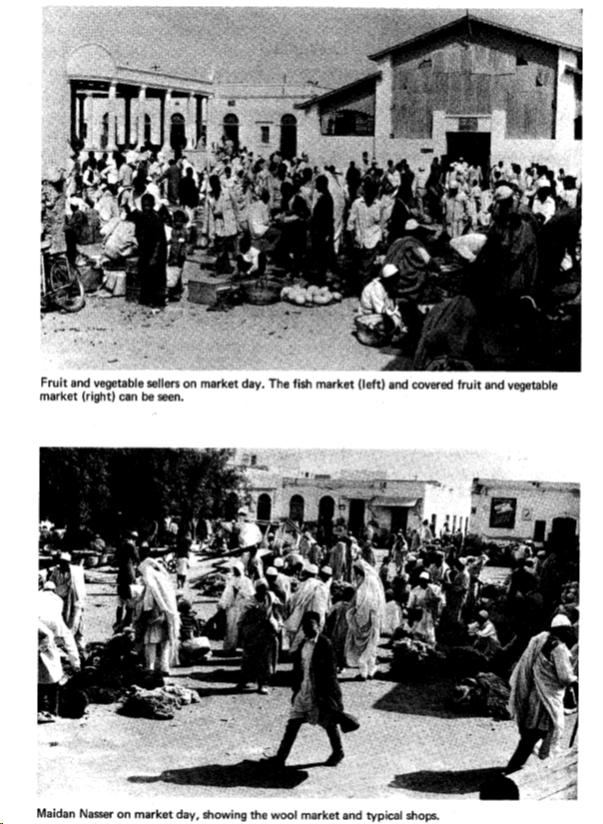
Book: Misurata, a market town in Tripolitania

misrata-market-picA small booklet published by the Durham Dept. of Geography in 1968, Misurata: a market town in Tripolitania by G. H. Blake is one of the few (=2 or 3) studies available on Misrata (مصراتة‎) in a western language. The brief introduction is below, and a PDF of the entire booklet is available by clicking here.

“The small towns of the Middle East and North Africa have received so little attention from geographers hitherto that there is a need for case-studies of this kind if only as prologomena for intensive future investigations. Several factors combined to permit little more than a superficial study of Misurata in the summer of 1966; the paucity of statistics, the lack of large scale maps and air photographs while fieldwork was being carried out, and above all the limited time available. In spite of these difficulties an attempt was made to examine the functions and morphology of a market town which is still strongly traditional in character, with a high proportion of the population deriving their living from the sale of goods and services in the market. Some of the results of this work are presented in the following pages. While there may not be much that is methodologically exciting, it is hoped that its publication will be fully justified by its timing, for in 1966 it was already clear that the cultural ethos and economic functions of Misurata are on the threshold of great changes.

Libya’s immense oil revenues have touched every aspect of national life and in Misurata have resulted in a spate of public and private building which is beginning to transform the ancient skyline of minarets, palm trees and low, flat-roofed houses, bringing into being an essentially European-type architecture and ground plan. In the next few years the town will develop from being a regional market to a genuine regional centre with significant functions in serving through traffic. The projected North African highway will pass nearby; Casr Ahmed is to be revived as a naval and military base; and there are plans to develop and settle the vast ex-Italian estates to the south and west. The people of Misurata are famous for their commercial enterprise and will not be slow to make good use of the opportunities thus presented, just as they have been quick to establish light industries in response to the building boom.

The promise of rapid modernisation makes Misurata a town of particular interest since it epitomises the problems of renewal and development in larger cities of cultures. It remains to be seen whether the Master Plan of the town, now being prepared in Rome, will succeed in preserving what is good in the old while creating a town capable of discharging its ever-growing social and economic responsibilities to the surrounding region.” (p. 1)

Article: An Oil Boom, Women, and Changing Traditions

Fikry, Mona. 1978. “An Oil Boom, Women, and Changing Traditions: A study of Libyan women in Benghazi.” In Folklore in the Modern World, ed. R. Dorson. Mouton: The Hague, pp. 65–76. [PDF]

This is an article about the modernization of Libya after the discovery of oil and its effects on the lives and roles of women in Benghazi. The article discusses in particular the suppression of the social and cultural lives of women in connection with modernizing forces, such as mass media, and draws attention to the declining visibility of, and place for, folklore and oral literature–which except for traditional poetry was mostly transmitted and performed by women. Fikry notes, for example, that:

“Tale-telling, called khurrafat in Libya, used to be an essential part of family entertainment in towns, villages, and tents, but in the city it has now all but disappeared to be replaced by television. The time that young children spent listening to tales is now spent studying, reading magazines, or watching television. Rare are the occasions when tales are told and few are the young urban women who know any tales to tell. Even the special night devoted to tale-telling during the wedding celebration is now firmly linked with the past.”


Article: The Arab city and municipal administrative modernity: Tripoli (Libya)

For those who read French, here is another essay by Nora Lafi about the history of Tripoli. It is freely available online.

Nora Lafi, “Ville arabe et modernité administrative municipale : Tripoli (Libye actuelle), 1795-1911.” [The Arab city and municipal administrative modernity: Tripoli (Libya), 1795-1911] Histoire urbaine 1, no. 3 (2001), pp. 149-167.

Abstract: This paper aims both at presenting a short bibliographical essay on Arab towns and, from the case of Tripoli (Libya), at examining the matter of the administrative modernity of such towns. The role in this process of modernization of the various traditional institutions of urban government is studied with the help of new archives, mostly local. A presentation of the machîkha al-bilâd – the cheikh albilâd (chief of the town) and its jamâ’a al-bilâd (town council) – as an organization of municipal kind is proposed in this paper, and the forms of a possible comparatism with Ancien Régime European towns are explored. The 1867 Ottoman municipal reforms (tanzimât) are then studied in the context of the inheritance of traditional forms of urban government.

Article: Gender and state-building in Libya

Although this blog shies away from contributing even more noise to the (often incoherent) Western din that is writing on politics in modern Libya, it is important to draw attention to less common but absolutely necessary approaches to any topic within Libyan studies. Here is a recent article on the politics of gender and inclusion by the well-known scholar and activist, Zahra’ Langhi (whom we’ve already mentioned here), co-founder of the Libyan Women’s Platform for Peace.

Zahra’ Langhi. “Gender and state-building in Libya: towards a politics of inclusion.” Journal of North African Studies 19/2 (2014), pp. 200-210.

Abstract: The Libyan Revolution marks a watershed moment in Libyan history and more specifically in the history of women’s participation in the public space. Women were at the forefront of the demonstrations as protesters, medical workers, and aid providers, as well as organising behind the scenes and in the diaspora calling for political change and a just inclusive transition to democracy. However, they have been systematically excluded from the public sphere facing intense de-politicisation and silencing at a crucial moment in their national political transformation process. The Libyan Revolution appears here, similar to other Arab revolutions, to present a ‘gender paradox’. On one hand, women are the politically empowered agents of the Revolution and change. On the other hand, they are the victims of a new kind of political violence and exclusion. Thus, there is a need to address women’s participation in the public sphere from a different approach than the usual ‘women’s empowerment’ approach. The suggested approach here is a more inclusive participatory integrated one of political and normative frameworks. Women’s role should not be limited to defending women’s rights issues or just their formal numerical representation in decision-making bodies. Rather they should struggle to become influential shapers of a new discourse of politics of inclusion which rests upon inclusive state-building, gender-equitable institutional reform, inclusive social transformation, demilitarisation and peace-building.

*For an electronic version of the article, contact me.

Article: Complaints from Libya at the Turn of the 20th Century

With apologies for a series of posts of articles that are not easily accessible, though worth reading if you have access, I present the following:

Henning Sievert, “Intermediaries and Local Knowledge in a Changing Political Environment: Complaints from Libya at the Turn of the 20th Century”. Die Welt des Islams 54, 3-4 (2014), pp. 322–362. [Online behind paywall]

Abstract: As historiography on Ottoman Tripolitania and Benghazi focuses mainly on the Italian invasion and on the Sanūsiyya and pays little attention to Ottoman records, studies on political practice and change in that period are rare. However, the special circumstances of that remote and sparsely populated part of the empire enable us to focus on the role of intermediaries and complaints within the imperial framework. Complaints and related correspondence were crucial in the negotiation of order, both from the government’s and from the subjects’ point of view. With the 19th-century reforms, new notions of order emerged, and old notions were modified. The new mode of politics did not, however, consist of immutable prescriptions but could acquire new layers of meaning in a process of translation into the vernacular politics of the Libyan provinces and vice versa. Imperial notions of order were thus read and utilised in various ways. The key interpreters and translators in this process were intermediaries between imperial, provincial and local levels. This contribution suggests to study political communication within the imperial framework by focusing on these intermediaries.

Article: Shakīb Arslān’s Libyan Dilemma

The essay “Shakīb Arslān’s Libyan Dilemma: Pro-fascism through anti-colonialism in La Nation Arabe” by Jakob Krais on the Ottoman administrator Shakīb Arslān’s writings about the Italian colonization of Libya is available online as part of the online publication Rethinking Totalitarianism and its Arab Readings. Proceedings of the Conference “European Totalitarianism in the Mirrors of Contemporary Arab Thought”, Beirut, October 6-8, 2010. Here is the introduction:

“Shakīb Arslān is considered one of the Arab world ‘s most important anti-colonial propagandists of the inter-war period. At the same time, he belongs to the few activists from the Middle East who actually tried to gain support from the fascist powers in the years preceding World War II. Apart from al-Ḥājj Amīn al-Ḥusaynī, the mufti of Jerusalem, with whom he collaborated, and the Iraqi Arab nationalist Rashīd ʿAlī al-Kaylānī, Arslān perhaps came closest to proclaiming unequivocal sympathy towards Italy and Germany. In this essay I will examine his views of Mussolini ‘s regime as expressed in the French-language journal La Nation Arabe which Arslān published in Geneva from 1930 to 1938. Italy represents a particularly interesting case insofar as it could be seen as an ally against the colonialist western powers Britain and France in the Middle East, but was itself an imperialist regime that ruled an Arab country, Libya. I will shed light on how Arslān dealt with this dilemma in his articles. Although a comprehensive account of Arslān ‘s assessment of fascism certainly would have to include other works of this prolific writer, as well as his correspondence with politicians in Europe and the Islamic world, here I shall concentrate on La Nation Arabe where he publicized his views for a larger audience, both western and Muslim. It is possible to distinguish two phases in his journalistic writings on Italy and Libya, one critical from 1930 to 1933 and one conciliatory, stretching from 1933 up to 1938.”

Read the rest of the piece here.

Article: Violence and the politics of prestige: the fascist turn in colonial Libya

A recently published article on the colonial period in Libya and the dynamics of fascist policies is the following, unfortunately behind a paywall. The abstract is below.

Eileen Ryan, “Violence and the politics of prestige: the fascist turn in colonial Libya.” Modern Italy 20/2 (2015), pp. 123-135.

“In 1922–1923, Fascist Party leaders hoped to define a sharp break from previous approaches to colonial rule and imperial expansion in Italy’s Libyan territories. Mussolini’s nomination of Luigi Federzoni, a leading figure of the Italian Nationalist Association, as the Minister of Colonies at the end of 1922 signalled a new era in Italian colonial administration focused on aggressive expansion and the institution of what was known as a ‘politics of prestige’. This definition of a fascist style of colonial rule appealed to the enthusiasm for violence among blackshirt militias and early fascist supporters in the Libyan territories. This definition of a fascist style of colonial rule, however, inspired immediate reaction from both colonial officials, with stakes in maintaining a measure of continuity and stability, and from those within the nascent Fascist Party who wanted to promote an alternative model of fascism in the colonies. This article examines contests to define fascism and fascist colonial rule in the Libyan territories through the employment of voluntary militias, the competing voices of Fascist Party outposts, and various programmes for the development of a colonial culture.”