Tag Archives: books

Book: The Berber language of Awjila | لهجة اوجلة الامازيغية

Here at the Silphium Gatherer we are going to close out this month with a focus on recent studies about the various Berber groups of Libya. [1]

Academic work on the Berbers of Libya has been primarily linguistic, but of course, as we often say here, all aspects of these groups are understudied. By sharing the main recent publications here, I hope to at least give an impression of what has been done and possibilities for future research. The first two works highlighted here are both based on linguistic data collected during the pre-regime period, as little fieldwork has been possible in the past several decades.

The most recent publication is my friend and colleague Marijn van Putten‘s overview of the grammar of the Berber variety spoken in the oasis of Awjila in eastern Libya: A Grammar of Awjila Berber (Libya), Rüdiger Köppe Verlag, Cologne, 2014 (Berber Studies 41). The material for this was collected in the 1960s by a very able linguist named Umberto Paradisi, whose tragic death in an accident in Benghazi prevented him from finishing his work. Marijn van Putten has now turned his work into a detailed and readable grammatical description which also includes all the material in Awjila Berber recorded by earlier scholars, including a number of fairy tales and songs.

On a Berber-language-related blog that Marijn and I started a while ago, you can also find some discussion of Awjila Berber (note that it is oriented primarily at those with some linguistic knowledge of Berber languages). Over at Marijn’s academia.edu page those interested will also find a number of further articles about the Berber variety of Awjila.


1 The term ‘Berber’ is usually used in scholarly works, but is sometimes considered pejorative—however, we’ll continue to use ‘Berber’ here in order to refer to publications without confusion.

Book: Architecture and Tourism in Italian Colonial Libya

Anyone who wants to get a feel for what Libya looked like during the height of the colonial period should read Brian McLaren’s beautifully-illustrated study Architecture and Tourism in Italian Colonial Libya (Washington University Press, 2006). Though somewhat hard-to-find and a little pricey, it is absolutely worth the purchase.

To be a tourist in Libya during the period of Italian colonization was to experience a complex negotiation of cultures. Against a sturdy backdrop of indigenous culture and architecture, modern metropolitan culture brought its systems of transportation and accommodation, as well as new hierarchies of political and social control. Architecture and Tourism in Italian Colonial Libya shows how Italian authorities used the contradictory forces of tradition and modernity to both legitimize their colonial enterprise and construct a vital tourist industry. Although most tourists sought to escape the trappings of the metropole in favor of experiencing “difference,” that difference was almost always framed, contained, and even defined by Western culture.” (From the publisher’s website).

There are academic reviews here and here.

Book: A historical work on Ottoman Tripoli | دراسة تاريخية في مدينة طرابلس العثمانية

A landmark contribution to the study of North African urban history, the history of Tripoli, and the history of Ottoman Libya is “A North African City between ancien regime and Ottoman reforms: the birth of municipal institutions in Tripoli 1795-1911” [مدينة في المغرب بين العهد القديم و التنظيمات العثمانية: تكوين المؤسسات البلدية في طرابلس الغرب] by Nora Lafi (academia page), a scholar now based at the Zentrum Moderner Orient in Berlin:

Lafi, Nora. 2002. Une ville du Maghreb entre ancien régime et réformes ottomanes: genèse des institutions municipales à Tripoli de Barbarie (1795-1911). Paris: L’Harmattan, Tunis: Institut de recherche sur le Maghreb contemporain (IRMC), 305p.

From a review on H-Net: “Lafi’s … is the first work of western scholarship to be thoroughly grounded in documents held in Tripoli’s Municipal Archives. (Studies on Tripoli usually make use of Italian, French, and British archives and published sources in many languages, including Arabic.) These are supplemented by sources in the Ottoman archives and diplomatic papers in both France and Italy… At the heart of the book is its demonstration that the city was managed by an assembly (the jama’a(t) al-bilad), headed by the mayor-like “chief of the city” (shaykh al-bilad), a notable elected by the other members of the jama’a. This contradicts the impression conveyed by many historical works, that Arab cities did not generate stable civic institutions of this sort, and have instead followed amorphous, enigmatic, and/or disordered civic trajectories under their reign from above by Ottoman delegates or puppets. In Lafi’s analysis, instead, we find urban and civic self-management at the middle levels. As early as the eighteenth century, long before the Ottoman reforms (tanzimat) of the following century, or subsequent European incursions, Tripoli’s municipal organization operated on a well-functioning, autonomous system of its own making.”

Book: Bridges Across the Sahara | جسور عبر الصحراء

Ahmida, Ali (ed.) 2009. Bridges Across the Sahara: Social, Economic and Cultural Impact of the Trans-Sahara Trade During the 19th and 20th Centuries. Cambridge Scholars Publishing.

“The objective of this edited book is to rethink the history of colonial and nationalist categories and analyses of modern Africa through an integration and examination of the African Saharan trade as bridges that link the North, Central, and West regions of Africa. Firstly, it offers a critique of the colonial, postcolonial and nationalist historiographies, and also of current western scholarship on northern and Saharan Africa especially Middle East Studies and African Studies Associations. Secondly, it provides an alternative narrative of the forgotten histories of the Sahara trade as linkages between the North and the South of the Sahara. The Sahara desert was seldom a barrier separating the northern, middle and western parts of the continent….”

Contributions:

“Introduction. Neither a Divide nor an Empty Space: The Sahara as a Bridge” by Ali Abdullatif Ahmida

“Trans Saharan Trade in Arabic Sources until the 16th Century: A Study of Means of Transactions” by Ahmed Elyas

“The Organization of Caravan Trade in Nineteenth and Twentieth-Century Western Africa” by Ghislaine Lydon

“The Sociocultural and Economic Exchange between the Augila Oasis and the Cyrenaican Bedouin in Libya’s Eastern Sahara: A Centuries-long Symbiotic Relationship” by John P. Mason

“Redeemed Lives in the Trans-Saharan Migrations of the Nineteenth Century” by Terence Walz

“Strategic Aspects of the Shrinking Trans-Saharan Trade in Eastern Libya: Revisiting the Italian Occupation of al-Jaghbub, 1925-26” by Fred H. Lawson

“Weapons and “smugglers” throughout Western Sahara: From the Anti-colonial Resistance to the First World War” by Francesco Correale

“Camels as Trading Goods: The Transition from a Beast of Burden to a Commodity in the Trans-Saharan Trade between Chad and Libya” by Meike Meerpohl

“Ibrahim Al-Koni’s Atlas of the Sahara” by Elliot Colla

Two Studies by Libyan Women | دراستان باقلام باحثتين ليبيتين

Amal Obeidi, Political Culture in Libya. Routledge: London (2001).

Political Culture in Libya appeared in 2001 as a welcome contribution to Libyan political studies. Few empirical studies of Arab countries have dealt with political culture and political socialisation or focused on people’s beliefs, values, and attitudes towards the government or political leaders, mainly because the regimes have been reluctant to allow opinion to be tested. The significance of this book is that it assesses the influence of state ideology on the new generation of Libyans, and examines their political culture. Reviews are here, here, and here.

Amal Obeidi is Associate Professor of Comparative Politics in the Department of Political Science,  University of Benghazi, Libya. She served as Dean of Faculty of Economics at the University of Benghazi in 1999-2001 and as head of Department of Political Science in 2006-2008. In her research she mainly focuses on security, especially in the Mediterranean; gender issues; and public policies. Besides the book shown here, her publications include “Security Policies in Libya” (Geneva Center for Security Studies 2004); “The Political Elites in Libya since 1969” (in:  Libya since 1969. Qadhafi’s Revolution Revisited, London 2011); “The Impact of the Revolution and the Transitional Period on Women’s Empowerment Policies in Libya” (Beirut 2013); and “From Forced Reconciliation to Recognition: The Abu Salim Case in Historical Perspective” (Leiden 2013).

Hana S. El-Gallal, Islam and the West: The Limits of Freedom of Religion. Peter Lang: Berlin (2014).

From the publisher’s blurb: “Religious Intolerance is on the rise. Debating religious freedom often means debating “West” versus “Islam”. This book challenges crucial stereotypes around this issue. It explores the scope of the right to freedom of religion in the International Treaties and Declarations and investigates why this right creates misunderstandings and misconceptions that often lead to intolerance and discrimination in countries of various political, social, and cultural backgrounds. Islam and the West attempts to find reasons for the rise of religious intolerance. The author looks at the limitation of the religious symbols law in France and the anti-terrorism measures in the USA; she discusses also Religious minorities and Apostasy in Saudia Arabia and Egypt. Furthermore, she calls for extending the scope, asking questions such as: How do societies deal with different religions and beliefs? How could and do they find ways of reconciling their conflicting demands while protecting human worth? How can universal values be found and established?”

Hana S. El-Gallal is a professor at the University of Benghazi, Libya, where she teaches International Law and is the head of the Cultural Committee in the Faculty of Law. She is member of the Libyan National Council of Human Rights and the founder and President of the Libyan Centre for Development and Human Rights. She obtained her PhD in Law from Bern University, Switzerland.

Books: Research on Libyan Nawba Music

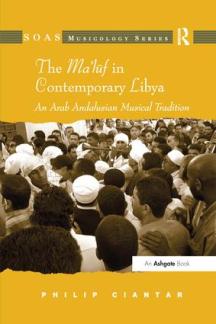
9781138252370Two studies on a type of traditional Libyan music called nawba (النوبة) appeared in 2012. The first is by a Maltese academic who conducted fieldwork in Libya and interviewed many well-known musicians (such as Hassan al-Areibi حسن العريبي).

  • Ciantar, Philip. 2012. The Ma’lūf in Contemporary Libya: An Arab Andalusian Musical Tradition. London: Ashgate.

More information can be found at the publisher’s site, including the table of contents and Preface. From the publisher’s description:

“The musical tradition of Ma’luf is believed to have come to North Africa with Muslim and Jewish refugees escaping the Christian reconquista of Spain between the tenth and seventeenth centuries. Although this Arab Andalusian music tradition has been studied in other parts of the region, until now, the Libyan version has not received Western scholarly attention.

This book investigates the place of this orally-transmitted music tradition in contemporary Libyan life and culture. It investigates the people that make it and the institutions that nurture it as much as the tradition itself. Patronage, music making, discourse both about life and music, history, and ideology all unite in a music tradition which looks innocent from the outside but appears quite intriguing and intricate the more one explores it.”

nawba-selectionThe second is a PhD thesis by a Libyan student at the Free University, Berlin. Both a summary in English as well as the entire PDF (in German) are available. The thesis provides a wealth of detail and analysis of individual nawba melodies and lyrics (including sheet music), but remains unpublished as far as I can tell.

  • El-Ageli, Muftah Ali. 2012. Die Andalusische Nauba in Libyen: Struktur und Aufführungspraxis. Ph.D. Thesis, Freie Universität Berlin.

The title translates to “The Andalusian Nawba in Libya: structure and performance practice” / “النوبة الاندلسية في ليبيا: هيكلها و ممارسة اداءها”.