Tag Archives: history

Archive: Jan Vansina and Libya

Jan Vansina was a Belgian historian who taught in the US for many years and is considered by many to one of the major figures of African history in the 20th century, pioneering the use of local oral traditions as important historical sources.

In the 1970s he became involved with Libyan scholars and played an important role in setting up what is now the Libyan Studies Center and designing its large-scale project to collect oral histories from participants in the resistance to Italian colonial rule and survivors of the Italian concentration camps. The connection to Libya was undoubtedly through his being on the PhD committee of Mohamed Jerary, one of the founders and long-term director of the Center (thanks to a comment on this post for the tip).*

Although Vansina did not end up writing much or anything about his work with the Libyan oral histories projects and time in Tripoli, the Jan Vansina Papers, held at Northwestern University, contain notes and information about his participation, including some interview designs and trainings he offered to Libyan historians:

Research Notes Libya: Oral History of the Italo-Libyan war (1911-1933)-boxes 2-3: This section contains research methods, procedures, and the interview tool used to collect the oral histories. Also included are maps, general information on the Libyan Studies Centre, and related essays on Libya.

The archive also contains lots of other material about his teaching and research, and exploring it may shed some light on how he became connected with the fledgling Center and helped shape their field research program.

There are also some photos from Libya taken by Vansina held in the University of Wisconsin-Madison Libraries Digital Collections.

*Jerary’s PhD thesis was on the ancient history of Libya, not on oral traditions.

Book: Confronting the Archive of Coloniality Across Italy and Libya

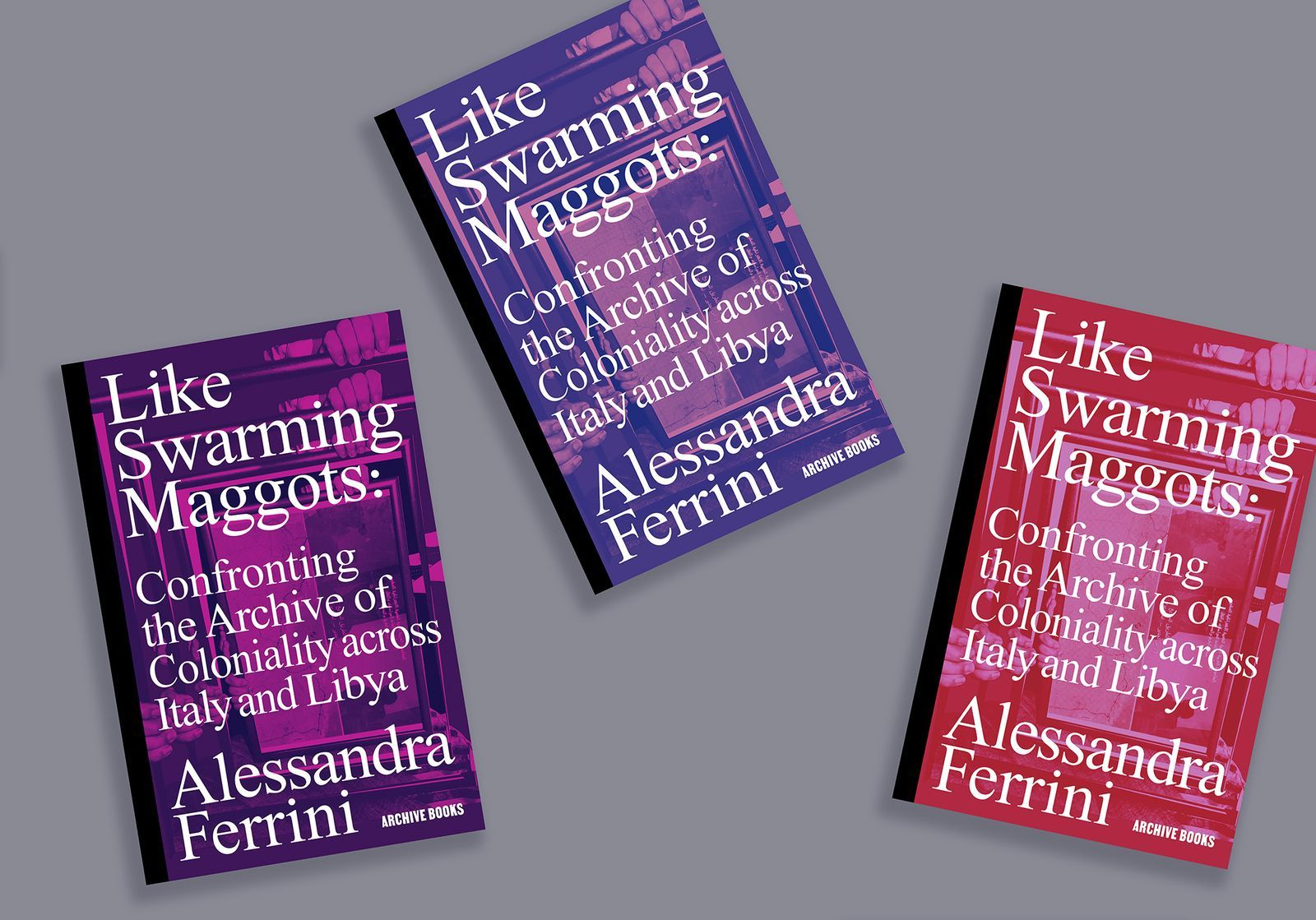
A new book by artist Alessandra Ferrini, entitled Like Swarming Maggots: Confronting the Archive of Coloniality Across Italy and Libya with contributions from a number of artists and writers (including yours truly), has just been published by Berlin-based Archive Books.

Featuring Ferrini’s long-term research on the colonial and neo-colonial relations between Italy and Libya through a critical engagement with the Italian ‘archive of coloniality’ and its structural violence. The book includes documentation of Ferrini’s major project Gaddafi in Rome, whose last iteration is currently exhibited at the 60th International Art Exhibition of La Biennale di Venezia curated by Adriano Pedrosa, as well as a series of works reflecting on positionality, censorship, and the erasure of the genocide perpetrated by the Italians in Libya.

Building on the artist’s interest in writing, translation, and collaboration as forms of resistance practice, it brings together different voices and visual materials, putting forward a reflection on the ethical dimension of cultural work. As a result, the book includes original contributions, reprints, and translations by writers, scholars, curators, and practitioners pivotal to the development of Ferrini’s work and thinking.

Like Swarming Maggots: Confronting the Archive of Coloniality Across Italy and Libya includes a preface by Bassam El Baroni and contributions by: Tewa Barnosa, Adam Benkato, NiccolòAcram Cappelletto, Chiara Cartuccia, Sarri Elfaitouri, Amalie Elfallah, Khaled Mattawa, Maaza Mengiste, Barbara Spadaro, Daphne Vitali.

Some articles on Libyan/Italian entanglements by Italian scholars

Ravelli, Galadriel. 2024. Libyan deportees on the Italian island of Ustica: Remembering colonial deportations in the (peripheral) metropole. Memory Studies. https://doi.org/10.1177/17506980231224759.

In 1911, the Italian liberal government launched the colonial occupation of what is now known as Libya, which was met with unexpected local resistance. The government resorted to mass deportations to the metropole to sedate the resistance, which continued for more than two decades under both the liberal and Fascist regimes. This chapter of Europe’s and Italy’s colonial history has been almost entirely removed from collective memory. The article explores the extent to which colonial deportations are remembered on the Sicilian Island of Ustica, which witnessed the deportation from Libya of more than 2000 people. Currently, the island is home to the only cemetery in Italy that is entirely dedicated to Libyan deportees. I argue that the visits of Libyan delegations, which took place from the late 1980s to 2010, succeeded in challenging colonial aphasia at the local level. Yet, as a result of Ustica’s peripheral position within the national space, the memory work developed through the encounter between local and Libyan actors remained marginal, despite its potential to redefine the Mediterranean as a symbolic space where colonial histories are articulated and remembered. Italy’s outsourcing of the memory work in relation to colonial deportations implies a missed opportunity to interrogate the postcolonial present and thus question persistent dynamics of power in Europe that exclude the constructed Other.

Morone, Antonio M. 2024. The Libyan askaris on the eve of national independence: two life stories across different strategies of intermediation. The Journal of North African Studies. https://doi.org/10.1080/13629387.2024.2360911.

Italian colonial authorities heavily relied on the askaris (i.e. native soldiers) throughout the history of colonialism to alleviate the economic and political burdens of colonial warfare. For that, the askaris became privileged intermediaries for the Italians and emerged as a de facto elite within colonial society, seeking social mobility for themselves and their families. After the end of the Second World War, the askaris lost their role as soldiers, but gained new relevance as political intermediaries for Italian or British plans regarding the final resolution of the Italian colonies affaire. The article delves into the life stories of two askaris, which were documented by the author on 3rd November 2009, in Tripoli. Their memories highlight the relationships of friendship or intimacy that existed with the colonisers and showcase the askaris’ ability to downplay colonial elements of domination and oppression through their intermediation. Being an askar entailed, on one hand, questioning the political and racial boundaries of society, and on the other hand, challenging the agendas of nationalist groups. The transition to independence indeed involved a struggle between colonisers and the colonised, as well as among various groups of colonial subjects, all vying for power within the post-colonial State and society.

Tarchi, Andrea. 2022. A ‘catastrophic consequence’: Fascism’s debate on the legal status of Libyans and the issue of mixed marriages (1938–1939). Postcolonial Studies 25(4). 527–544. https://doi.org/10.1080/13688790.2021.1964764.

This article assesses the role that institutional concern for the possibility of interracial marriages played in the Italian Fascist party’s internal debate regarding the legal status of Libyans in the second half of the 1930s. Following the end of the ‘pacification’ of the Libyan resistance in 1932, Governor Italo Balbo pushed for the region’s demographic colonization and the legal inclusion of the colonial territory and its population within the metropole. In contrast, Fascist Party officials in Rome endorsed starker racial segregation in the colonies based on the racist ideology that permeated the regime after the declaration of the empire in 1936. The legal inclusion of Libyans within the metropolitan body politic touched upon the regime’s most sensitive theme: the need to avoid any promiscuity that could interfere with the racial consciousness of Fascist Italy. This article analyses this dispute through the lens of interracial marriage and concubinage regulations, framing it into the definition of a normative standard of Italian whiteness through the racialization of the colonial Other.

Rossetto, Piera. 2023. ‘We Were all Italian!’: The construction of a ‘sense of Italianness’ among Jews from Libya (1920s–1960s). History and Anthropology 34(3). 409–435. https://doi.org/10.1080/02757206.2020.1848821.

The paper explores how a ‘sense of Italianness’ formed among Jews in Libya during the Italian colonial period and in the decades following its formal end. Based on interviews with Jews born in Libya to different generations and currently living in Israel and Europe, the essay considers the concrete declensions of this socio-cultural phenomenon and the different meanings that the respondents ascribe to it. Meanings span from the macro level of historical events and societal changes, to the micro level of individual social relations and material culture. Viewed across generations and framed in the peculiarities of Italian colonial history, the ‘sense of Italianness’ expressed by Jews in Libya appears as both a colonial and post-colonial legacy.
Article: Ottoman abolitionist policy in Trablusgarp and Benghazi

Hargal, Salma. 2024. Ending slavery in imperial peripheries: Ottoman abolitionist policy in Trablusgarp and Benghazi provinces (1857–1911). Middle Eastern Studies.

When Istanbul prohibited the trade of enslaved Africans in 1857, the Ottoman local authorities expanded efforts to curb human trafficking throughout the imperial realm. These endeavours also included Libya, which lies at the frontiers of the Greater Sahara, a major slave-raiding zone in the nineteenth century. The historiography devoted to modern Libya maintains that the Porte took action to curb slavery only in response to British pressure. In this article, I seek to situate the prohibition of human trade in Libya within the larger scope of the end of slavery in the imperial realm. I argue that the Ottomans conducted an abolitionist policy in Libya that was embedded in the reforms undertaken in these peripheral provinces, namely, to foster the Porte’s sovereignty at its imperial frontier. I further argue that the enslaved population gained agency in the manumission process and in their integration into Ottoman society after their liberation. This bottom-up approach to the end of human bondage reveals the entanglement of old and new patterns of manumission in the era of abolition as well as the social integration of these emancipated slaves into Ottoman society during the Reform period.

First PhD on a Libyan topic?

In 1952, a person named Abdul Amir Majeed (b. 1916, d. ?) was awarded a PhD from Ohio State University with a dissertation entitled Libya: A Geopolitical Study. As far as I can find so far, it seems to be the first PhD about Libya—the main reason for posting it here, as it is a fairly superficial overview of Libyan history, geography, climate, and social structure, containing information also found in other sources of the time. It seems to have largely been written prior to the foundation of the Libyan state in 1951, and so contains quite a few comments alluding to problems to face the new state, while also providing a rather hesitant outlook on the success of the new national project. Some quotes:

"Fortunately the new state of Libya has a homogeneous population, one that
shares common ethnological origin, practises one religion and speaks a common language." (202)
"The repercussions resulting from Libyan independence will be most significant in Africa, the continent which has already been profoundly affected by this action" (221)
"Libya is the land to which the United Nations has just handed mankind’s greatest political attainment - self-government. Were this experiment being undertaken in any period but that of the cold war of 1952, it would be a most hopeful and inspiring advance over colonialism. But, actually, by the hoisting of the flag of Libyan independence, grave political and strategic questions for the western world are raised in a sensitive and important area" (223)

Lectures and Publications on Medieval Libya

The LibMed Project (Medieval Libya / La Libye médiévale) has an open lecture series for 2022-2023 entitled Revisiting the History of Medieval Libya (7th-16th centuries CE) / نظرة جديدة في تاريخ ليبيا خلال العصر الوسيط (ق 7- 16م) which will include monthly lectures by a variety of Libyan and European scholars. The lecture schedule is available in English and Arabic.

Despite being well-known for the Greek and Roman era, Libya remains rather unknown for the tenth centuries of the Islamic era, that began with the Islamic conquest of the 1st/7th century and ended with the progressive establishment of the Ottoman rule in the 10th/16th century. Thus, this webinar aims at reactivating the academic interest toward this space, that can be conceptualized as a crossroad within the global Islamic world, connecting the Maghrib with the Mashriq, the Mediterranean Sea and Saharan Africa. Following the first conference cycle (2021-2022), in 2022-2023 we will continue to explore the sources available to the historians to write, reshape and reconsider the history of medieval Libya. A special emphasis will be put on new corpuses, especially material documentation.


The organizers of the LibMed project have also announced a new book series called Libya Islamica:

Libya Islamica is a peer reviewed book series that focuses on the different historical, geographical and cultural aspects within the borders of present-day Libya, from the Islamic conquest (1st/7th century) until the establishment of the Ottoman rule (10th/16th century). The series covers a range of topics, such as the study of autonomous powers, networks and prosopography, local and regional histories, popular memories, intellectual productions, documents and deposits, linguistic variety, archaeology and epigraphy, material cultures and heritage, etc.

In fact, the first volume of the Libya Islamica series has already been announced, an Arabic work by Hafed Abdouli to appear in 2023 entitled من تريبوليتانيا إلى أطرابلس: المشهد التعميري خلال العصر الوسيط المتقدّم بين التواصل والتحوّلات [From Tripolitania to Tripoli: The Settlement Landscape during the Early Medieval Period between Continuity and Change].


European Journals and Correspondence from early modern Libya (sources for the study of early modern Libya ii)

Previous posts in this series on historical sources for the study of early modern Libya:
i. Early Modern Libyan Manuscripts in the Bibliothèque Nationale de France

The present post gives references to journals and correspondence written by English observers, mostly diplomats of some kind, who lived in the region for a period of time. Travel accounts, which are far more numerous, will be dealt with separately. Fortunately, several of the most extensive collections of correspondence have been collected and published—those are the ones detailed here, with a few references thrown in to unpublished material; this post is not necessarily exhaustive.

17th century

Thomas Baker, English consul in Tripoli between 1677 and 1685 (then part of the Ottoman Empire and a key base of the “Barbary pirates”), kept a detailed journal during his time in the city-state. Though English consuls had been in Algiers and Tunis for some time, one was only sent to Tripoli from 1658, primarily for dealing with pirates, rather than trade. Baker’s journal, now preserved in the Bodleian Library at Oxford, is an intriguing early record at a time for which hardly any historical sources exist.

  • Piracy and Diplomacy in Seventeenth-Century North Africa: The Journal of Thomas Baker, English Consul in Tripoli, 1677-1685, edited by C.R. Pennell (Rutherford: Fairleigh Dickinson University Press, 1989)

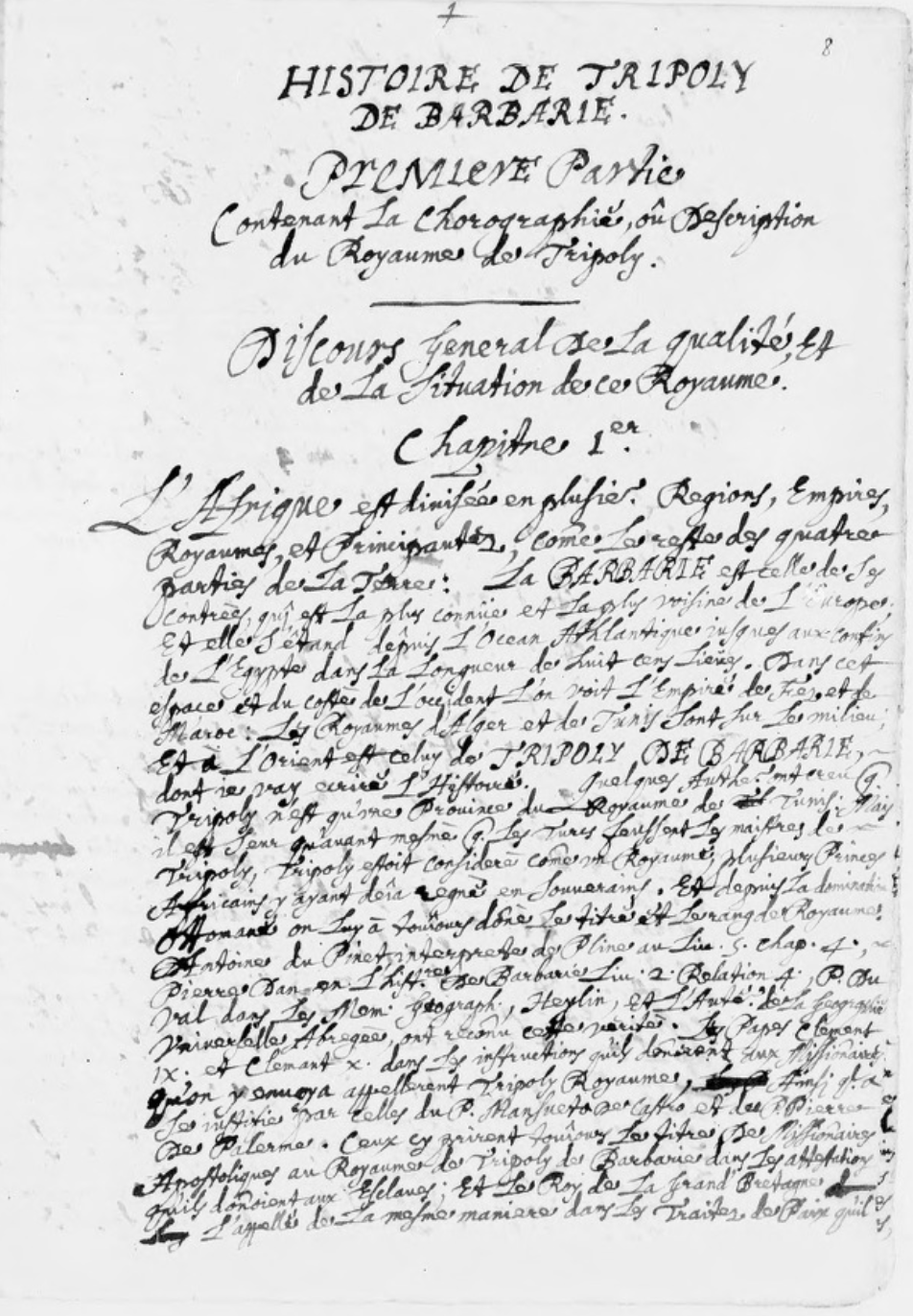
In the late 1600s, Dominique Girard, a Provençal surgeon captive in Tripoli between 1668 and 1675, composed a lengthy (over 1,000 pages) chronicle-diary, known as the Histoire chronologique du royaume de Tripoly de Barbarie. It is now held in the Bibliothèque nationale de France as BNF ms. fr. 12219 & 12220. It seems to have been little studied, excepting a recent PhD thesis.

  •  (al-Gawhari) Bushreida, Amal. 2017. Le Manuscrit de « L’Histoire chronologique du royaume de Tripoli de Barbarie ». Université de Poitiers Thèse de doctorat.
  • Laronde, André. 2006. Dominique Girard et la Cyrénaïque : le regard d’un captif français en Barbarie au XVIIe siècle. Bulletin de la Société nationale des Antiquaires de France 2001(1). 120–127.

Continue reading

Research Roundup Summer 2021

Here is my occasional roundup of published research on Libya in the humanities and social sciences which I find interesting or useful. I’ll also slowly be gathering some of the older individual posts on this blog into collective roundup posts.

Ali Ahmida, Genocide in Libya: Shar, a Hidden Colonial History (Routledge, 2020)

This original research on the forgotten Libyan genocide specifically recovers the hidden history of the fascist Italian concentration camps (1929–1934) through the oral testimonies of Libyan survivors. This book links the Libyan genocide through cross-cultural and comparative readings to the colonial roots of the Holocaust and genocide studies.
     Between 1929 and 1934, thousands of Libyans lost their lives, directly murdered and victim to Italian deportations and internments. They were forcibly removed from their homes, marched across vast tracks of deserts and mountains, and confined behind barbed wire in 16 concentration camps. It is a story that Libyans have recorded in their Arabic oral history and narratives while remaining hidden and unexplored in a systematic fashion, and never in the manner that has allowed us to comprehend and begin to understand the extent of their existence.
     Based on the survivors’ testimonies, which took over ten years of fieldwork and research to document, this new and original history of the genocide is a key resource for readers interested in genocide and Holocaust studies, colonial and postcolonial studies, and African and Middle Eastern studies.

There is an illuminating interview with the author on Jadaliyya, in addition to one on the New Books Network. Continue reading

Early Modern Libyan Manuscripts in the Bibliothèque Nationale de France (sources for the study of early modern Libya i)

A great deal of historical writing on early modern Libya depends on sources written by Westerners, whether colonial archival documents, or travelogues and journals written by travellers, British diplomats’ relatives, and so forth. Only recently are local documentary archives coming to light (e.g. the ones in Ghadames). But there are also Libyan historical texts from before the colonial era scattered in collections in Libya and elsewhere. Here and in some upcoming posts I’ll try to post some brief guides to these resources, many of which still require study and publication.

The Bibliothèque Nationale de France in Paris has a few interesting Libyan historical manuscripts (described in William MacGuckin de Slane’s Catalogue des manuscrits arabes, pp. 339-340). Fortunately, several of the manuscripts have been digitized and are freely available to download and read. Here is a brief description of each manuscript. Continue reading

Research Roundup Spring 2019

Seasonal (that is, according to my whim and free time) roundup of research on Libya, some published recently, and some older works I’ve only recently come upon.

This series of articles focuses on Libya to investigate how individual and collective identities are imagined, experienced, and narrated in a mobile and interconnected world. Drawing from original and unexplored sources in seven different languages, our case studies illuminate subjects and circuits long neglected from historiography, and yet crucial for the understanding of the transnational and transcultural memory of Libya. Our critical engagement with ways in which histories of Libya have been materialised, colonised, regimented and forgotten reflects a wider shift across the academic discipline of History.

The contents include the following articles:

***

Oh hey, the latest issue of Quaderni di archeologia della Libya (#21) is out. It is one of the three academic journals which cover archaeological-related topics in Libya. It hadn’t appeared since 2009, due no doubt to the complications of carrying out work in Libya during the regime and afterwards. But at the totally insane price of €276 for a hard copy or €184 for an ebook, and without online subscription options, it’s basically unobtainable and inaccessible. Too bad. At least the table of contents of the latest issue can be viewed here.

***

Two articles about Libyan politics and policy after 2011 have been published in The Journal of North African Studies:

This article compares the actors, institutions and strategies of the first Tunisian Provisional Administration (TPA), which was in place from the departure of authoritarian President Ben Ali until the elections for a National Constituent Assembly, with those of the Libyan National Transition Council (NTC), in place from the start of authoritarian collapse to the first post-uprising elections. The two first provisional administrations exhibited important differences. Key actors in the TPA were ‘soft-liners’ from the old regime and a network of civil society actors, while in the NTC armed groups soon became the most important actors. Functioning state institutions also permitted the TPA to carry out its work more effectively. Finally, the two provisional administrations deployed very different strategies, with the TPA operating on a basis of dialogue and consensus while the NTC often struggled to reach collective decisions. The paper argues that, while many of the differences between the two first provisional administrations can be traced back to different historical and structural influences and these channeled actors’ decisions, the first provisional administrations nonetheless had opportunities to shape later phases of change.

This case study of Libya’s foreign policy after the regime change in 2011 represents a major analytical challenge, since the country’s massive internal dysfunctions – extreme weakness of the state, the emergence of new elites, proliferation of private actors, power competition and widespread violence – have prevented the normalisation of its political and economic life and, consequently, the normalisation of its foreign policy. However, this does not mean that there is no Libyan ‘foreign policy’, or perhaps a number of intertwined foreign policies, as different Libyan political actors have been proactive in establishing contacts and maintaining alliances – often antagonistic – with external powers. Libya’s recent evolution provides some indication of what its foreign policy might look like in the future, once the situation in the country has normalised. On the one hand, it is possible to determine the external determinants on both the regional and global level, which have and will have the most influence on Libyan foreign policy. On the other hand, with all the caution required to interpret the current unstable and fluid situation, an analysis of the political process and the behaviour of the actors in Libya highlights some key issues that constitute the universe of Libyan interests abroad and, consequently, the top priorities of its foreign policy, which will inevitably focus on hydrocarbons and security in any future scenario. Finally, the article addresses whether discontinuity in domestic politics resulting from regime change might lead to a structural modification of Libya’s external behaviour.

***

This article analyses the practices of deportation and transportation of colonial subjects from Libya, Italy’s former possession, to the metropole throughout the entire colonial period (1911–1943). For the most part, the other colonial powers did not transport colonial subjects to Europe. Analysing the history of the punitive relocations of Libyans, this article addresses the ways in which the Italian case may be considered peculiar. It highlights the overlapping of the penal system and military practices and emphasizes the difficult dialogue between “centre” and “periphery” concerning security issues inside the colony. Finally, it focuses on the experience of the Libyans in Italy and shows how the presence there of colonial subjects in some respects overturned the “colonial situation”, undermining the relationship of power between Italians and North Africans.