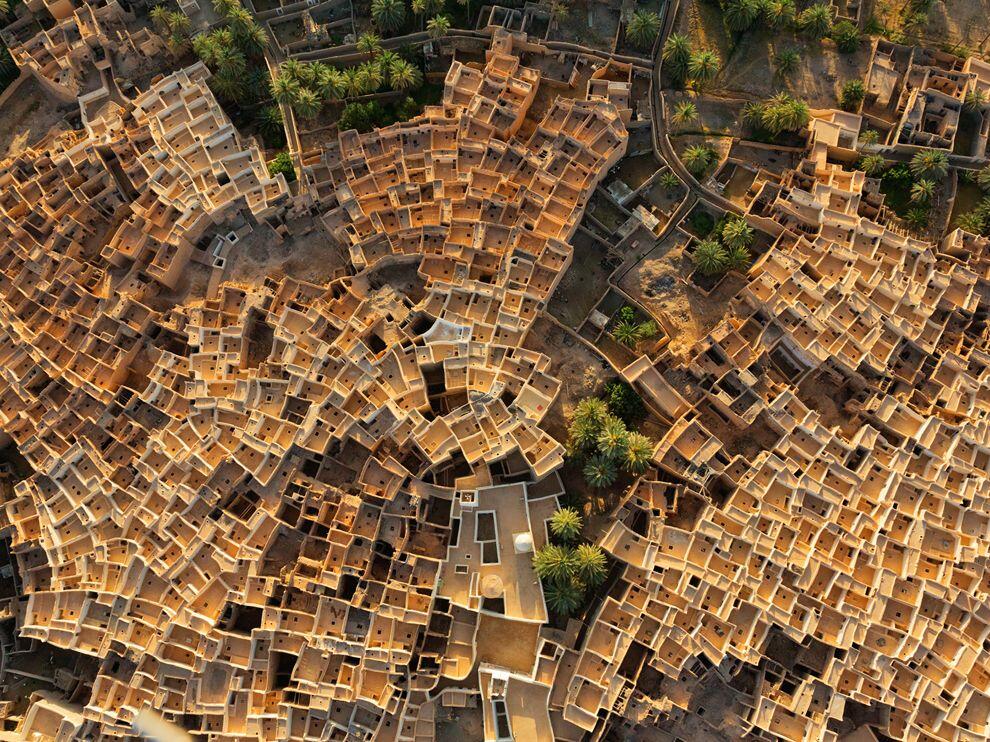
Ghadames. Image by George Steinmetz, National Geographic.
The historic city of Ghadames in the far west of Libya is well-known for its beautiful vernacular architecture. It is also is home to a unique variety of the Berber language. Like in Awjila, fieldwork in Ghadames was primarily done before the regime came to power and both research and mention of Berbers were restricted. Much material was collected primarily by a French linguist named Jacques Lanfry, who stayed in the oasis in the 1940s. Prior to that, linguistic material from Ghadames had not been published since 1904. Lanfry’s material has now been analysed by Maarten Kossmann, who works on a wide variety of languages in North Africa including several Berber varieties, and published as A Grammatical Sketch of Ghadames Berber (Libya). Rüdiger Köppe Verlag: Cologne (2013, Berber Studies 40). The publisher’s website states:
“Ghadames constitutes a Berber language on its own, which has followed different historical paths from all other languages. It preserves a number of phonological features that are not commonly found elsewhere and in its morphology, Ghadames also has a number of highly unusual features. While much of its syntax follows general Berber patterns, a number of outstanding features occur. Ghadames Berber lexicon has undergone relatively low influence from Arabic; thus in a count of loanwords in traditional narrative texts, Ghadames has 18% loanwords from Arabic, whereas languages such as Tashelhiyt and Figuig have twice as much. Furthermore there are a number of recognizable loans from Tuareg and Hausa.
In spite of the importance of Lanfry’s materials, in Berber studies the language of Ghadames has not yet been given the place it deserves. This may be due to the fact that anfry’s studies are difficult to obtain, and that Lanfry’s notations prove somewhat difficult to interpret for a superficial reader. Moreover, while Lanfry provides a detailed description of verbal morphology, other subjects remain underrepresented, such as syntax. This is the reason the author decided to write this short grammatical sketch, based on Lanfry’s materials.”
 The most recent publication is my friend and colleague

 Anyone who wants to get a feel for what Libya looked like during the height of the colonial period should read Brian McLaren’s beautifully-illustrated study
  Quaderni di Archeologia della Libia is a journal going back to the 1950s which publishes the results of various types of archeological fieldwork and research concerning places now in Libya. Most articles are in Italian, but some are in English and other languages. As it does not seem to have its own website, I have taken the liberty of posting a link to a list of contents online.
 A landmark contribution to the study of North African urban history, the history of Tripoli, and the history of Ottoman Libya is “A North African City between ancien regime and Ottoman reforms: the birth of municipal institutions in Tripoli 1795-1911” [مدينة في المغرب بين العهد القديم و التنظيمات العثمانية: تكوين المؤسسات البلدية في طرابلس الغرب] by
  The Silphium Gatherer | مجمّع سلفيوم