Author Archives: AB

Hessa6’s collaborative new album “Unimported Disc”

The project Hessa6 (حصة سادسة) is “dedicated to unlocking the power of art to bring about social change through a range of activities that include researching, archiving, producing and promoting Libyan art.” With support from the Arab Fund for Culture and Arts, Hessa6 has released a new album entitled دسكة غير مستوردة “Unimported Disc” (click here to listen on Spotify). Described as “an electrifying musical project that brings together an eclectic mix of artists, rappers, and bands from across Libya”, the new album presents diverse, homegrown sounds in multiple genres, with lyrics in Arabic and Amazigh varieties, and incredible cover art for the album and for each track by Moneer Alwerfally.

The tracks and their descriptions as provided by Hessa6 on their Instagram page are below:

Continue reading

Book: Jewelry and Adornment of Libya

Hala Ghellali’s long-awaited book on Libyan jewelry is finally in print! An account based on the author’s own collections and her long personal experience and interaction with artisans of bygone generations, this will be the resource on the topic for a long time. Cover photo by Sasi Harib.

Publisher’s description: Hala Ghellali was eighteen years old when her father first took her to the suq to buy her first silver bracelets. They visited traditional jewelers in the madina al-qadima, the old walled city of Tripoli. This single event in 1975, ignited her lifelong passion for traditional jewelry and costume items and she has been collecting objects and stories ever since. Her unique stories, personal observations, research and firsthand information about jewelry design and silversmithing fill this book. ‘Jewelry and Adornment of Libya’ aims to share with its readers a lifetime passion for the jewelry made in Tripoli. It includes a section dedicated solely to the role of jewelry and costume in Tripoli with narratives of traditional weddings, and traditions linked to jewelry gifting in the city. The book is dedicated to the local jewelers and masters of weaving and embroidery who have almost all disappeared, their art and skills not being passed on to the present generation.

Essay: Identity, Displacement, and Coming of Age

An essay entitled “Identity, Displacement, and Coming of Age with Banat Collective” by Farrah Fray, author of the poetry chapbook The Scent of My Skin, appeared in the Journal of Middle East Women’s Studies back in 2019.

Excerpt: Somehow summer is the least peaceful time of year. The summer of 2018 was no exception. I had just finished writing my dissertation two weeks before boarding a flight to Libya to visit family. Leading up to my trip, a sense of uncertainty about the future began to loom over my head. After I completed my degree, would my family pressure me to return to Libya? If so, what were the best options for my well-being? Most important, how would I cope or fit in? The last time I had lived in Libya for more than a few weeks was in 2007, when my parents decided that we would settle down in Zawiyah after spending more than ten years in the United Kingdom. Four years later, after the uprisings of 2011, we returned to London. I have been in the British capital since then, save the annual visit to Libya….


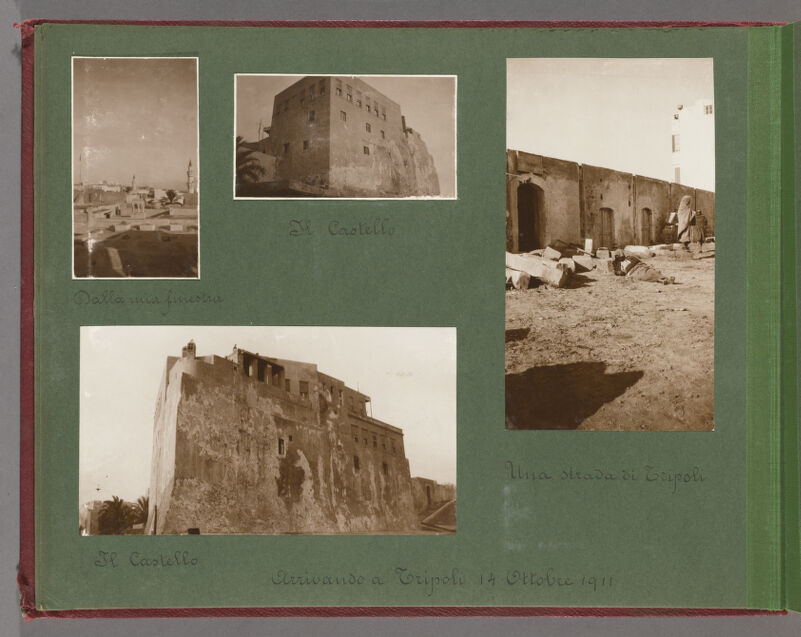
Photographic Archives of the “Italo-Turkish War”

The Harvard library holds several private photographic albums documenting the Italian invasion of Libya in 1911-12, sometimes referred to as the “Italo-Turkish War”. The albums belonged to individuals: Count Pompeo Campello, a professional photographer and army officer, Carlo Caneva, general of the armed forces in Libya, and Angelo Cormanni, soldier working in the telegraph unit.

Pompeo di Campello (1874-1927): “Campagna di Libia (9 ottobre 1911 – 28 maggio 1912)”

Carlo Caneva (1845-1922): “Guerra Italo-Turca 1911-1912 / Ricordi di Bengasi”

Angelo Cormanni: “Guerra di Africa”

Some studies have been written about these albums:

  • Dalila Colucci, Images of Propaganda: Emotional Representations of the Italo-Turkish War 2021, “Close Encounters in War and the Emotions.” Eds. Gianluca Cinelli, Patrizia Piredda, and Simona Tobia. Close Encounters in War 4 (2021), 75–122.
  • Luca Mazzei, “L’occhio insensibile. Cinema e fotografia durante la prima Campagna di Libia 1911-1913,” in Fotografia e culture visuali del XXI secolo, vol. 2, ed. Enrico Menduini and Lorenzo Marmo (Rome: Roma Tre-Press, 2018).

Some articles on Libyan/Italian entanglements by Italian scholars

Ravelli, Galadriel. 2024. Libyan deportees on the Italian island of Ustica: Remembering colonial deportations in the (peripheral) metropole. Memory Studies. https://doi.org/10.1177/17506980231224759.

In 1911, the Italian liberal government launched the colonial occupation of what is now known as Libya, which was met with unexpected local resistance. The government resorted to mass deportations to the metropole to sedate the resistance, which continued for more than two decades under both the liberal and Fascist regimes. This chapter of Europe’s and Italy’s colonial history has been almost entirely removed from collective memory. The article explores the extent to which colonial deportations are remembered on the Sicilian Island of Ustica, which witnessed the deportation from Libya of more than 2000 people. Currently, the island is home to the only cemetery in Italy that is entirely dedicated to Libyan deportees. I argue that the visits of Libyan delegations, which took place from the late 1980s to 2010, succeeded in challenging colonial aphasia at the local level. Yet, as a result of Ustica’s peripheral position within the national space, the memory work developed through the encounter between local and Libyan actors remained marginal, despite its potential to redefine the Mediterranean as a symbolic space where colonial histories are articulated and remembered. Italy’s outsourcing of the memory work in relation to colonial deportations implies a missed opportunity to interrogate the postcolonial present and thus question persistent dynamics of power in Europe that exclude the constructed Other.

Morone, Antonio M. 2024. The Libyan askaris on the eve of national independence: two life stories across different strategies of intermediation. The Journal of North African Studies. https://doi.org/10.1080/13629387.2024.2360911.

Italian colonial authorities heavily relied on the askaris (i.e. native soldiers) throughout the history of colonialism to alleviate the economic and political burdens of colonial warfare. For that, the askaris became privileged intermediaries for the Italians and emerged as a de facto elite within colonial society, seeking social mobility for themselves and their families. After the end of the Second World War, the askaris lost their role as soldiers, but gained new relevance as political intermediaries for Italian or British plans regarding the final resolution of the Italian colonies affaire. The article delves into the life stories of two askaris, which were documented by the author on 3rd November 2009, in Tripoli. Their memories highlight the relationships of friendship or intimacy that existed with the colonisers and showcase the askaris’ ability to downplay colonial elements of domination and oppression through their intermediation. Being an askar entailed, on one hand, questioning the political and racial boundaries of society, and on the other hand, challenging the agendas of nationalist groups. The transition to independence indeed involved a struggle between colonisers and the colonised, as well as among various groups of colonial subjects, all vying for power within the post-colonial State and society.

Tarchi, Andrea. 2022. A ‘catastrophic consequence’: Fascism’s debate on the legal status of Libyans and the issue of mixed marriages (1938–1939). Postcolonial Studies 25(4). 527–544. https://doi.org/10.1080/13688790.2021.1964764.

This article assesses the role that institutional concern for the possibility of interracial marriages played in the Italian Fascist party’s internal debate regarding the legal status of Libyans in the second half of the 1930s. Following the end of the ‘pacification’ of the Libyan resistance in 1932, Governor Italo Balbo pushed for the region’s demographic colonization and the legal inclusion of the colonial territory and its population within the metropole. In contrast, Fascist Party officials in Rome endorsed starker racial segregation in the colonies based on the racist ideology that permeated the regime after the declaration of the empire in 1936. The legal inclusion of Libyans within the metropolitan body politic touched upon the regime’s most sensitive theme: the need to avoid any promiscuity that could interfere with the racial consciousness of Fascist Italy. This article analyses this dispute through the lens of interracial marriage and concubinage regulations, framing it into the definition of a normative standard of Italian whiteness through the racialization of the colonial Other.

Rossetto, Piera. 2023. ‘We Were all Italian!’: The construction of a ‘sense of Italianness’ among Jews from Libya (1920s–1960s). History and Anthropology 34(3). 409–435. https://doi.org/10.1080/02757206.2020.1848821.

The paper explores how a ‘sense of Italianness’ formed among Jews in Libya during the Italian colonial period and in the decades following its formal end. Based on interviews with Jews born in Libya to different generations and currently living in Israel and Europe, the essay considers the concrete declensions of this socio-cultural phenomenon and the different meanings that the respondents ascribe to it. Meanings span from the macro level of historical events and societal changes, to the micro level of individual social relations and material culture. Viewed across generations and framed in the peculiarities of Italian colonial history, the ‘sense of Italianness’ expressed by Jews in Libya appears as both a colonial and post-colonial legacy.

Article: A socio-historical analysis of English in Libya

Gherwash, Ghada. 2024. A socio-historical analysis of English in Libya. World Englishes 43(1). 71–85. https://doi.org/10.1111/weng.12632 (paywall).

Abstract: Political instability has been a mainstay in Libya since the Italian occupation in 1911. In the intervening years, the shifting political landscape has had an undeniable influence on the presence of English in the country. In this paper, I argue that Libya presents an ideal case study for Kachru’s Concentric Circles of English, where ‘linguistic ammunition’ (Kachru, 1986: 121) is used to manipulate and control the masses and spread anti-Western sentiment in this expanding circle country. To provide a much-needed socio-historical context for a country whose English language and linguistic history remains understudied (Hillman et al., 2020), this paper touches on key events in Libya’s political history that have influenced the status of English and language use; from the Italian colonization, to Qaddafi’s decade-long ban of English, to the 2011 Revolution, and beyond. This paper is divided into six sections: (1) critical approaches to language policy (Tollefson, 1991) and Foucault’s governmentality approach (1991); (2) demographic and geographic description of Libya; (3) historical and political overview; (4) educational language policy and the development of the education system; (5) English language policy in Libya (the ban on use of English in 1986 following the 1969 coup that brought Qaddafi to power and the reintroduction of English in the mid-1990s); and will conclude with (6) English language in post-Qaddafi Libya. Understanding these key moments in Libyan political history will provide the context needed to understand how a generation of Libyans found themselves without the linguistic skills necessary to compete in the global economy.

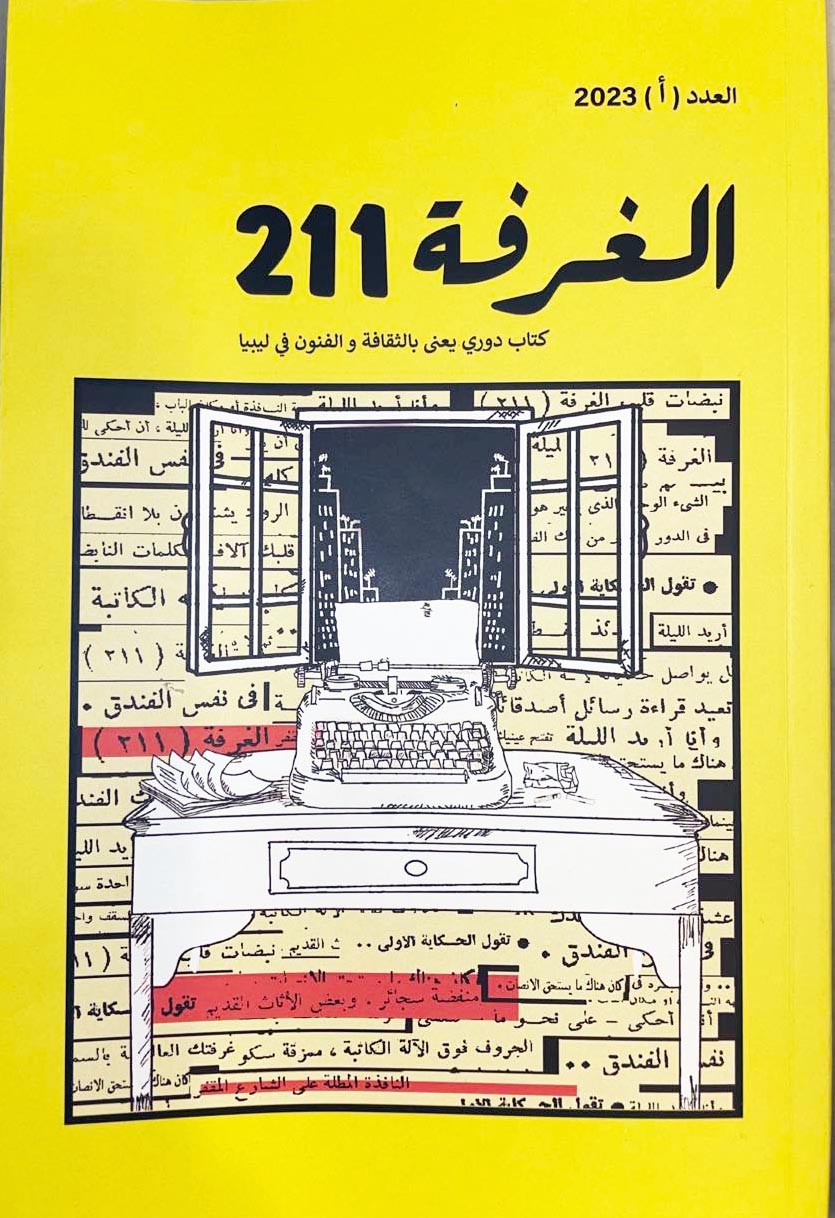
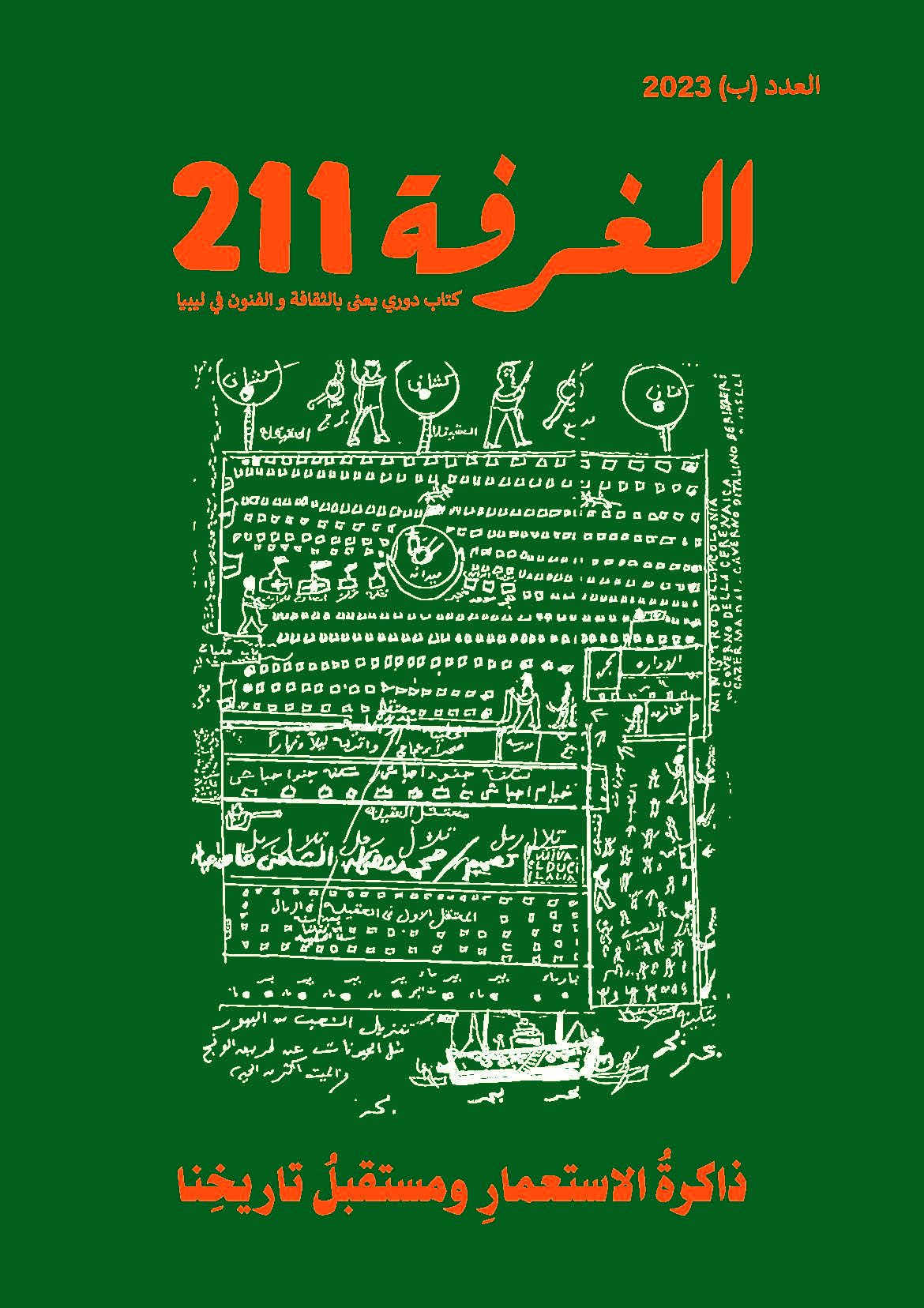
Ghurfa 211 / الغرفة 211

Ghurfa 211 is a new Arabic-language periodical focusing on arts and culture published by the Arete Foundation for Arts and Culture in Libya.

Its name comes from the work “Season of Stories” by Khalifa al-Fakhri, in which “he writes that Room 211 is a refuge during the night-time winter rains. When the cafes shake off their patrons and the sitting-rooms their guests, “the only thing you have is to return to Room 211″ where there is loneliness and the gathering words pulsating in the chest until a charge that sifts the feelings fills the body and from it writing begins.”

The first two issues appeared in 2023, containing poetry, short fiction, commentary, essays, and letters by Libyan writers (some translated from English and other languages into Arabic).

See also their facebook site.

Article: Ottoman abolitionist policy in Trablusgarp and Benghazi

Hargal, Salma. 2024. Ending slavery in imperial peripheries: Ottoman abolitionist policy in Trablusgarp and Benghazi provinces (1857–1911). Middle Eastern Studies.

When Istanbul prohibited the trade of enslaved Africans in 1857, the Ottoman local authorities expanded efforts to curb human trafficking throughout the imperial realm. These endeavours also included Libya, which lies at the frontiers of the Greater Sahara, a major slave-raiding zone in the nineteenth century. The historiography devoted to modern Libya maintains that the Porte took action to curb slavery only in response to British pressure. In this article, I seek to situate the prohibition of human trade in Libya within the larger scope of the end of slavery in the imperial realm. I argue that the Ottomans conducted an abolitionist policy in Libya that was embedded in the reforms undertaken in these peripheral provinces, namely, to foster the Porte’s sovereignty at its imperial frontier. I further argue that the enslaved population gained agency in the manumission process and in their integration into Ottoman society after their liberation. This bottom-up approach to the end of human bondage reveals the entanglement of old and new patterns of manumission in the era of abolition as well as the social integration of these emancipated slaves into Ottoman society during the Reform period.