Cirenaica: some photographic representations of Italy’s action (Istituto agronomico per l’Oltremare, Firenze, 1946)

(Colonial propaganda, obviously)
Cirenaica: some photographic representations of Italy’s action (Istituto agronomico per l’Oltremare, Firenze, 1946)
(Colonial propaganda, obviously)
In 1952, a person named Abdul Amir Majeed (b. 1916, d. ?) was awarded a PhD from Ohio State University with a dissertation entitled Libya: A Geopolitical Study. As far as I can find so far, it seems to be the first PhD about Libya—the main reason for posting it here, as it is a fairly superficial overview of Libyan history, geography, climate, and social structure, containing information also found in other sources of the time. It seems to have largely been written prior to the foundation of the Libyan state in 1951, and so contains quite a few comments alluding to problems to face the new state, while also providing a rather hesitant outlook on the success of the new national project. Some quotes:
"Fortunately the new state of Libya has a homogeneous population, one that
shares common ethnological origin, practises one religion and speaks a common language." (202)
"The repercussions resulting from Libyan independence will be most significant in Africa, the continent which has already been profoundly affected by this action" (221)
"Libya is the land to which the United Nations has just handed mankind’s greatest political attainment - self-government. Were this experiment being undertaken in any period but that of the cold war of 1952, it would be a most hopeful and inspiring advance over colonialism. But, actually, by the hoisting of the flag of Libyan independence, grave political and strategic questions for the western world are raised in a sensitive and important area" (223)


After almost 100 years, the anti-colonial novel “The Conscript” has finally appeared in Italian translation, thanks to the work of translator Uoldelul Chelati Dirar and funding obtained by Alessandra Ferrini.
Originally written in Tigrinya in 1927, an English translation by Ghirmai Negash appeared in 2012, while an Arabic version by Faraj al-Tarhouni has come out in recent years in Libya. The author, Gebreyesus Hailu (1906–1993) was a prominent and influential figure in the cultural and intellectual life of Eritrea during the Italian colonial period and in the post-Italian era in Africa. He earned a PhD in theology, was vicar general of the Catholic Church in Eritrea, and played several important roles in the Ethiopian government, including as cultural attaché at the Ethiopian Embassy in Rome.
The original Tigrinya version of the novel is not in print but a PDF has been made available by Ghirmai Negash, the English translator, and can be found here.
In the 1930s, a “Commission for the Liberation of Libya” (هيئة تحرير ليبيا) headed by Bashir al-Sa‘dawi published a book entitled The Black-Red Atrocities from the Pages of Italian Colonization in Libya, or, Civilization by Iron and Fire (الفضائع السود الحمر من صفحات الاستعمار الايطالي في ليبيا او التمدين بالحديد والنار) documenting atrocities committed by the Italian colonial occupation in Libya and mocking claims that colonization would lead to modernization and progress for the colonized. It appears to be the case that this book is a revised version of al-Sa‘dawi’s Fadhā’i‘ made by a group of Libyan exiles in Syria. The second printing under this title, in 1948 in Cairo, added a section arguing for Libyan unity and independence after WWII. Together with the earlier edition of Sa‘dawi’s work and Shatwan & Sherif’s “Aspirations et idéal national” it is one of the few Libyan anti-colonial writings of the time.
In the 1930s the Tripolitanian notable and politician Bashir al-Sa‘dawi, later to be viewed as one of the main figures in the movement for Libyan independence, published an essay entitled ‘The atrocities of fascist Italian colonialism in Tripolitania-Barqa’ (مقال: فظائع الاستعمار الايطالي الفاشستي في طرابلس-برقة). Published by the “Association for the defense of Tripolitania-Barqa”, about which I know little, this essay seems to be one of the earliest Libyan anti-fascist and anti-colonial writings.
In the late 1950s into the 1960s, the area of Durham, England became very involved in the development of the oil industry, including accompanying types of research, in Libya. The University of Durham’s geography department hosted a major geographic research project on Libya, and the county of Durham was involved in the construction of one of the earliest oil pipelines in Libya (the very first shipment of Libyan crude oil in 1961 actually went to a British refinery). This activity, funded by various parties interested in the exploration and mapping of Libya, produced over a dozen MA and PhD dissertations on various aspects of Libyan geography in the 1960s, as well as other publications. In fact, Durham’s Geography department hosted what may have been the very first crop of Libyan PhD students in a Western university.
The Department of Geography also published a handful of studies on Libya stemming from the same period of research activity, including much fieldwork on-site in Libya. (Click the links below for PDFs)
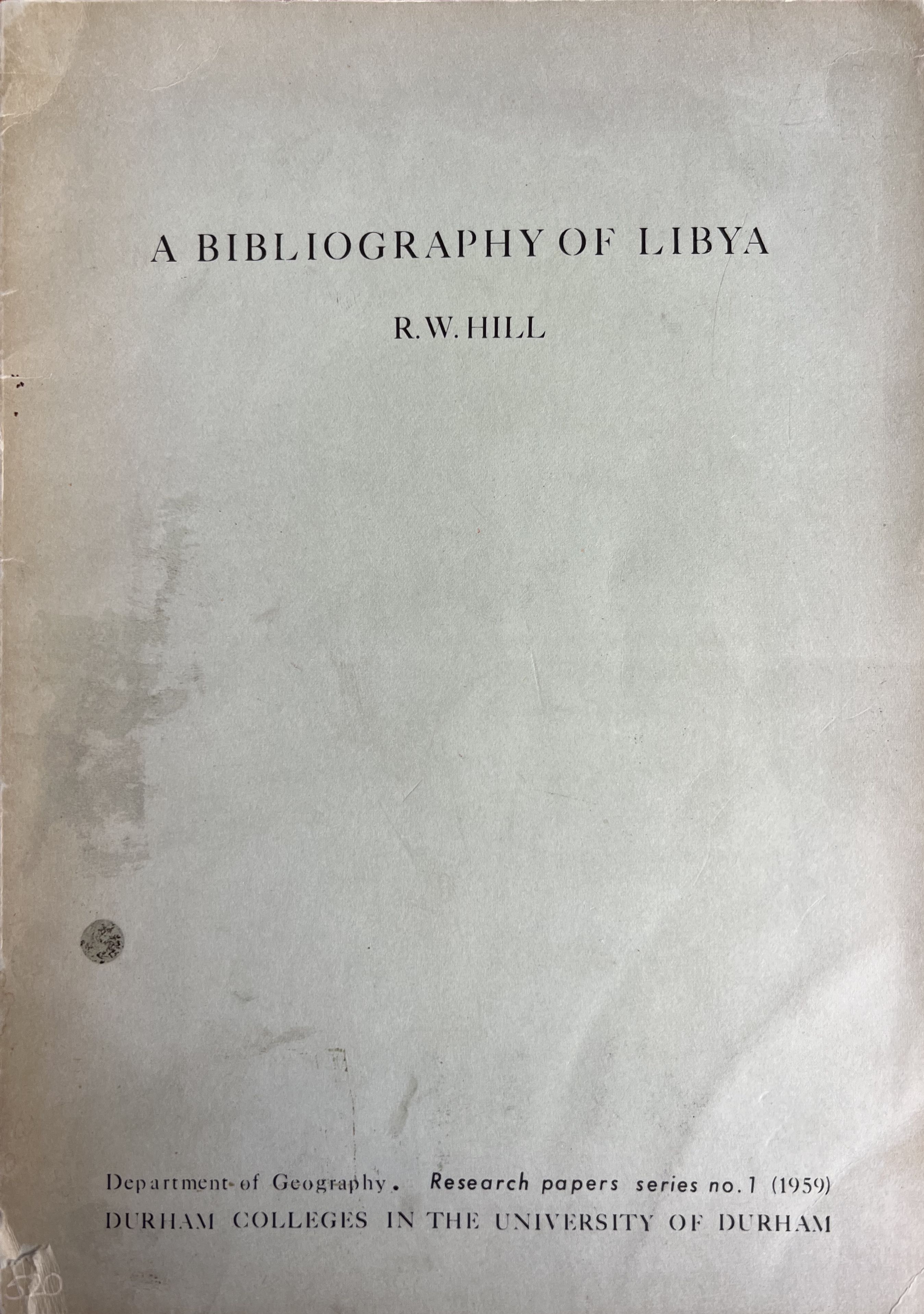


R.W. Hill, A Bibliography of Libya (Department of Geography, Research Papers Series No. 1, 1959). Durham.
S.G. Willimott & J.I. Clarke (eds.). Field Studies in Libya (Department of Geography, Research Papers Series No. 4, 1960). Durham.
D.W. Gilchrist Shirlaw, S.G. Willimott, J.I Clarke, M.E. Frisby. Soil Survey of Tauorga Tripolitania, Libya (Department of Geography, 1961). Durham
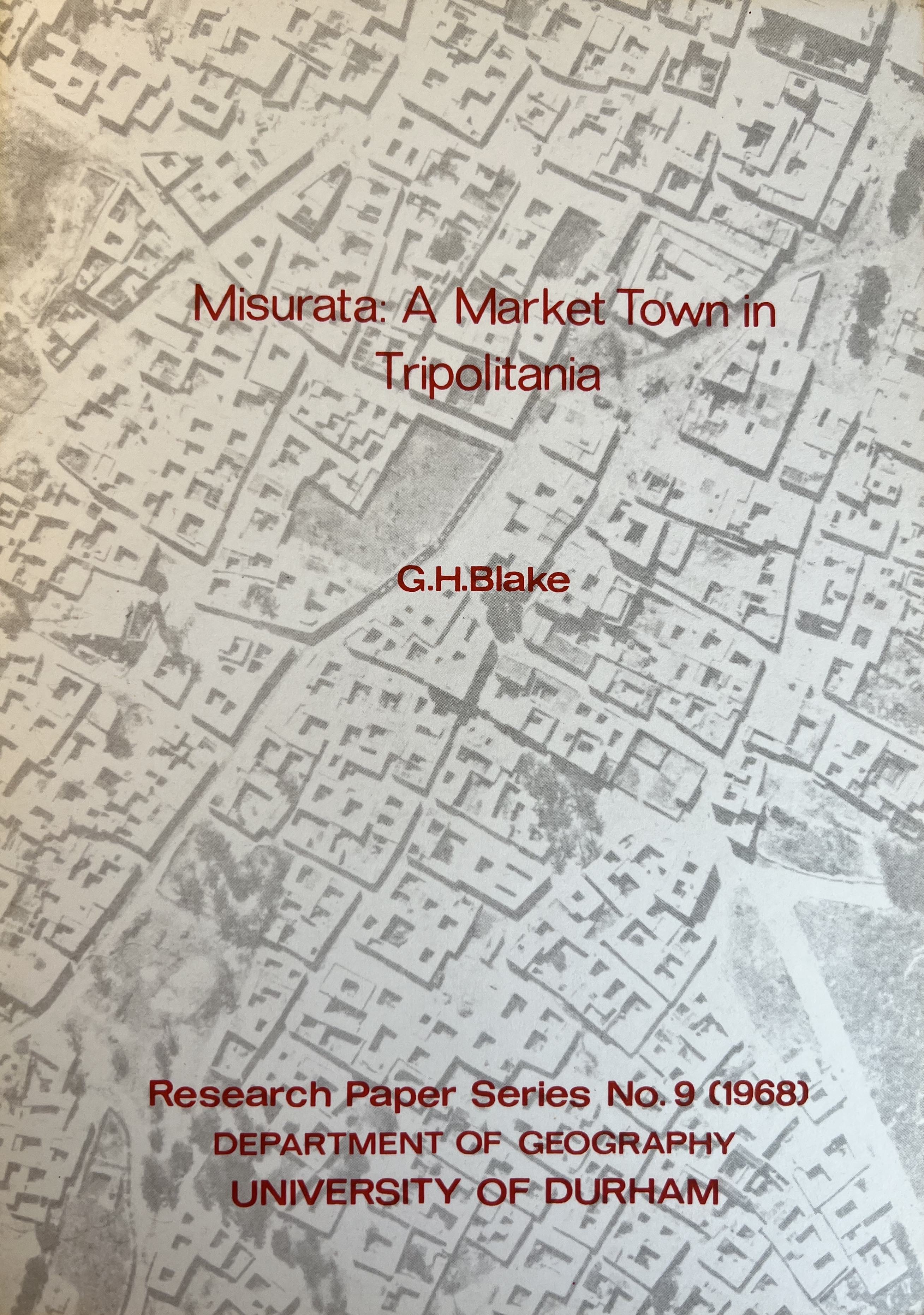
G.H. Blake. Misurata: A Market Town in Tripolitania (Department of Geography, Research Papers Series No. 9, 1968). Durham.
A new article is the first (to my knowledge) study focused on the Libyan folkloric character Bousaadiya (بو سعدية). See also the author’s recent podcast episode on the same topic.
Tayeb, Leila. 2023. To Follow Bousaadiya: Mobility and Memory in Libyan Cultural Politics. Middle East Journal of Culture and Communication 16/3. 313–336. [not open access]
This article takes the figure of Bousaadiya, once performed in varying iterations throughout central North Africa, as an entry point to approach the problematics of mobility and memory in Libya. Bousaadiya performance, a multidimensional set of practices that I read critically as dance, produces an embodied social ground upon which Libyans have enacted and contested racialized practices of belonging and a mobile gravesite where it is possible to interrogate regional histories of enslavement and their material and symbolic legacies. While reading Bousaadiya performance enables an excavation of the trans-Saharan slave trade and its ghostly e/affects, performing Bousaadiya enabled the incomplete burial of these through surrogation, easing particular losses. In this article, I explore both of these aspects of the performativity of Bousaadiya’s dance, which is underscored by the forms of remembering it that continue to proliferate. To follow Bousaadiya is to grapple with the ongoing unresolvedness in Libyan cultural politics of the country’s histories of slave economies and the hierarchies left in their wake and to gesture toward the prospect of repair.
The LibMed project’s seminar schedule for the 2023-2024 academic year is now available. LibMed is an international team of scholars working on medieval Libya, from the Islamic conquest (7th century CE) until the establishment of Ottoman rule (16th century CE). To register for an online seminar, email the address at the bottom of the poster below.


Cherstich, Igor. 2023. Smoking, Praying, Killing: The Politics of Boredom in Post-Revolutionary Libya. In Revolution Beyond the Event: The Afterlives of Radical Politics, ed. by Charlotte Al-Khalili, Narges Ansari, Myriam Lamrani, and Kaya Uzel (London: UCL Press). [open access]
Modern Libyan history has been marked by two revolutionary occurrences. In 1969 Colonel Muʿammar al Gaddafi led a coup against the king of Libya, abolishing the monarchy and establishing one of the most perdurable socialist governments of the twentieth century. Forty years later, a revolution broke out against Gaddafi, determining the sudden collapse of the socialist state. In this chapter I will examine the aftermaths of these two uprisings. In so doing, I will show that in spite of their antithetical character – one revolution brought Gaddafi to power, the other put his rule to an end – both events were characterised by a similar, fundamental discrepancy. More specifically, I will demonstrate that in both cases the revolutionaries claimed to have brought about a completely new phase in Libyan history: a novel era marked by an unprecedented sense of vitality and dynamicity. Equally, I will show that the insurgents attained exactly the opposite of what they aimed to achieve: rather than precipitating an age of effervescence and movement, they generated an age of stasis. A stagnant state of affairs where Libyans could not help but feeling stuck, lethargic, and bored.
Abouzzohour, Yasmina & Tarik M. Yousef. 2023. What drives public trust in the military in non-democracies: Evidence from Libya (2014-2019). The Journal of North African Studies. [open access]
This article investigates the conditions that lead to heightened trust in the military in non-democracies through an empirical study of post-2011 Libya. Drawing on the political science and sociology literatures on institutional trust in non-democratic contexts, we develop hypotheses linking public trust in the military to personal safety, political interest, Islamist orientation, trust in institutions, regionalism, and support for democracy. Using survey data collected by the Arab Barometer between 2014 and 2019, we empirically test these hypotheses. Our findings reveal a confluence of factors driving trust in the military in Libya, including regional, generational, educational, and class divides. Being older, male, and from the East contribute positively to trust in the military as well as perceived personal safety, trust in government, interest in politics, and support for democracy. On the other hand, an Islamist orientation, education and income are negatively correlated. These results allow us to speculate about the drivers of trust in the military. In particular, the positive impact of personal safety and support for democracy could reflect the public's perception of the army as responsible for ensuring safety and protecting a nation in turmoil. The role of interest in politics could be attributed to the charged context of politics and security after the 2014 elections. Notably, regional exceptionalism in the East could be related to the role and behaviour of the eastern-based, self-proclaimed Libyan National Army. Our paper contributes to the limited empirical research on trust in the military in non-democracies, backsliding in conflict countries, and political attitudes in Libya.
 The Silphium Gatherer | مجمّع سلفيوم