Tag Archives: articles

Research Roundup Winter 2018

This edition of the research roundup includes sources on primarily colonial Libya from various perspectives, as well as some more recent works on topics such as cultural heritage.

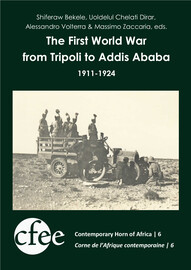
For a long time now it has been common understanding that Africa played only a marginal role in the First World War. Its reduced theatre of operations appeared irrelevant to the strategic balance of the major powers. This volume is a contribution to the growing body of historical literature that explores the global and social history of the First World War. It questions the supposedly marginal role of Africa during the Great War with a special focus on Northeast Africa. In fact, between 1911 and 1924 a series of influential political and social upheavals took place in the vast expanse between Tripoli and Addis Ababa. The First World War was to profoundly change the local balance of power.

This volume consists of fifteen chapters divided into three sections. The essays examine the social, political and operational course of the war and assess its consequences in a region straddling Africa and the Middle East. The relationship between local events and global processes is explored, together with the regional protagonists and their agency. Contrary to the myth still prevailing, the First World War did have both immediate and long-term effects on the region. This book highlights some of the significant aspects associated with it.

The entire book is fascinating and opens up new areas of research tying into dynamics of which Libya was ultimately a part. The specific essays concerning Libya are:

***

In the spring of 1931, Italian colonial authorities ordered the construction of a fence on the border between Libya and Egypt. By September, 270 kilometres of cement, chain-link fence, and barbwire stretched from the shores of the Mediterranean to the Oasis of Jaghbub. Italian authorities constructed the fence in order to deny Omar al-Mukhtar and his resistance fighters safe-havens and material support in neighbouring Egypt. Thus Cyrenaica, the eastern province of Libya, which was already completely separated from Tripolitania (Libya’s western province) by the desert of Sirtica, had now been also cut off from Egypt to the east of the fence. The peoples of Cyrenaica, particularly those living on the fertile highlands of the Jebel Akhdar, were the major source of support for Omar al-Mukhtar’s anti-colonial insurgency. The year before the fence went up, Italian authorities ordered the deportation and internment of between one-half and two-thirds of the civilian population of Cyrenaica—between 90,000 and 110,000 people

***

From the description: “When Italian forces landed on the shores of Libya in 1911, many in Italy hailed it as an opportunity to embrace a Catholic national identity through imperial expansion. After decades of acrimony between an intransigent Church and the Italian state, enthusiasm for the imperial adventure helped incorporate Catholic interests in a new era of mass politics. Others among Italian imperialists-military officers and civil administrators-were more concerned with the challenges of governing a Muslim society, one in which the Sufi brotherhood of the Sanusiyya seemed dominant. Eileen Ryan illustrates what Italian imperialists thought would be the best methods to govern in Muslim North Africa and in turn highlights the contentious connection between religious and political authority in Italy.

Telling this story requires an unraveling of the history of the Sanusiyya. During the fall of Qaddafi, Libyan protestors took up the flag of the Libyan Kingdom of Idris al-Sanusi, signaling an opportunity to reexamine Libya’s colonial past. After decades of historiography discounting the influence of Sanusi elites in Libyan nationalism, the end of this regime opened up the possibility of reinterpreting the importance of religion, resistance, and Sanusi elites in Libya’s colonial history. Religion as Resistance provides new perspectives on the history of collaboration between the Italian state and Idris al-Sanusi and questions the dichotomy between resistance and collaboration in the colonial world.”

***

Abstract: Libya’s cultural heritage is facing significant threats and damage, not only from unregulated development, but also increasing acts of civil disorder. With two de facto governments claiming authority in the country, no clearly operating constitution, contesting militias, and rising religious extremism, more damage is being done to the country’s cultural heritage than was caused by the events of the 2011 Revolution. During the Gaddafi regime, Libya’s cultural heritage from the pre-Arab period was seen as a reminder of Libya’s colonial past and therefore neglected for political reasons. And given the many challenges facing the new Libya, it is not surprising that cultural heritage struggles for recognition and protection. Working within this challenging environment, the Libyan Department of Antiquities continues to negotiate the protection of cultural sites in contested areas and to draw up plans for emergency inventory, crisis planning, and protection work. Despite their best efforts, it remains unclear what the future will hold for the cultural heritage of Libya.

***

The Italo-Turkish War (1911-1912), now remembered primarily as Italy’s war for what is now Libya, swelled from a localized colonial invasion into a significant Mediterranean conflict and a global cause célèbre that attracted support and aid for the embattled Ottoman regime from diverse locations both inside and outside the borders of the empire. This dissertation examines the means by which the Ottoman Empire erected an asymmetric defense of its last North African provinces to preserve its territory and empire from Italian occupation and annexation. Drawing on sources in Ottoman Turkish, Arabic, Greek, and Judeo-Spanish, this study demonstrates how the Sublime Porte and the Committee of Union and Progress (CUP) initially deployed a rhetoric of unity, constitutionalism, and international law to protect the empire from the Italian invasion. Due to the efficacy of Italian diplomacy, the Ottomans, unable to enlist Great Power support for the preservation of imperial territory, developed a defensive strategy for its North African territories that relied primarily on humanitarianism and volunteerism. This dissertation, therefore, investigates the vital contribution of pan-Islamism and the broad appeal of a loose ideology of Muslim anticolonialism in the empire’s attempts to bolster its forces with international aid and volunteers. While many studies tend to brush aside the importance of early twentieth-century pan-Islamism as either a pipe dream of Wilhelmine champions of German imperialism and their Ottoman collaborators or as merely a rhetorical movement devoid of substantial consequence, this dissertation reveals how global appeals to Islamic unity to combat European expansionism translated into material benefits for Ottomans on the battlefield. Through an examination of documents from the Turkish Red Crescent and the Turkish General Staff archives, it highlights the crucial assistance of global Islamic humanitarian aid to the Ottoman war effort in the form of sizeable financial contributions to the Ottoman Red Crescent from Muslims over the duration of the conflict. The Red Crescent organization provided a means to funnel aid to the battlefield collected in mosques, mass meetings, newspaper subscriptions, and Islamic associations within and without the Ottoman Empire. This charitable aid facilitated the deployment to North Africa of multiple Red Crescent teams which assumed, in most cases, sole responsibility for the medical care of both soldiers and civilians of the Ottoman provinces. Simultaneously, the Ottoman ranks in Tripolitania and Cyrenaica swelled as calls for coreligionist volunteers to take up arms were heeded throughout Africa and Asia. Ultimately, the empire’s anticolonial ideology proved an effective unifier for the many Muslims around the world who shouldered a great deal of the cost of the conflict. While Italy’s expenses for its war for colonial expansion ballooned, the defense of North Africa cost the Ottoman treasury very little.
Research Roundup Fall 2018

Back for your seasonal research roundup, containing sources on several totally un/under-researched areas.

After the Tunisian popular revolution of 2011, and during the civil war in Libya that followed, roadside stands near the Tunisian–Libyan bor- der near Remada, Tunisia sold nationalist souvenirs of the revolution with the reinstated Libyan flag (first flown from 1951 to 1969) as well as the Tunisian flag1. Post–independence governments in North Africa have been deeply invested in enforcing the borders they inherited from colonial regimes. Even when borders «were originally “artificial” creations, they have long since become an integral part of the lives of borderlanders. . . borders have an impact on social identities and have come to “demarcate mental space”» (Nugent and Asiwaju 1996, p. 10 in Lentz 2003, p. 274). International borders, for many people, are deeply meaningful and naturalized through socialization in school lessons, bureaucratic administrative procedures, economic systems, and even children’s play. In refugee camps and shelters on the Tunisian side of the border, Libyan children made homemade flags to decorate their temporary dwelling spaces. While «borders and borderlands define ourselves and others» (Lloyd et al 2010, p. 703 and Paasi 2003), a border in and of itself means nothing without human mediation, notably in the dual forms of policing and narration. As I explain in this article, during the first years of the Libyan civil war, the selves and others people were mediating were not only national — Tunisian and Libyan — but also ethnic: minority Amazigh (Berber) and majority Arab.

***

Historically, connections between southern Libya and northern Chad have always been close, if only due to the fundamental need for connectivity that characterises most Saharan economies. Drawing on so far mostly inaccessible archival records and oral history, this article outlines the implications of this proximity, arguing that it led to intimate entanglements within families and an ongoing confusion of property rights. This in turn resulted in increased rather than diminished hostility during the years of war that opposed the two countries, as people attempted to define uncertain boundaries, and were – and still are – competing for access to similar resources, moral, symbolic, social, and economic.

***

This article will challenge the currently accepted notions of weak British consular presence, influence and activity in the southern Mediterranean during the period 1795–1832 through a case study of the careers of three successive consuls in the Regency of Tripoli: Simon Lucas, William Wass Langford and Hanmer Warrington. Utilising the official cor- respondence of these agents, the extent of the consular bridgehead in the capital, Tripoli, will be investigated, and how, through these consular and diplomatic agents, it served to define imperial interests and activity at the frontiers of empire. Moreover, the overlapping personal and professional networks within which the consuls embedded themselves, the role of enterprising missions and the development of an intelligence-gathering network will be of central significance in understanding the consequent ruptures in the social and political fabric of the Regency of Tripoli. British imperial interest in North Africa during and immediately post the Napoleonic era remains under-studied and misunder- stood within both British diplomatic and imperial history. This article challenges the exist- ing literature that underestimates the diplomatic as well as consular power exercised by the British consuls to Algiers, Tunis and Tripoli, as well as the importance of these three Barbary regencies to wider strategic interests in the Mediterranean.

***

Zarrugh, Amina. ‘You Exile them in their Own Countries’: The Everyday Politics of Reclaiming the Disappeared in Libya. Middle East Critique 27(3), pp. 247–259.

Located in Libya’s capital city of Tripoli, Abū Salīm Prison has become suspended in Libya’s national collective memory as the site of a contested prison killing in 1996. During the late 1980s and early 1990s, the prison hosted many prisoners of conscience, namely individuals who forcibly had been disappeared because security personnel suspected them of opposing the regime of Mu’amar Qadhdhafi. Drawing on interviews with their family members, I trace how Libyan families contested the state’s violence and forced disappearance through everyday behaviors, such as inquiring about their relatives’ whereabouts and visiting Abū Salīm Prison. The article contributes to an ongoing discussion within sociology, anthropology, and area studies about the significance of small-scale acts of resistance as forms of political action. Disappearance not only pulled people apart, but also brought them together, often around the same spaces that were intended to disenfranchise them.

***

For a change, an article which looks, at least in part, at the Libyan south (and is open-access!):

Tabib, Rafaa. 2015. Mobilized publics in Post-Qadhafi Libya: the emergence of new modes of popular protest in Tripoli and Ubari. Mediterranean Politics 21(1), pp. 86–106

As the formal transformation process in Libya faltered and political and local elites were locked in contestation over shares of power and resources, spaces opened for non-formal movements of citizens pushing to exert influence on the political sphere, and to pursue their interests vis-à-vis state institutions with hitherto unknown forms of contentious action. This article investigates two distinctively different examples of such initiatives: on the one hand, the movement against militia rule and the extension of the mandate of the General National Congress (GNC) that emerged in Tripoli in the fall of 2013 and organized demonstrations for new elections throughout the spring of 2014. On the other, a movement for more equitable access to resources and citizenship rights that emerged in the provincial town of Ubari in the Fezzan region and gained momentum in late 2013 through the (largely peaceful) disruption of oil production. The chapter argues that through their mobilization capacities and innovative forms of contentious action, both movements compelled political and institutional actors to recognize mobilized publics as a force to reckon with, and modify the ways they interact with citizens and the general public.


Journal issue: Tripoli, port de mer, port de désert

Available freely online is a special journal issue from 2013, based on a workshop which took place in 2011, on the theme “Tripoli, port to the sea, port to the desert” in Paris. The special issue contains 7 articles, all in French, about different aspects of pre-modern to early-modern Tripoli. All articles can be read online as well as downloaded.

Tripoli, port de mer, port de désert: Table ronde du 25-26 novembre 2011 Université Paris 1 Panthéon-Sorbonne coordonnée par Rémi Dewière et Güneş Işıksel, special issue of Hypothèses (1/16), 2013:

Rémi Dewière, Güneş Işıksel, Introduction, pp. 343–352

Dominique Valérian, Tripoli dans les réseaux d’échanges intercontinentaux à la fin du Moyen Âge, pp. 353–363

Nicola Melis, Tripoli vu par les Ottomans, pp. 365–373

Güneş Işıksel, Le statut de la Tripolitaine dans l’espace politique ottoman au xvie siècle, pp. 375–382

Rémi Dewière, «Regards croisés entre deux ports de désert»: L’enjeu des sources pour l’étude des relations entre Tripoli et le sultanat de Borno, pp. 383–393

Nora Lafi, Violence factieuse, enjeux internationaux et régulation ottomane de la conflictualité urbaine à Tripoli d’Occident entre xviiie et xixe siècles, pp. 395–403

Salvatore Bono, Tripoli 1510-1911: Historiographie et sources occidentales, pp. 405–412

Article: “Omar al-Mukhtar and the formation of cultural memory”

Nasser, Hala Khamis & Marco Boggero. 2008. “Omar al-Mukhtar: the formation of cultural memory and the case of the militant group that bears his name.” Journal of North African Studies 13(2), pp. 201–217.

Abstract:

“This paper investigates how the martyr figure of Omar al-Mukhtar (1858–1931) became a popular transnational icon in Africa, Asia and the Arab world. Originally part of the history of Cyrenaica, Omar al-Mukhtar became part of Arab culture during the struggle against colonialism and is now part of a suggested Arab ‘imagined community’. The paper explores how his memory has been shaped in new and multiple ways in contemporary culture and politics of Middle East and North Africa. Al-Mukhtar’s historic character has crossed the Libyan boundaries and the Cyrenaican leader became instrumental not only in the history of modern Libya, but contributed to the formation of different forms of Arab nationalism during their struggle against colonialism. The authors investigate how the construction of martyrdom developed and show that the pattern of collective memory did not proceed unambiguously. Further, they demonstrate how the martyr’s legacy has been and is still utilised for political mobilisation and make the case by studying the activities of transnational insurrection groups – the ‘brigades’ or ‘forces of Omar al-Mukhtar’ from its original inceptions to recent occurrences.”

Article: Languages in Libya, building blocks of national identity…

Baldinetti, Anna. 2018. “Languages in Libya: building blocks of national identity and soft power tools,” The Journal of North African Studies 23/3 (Special issue: Soft Power in the Maghrib after the Arab Uprisings), pp. 418–439.

Abstract: Tracing the general lines of language policies in Libya since independence, this article discusses how Arabic has been instrumental in forging a national identity, and examines its role as a soft power tool used by Qadhafi’s regime through the World Islamic Call Society (WICS), established in 1972, which prioritised the teaching of the Arabic language. The article seeks to understand whether the 2011 revolution – at least until 2013, before the beginning of the ongoing internal conflict – has challenged the role of Arabic as the only constituent language of national identity.

Article: Italian colonial psychiatry in Libya

Scarfone, Marianna. 2016. Italian colonial psychiatry: outlines of a discipline, and practical achievement in Libya and the Horn of Africa. History of Psychiatry 27(4), pp. 389–405.

Abstract:
This article describes the establishment of psychiatry in Italy’s former colonies during the period 1906–43, in terms of the clinical and institutional mechanisms, the underlying theories and the main individuals involved. ‘Colonial psychiatry’ (variously called ‘ethnographic’, ‘comparative’ or ‘racial’ psychiatry) – the object of which was both to care for mentally afflicted colonists and local people and also to understand and make sense of their pathologies – received most attention in colonial Libya, starting in the first months of the Italian occupation (1911–12) and then taking institutional form in the 1930s; in the colonies of what was known as ‘Italian East Africa’, on the other hand, less was said about psychiatric care, and practical achievements were correspondingly limited.

Article: The music of Dania Ben Sasi in 2011

On the anniversary of the revolution, we’re sharing a new article by Leila Tayeb, “Our star: Amazigh music and the production of intimacy in 2011 Libya” out in the Journal of North African Studies, about the music of Libyan Amazigh singer Dania Ben Sasi during the events of the 2011 revolution.

The abstract is:

This article explores the production and circulation of Amazigh music among Libyans between 2011 and 2013. It takes as a focal point the performance archive of Serbian-Libyan Amazigh singer Dania Ben Sasi, whose Amazigh-language music found unprecedented fame in Libya in 2011. Through close readings of her initial musical recording of that year, interviews with Ben Sasi and listeners, analysis of performances onstage and in daily life, and drawing on ethnographic fieldwork undertaken in Libya, Serbia, and Tunisia, I present a brief history of a temporary moment of political possibility. I suggest that the formation of an intimate public around Amazigh music in Libya offered glimpses of an unfinished future in which popular practices of recognition could still be built.

The article appears to be freely accessible online at the above link.

Two Essays on Hisham Matar’s Novels

Tasnim Qutait, “Like His Father Before Him”: Patrilineality and Nationalism in the work of Hisham Matar, Jamal Mahjoub and Robin Yassin-Kassab, Postcolonial Interventions 2/2, 2017, pp. 129–160.

Abstract: Despite recent increased attention to the study of masculinities in the Middle East, discussions of gender and nationalism in the Arab world tend to focus on the impact of the patriarchal nation-state on women. This focus, in part reflecting the persistence of essentialist discourses about the disempowered Arab woman, elides the centrality of masculinity and patrilineality to the narratives of the nation-state. In this article, I consider the implications of patrilineality in the work of three Arab British authors, identifying the centrality of the absent or distant father to the examination of nationalism and exile in this emerging literature. The article examines two novels by Hisham Matar, In the Country of Men (2006) and Anatomy of a Disappearance (2011), alongside Jamal Mahjoub’s Travelling with Djinns (2003) and Robin Yassin-Kassab’s The Road from Damascus (2008). Matar, Yassin-Kassab and Mahjoub are three writers settled in Britain and writing in English, with backgrounds in Libya, Syria and Sudan respectively. I argue that all three writers employ a narrative of failed filial relationships in order to dramatize a sense of distance from the post-independence generation, and the growing awareness of the discontinuities between an emancipatory national project and the reality of state violence.

Christopher Micklethwait, “Zenga Zenga and Bunga Bunga: The Novels of Hisham Matar and a Critique of Gaddafi’s Libya”, in The Edinburgh Companion to the Arab Novel in English: The Politics of Anglo-Arab and Arab-American Literature and Culture, edited by Nouri Gana, Edinburgh University Press, 2013, pp. 171–196.

From the essay: “The two novels of Anglo Libyan author Hisham Matar, In the Country of Men (2006) and Anatomy of a Disappearance (2011), center on the abduction of their respective protagonists’ fathers at the hands of revolutionary dictatorships. In the former, the father, Faraj el Dewani, is seized by members of the Revolutionary Committee during the reign of political terror in Libya in 1979, viciously tortured in custody, and then released to his family after confessing and revealing the names of his co-conspirators. In the latter, the father, Kamal Pasha El-Alfi, an ex-minister and exiled dissident of an unnamed Arab country, is kidnapped from the home of his mistress in Geneva in the winter of 1972, never to be seen or heard from again. The thematic similarities of these plots have made it difficult not to relate them to the author’s family and personal experiences with the regime of Colonel Gaddafi, which ruled Libya from 1969 until 2011. As Matar has reported in several public interviews, his father, political dissident Jaballa Matar, vanished from Cairo in 1990 where he had been living in exile; he had been abducted by Libyan agents with the cooperation of Egyptian security forces and clandestinely repatriated to Libya where he was held, for a time, in Libya’s infamous Abu Salim prison, only to disappear completely in 1996…”

Article: Exported Urbanity in 1970s Libya

Sometimes I come across studies on topics I never even knew could be topics. Here, an essay examining the models  of urbanity ‘exported’ to Libya by Croatian architects working on the naval base in Khoms (الخمس), Libya.

Smode Cvitanović, Mojca, Smokvina, Marina, Kincl, Branko. 2016. “Maritime Ports as the Testing Field for a New Urbanity. Centroprojekt Zagreb Design for Naval Base Homs, Libya, 1976.” In Urban Planning in North Africa, ed. Carlos Nunes Silva, Routledge, pp. 145–155. [Link to partial preview]

“Drawing on experience gained through the modernization of their own country after the Second World War, Yugoslav experts made their mark applying their expertise in many African and Asian countries, thereby taking part in the creation of those continents’ modern societies in the years that followed. A large field of expertise was as a consequence applied including civil engineering, architecture, and urban planning. A specific professional sector among Yugoslav ‘exports’ was the design and construction of port facilities. Depending on the developments adjacent to the ports, different expertise in urban planning and architecture was needed within this multi-disciplinary task. Architectural developments, as support to a port facility, were usually planned in empty areas and without a previously established analogous architectural or urban typology in the local tradition. This chapter follows the particular case of the Naval Base Homs (Khoms, Al-Khums) in Libya which received a significant contribution of urban and architectural design, the task having been assigned to the Centroprojekt Zagreb company in the mid-1970s. The chapter examines the models of urbanity ‘exported’ by Croatian architects engaged in a task whose primary function was to support the adjacent port facility.”

Article: The Origins and Development of Zuwila

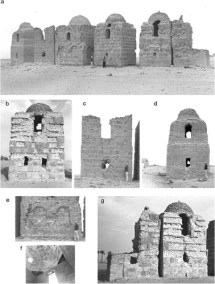
raza_a_980126_f0008_bDavid J. Mattingly, Martin J. Sterry & David N. Edwards. 2015. “The origins and development of Zuwīla, Libyan Sahara: an archaeological and historical overview of an ancient oasis town and caravan centre.” Azania: Archaeological Research in Africa 50(1), 27–75

This article is open-access and can be read by everyone for free by clicking on the above link!

Abstract: “Zuwīla in southwestern Libya (Fazzān) was one of the most important early Islamic centres in the Central Sahara, but the archaeological correlates of the written sources for it have been little explored. This paper brings together for the first time a detailed consideration of the relevant historical and archaeological data, together with new AMS radiocarbon dates from several key monuments. The origins of the settlement at Zuwīla were pre-Islamic, but the town gained greater prominence in the early centuries of Arab rule of the Maghrib, culminating with the establishment of an Ibāḍī state ruled by the dynasty of the Banū Khaṭṭāb, with Zuwīla its capital. The historical sources and the accounts of early European travellers are discussed and archaeological work at Zuwīla is described (including the new radiocarbon dates). A short gazetteer of archaeological monuments is provided as an appendix. Comparisons and contrasts are also drawn between Zuwīla and other oases of the ash-Sharqiyāt region of Fazzān. The final section of the paper presents a series of models based on the available evidence, tracing the evolution and decline of this remarkable site.”