Tag Archives: articles

Article: Libya, Social Origins of Dictatorship, and the Challenge for Democracy

A topic of renewed relevance amidst increasing partisanship, resurfacing of old loyalties, and neo-colonial interests by Western nations is treated in this contribution by Libyan historian Ali Ahmida to a special issue on North African revolutions: “Libya, Social Origins of Dictatorship, and the Challenge for Democracy.” Journal of the Middle East and Africa 3 (2012), 70–81.

The abstract is as follows:

This article analyzes the 2011 revolution in Libya by focusing on three elements: the Qaddafi regime’s failure to address the question of political reform and its subsequent alienation of important elite groups within the country; the impact of demography, urbaniza- tion, and global social media on the progress of the revolution; and the success of an enterprising revolutionary leadership within Libya that was able to obtain critical diplomatic and military sup- port from the United Nations, the Arab League, and NATO. The main thesis of this article is that the regime’s inability to make serious political reforms appropriate to changes occurring in the economy, education, and society eventually led to conflict between a dynamic social structure and a rigid political system that was unable to meet the demands and grievances of new social forces, especially unemployed youth. The gap between the Libyan youth and the ruling elite undermined the gains achieved by the regime during the 1970s and eventually led to the formation of an alie- nated revolutionary coalition. Had Muammar Qaddafi responded with openness to the calls for reform and not overreacted to the uprisings in Tunisia and Egypt, the urban elite in Libya might have been placated and the violent rebellion might have been avoided.
Two articles on Berbers and Revolution

After a brief pause, here are two articles in Italian on Berber and other minority communities in Libya and the Libyan Revolution by Anna Maria di Tolla, a specialist in Berber literature and Ibadism at the University of Naples and Anna Baldinetti, a historian of Libya at the University of Perugia. Since the articles are not easily available online, get in touch if you would like copies.

Anna Maria di Tolla. “I berberi del Gebel Nefusa tra rivoluzione e identità culturale.” in La rivoluzione ai tempi di Internet: Il futuro della democrazia nel Maghreb e nel mondo arabo. Napoli (2012), 73-91.

Anna Baldinetta. “Identità nazionale e riconoscimento delle minoranze in Libia: le richieste della società civile.” in La guerra ai confini d’Europe: Incognite e prospettive mediterranee per l’Italia. Roma (2014), 103-119.

Article: Sufism and anti-colonial Resistance in Algeria and Libya

In the coming posts, we return to sharing publications on a variety of subjects which are available online. The following is from the open-access journal Open Theology.

Fait Muedini. “Sufism and Anti-Colonial Violent Resistance Movements: The Qadiriyya and Sanussi Orders in Algeria and Libya.” Open Theology 2015; 1: 134–145.

Abstract: In this article, I examine the role of Sufism (and Sufi leaders) as they relate to anti-colonial political and military resistance movements. Sufism is often viewed as a non-violent and non-political branch of Islam. However, I argue that there are many historical examples to illustrate the presence of anti-colonialist Sufi military movements throughout the “Muslim World,” and I give particular attention to the cases of ‘Abd al-Qadir of the Qadiriyya movement and his anti-colonialist rebellion against France in Algeria in the 1800s, as well as that of Italian colonialism in Libya and the military response by the Sanussi order. Thus, while Sufism clearly has various teachings and principles that could be interpreted to promote non-violence, Sufi political movements have also developed as a response to colonialism and imperialism, and thus, one should not automatically assume a necessary separation from Sufism and notions of military resistance.

Article: Late Ottoman Notables in Libya

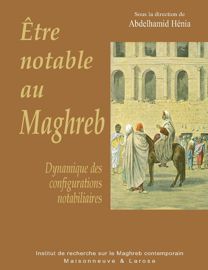
In the edited book Être notable au Maghreb: dynamiques des configurations notabiliaires published by the Institut de recherche sur le Maghreb contemporain in 2006, there are two essays on notables in Libya during the late Ottoman period and just after the Italian conquest. Fortunately, the entire volume is available for free online, over at OpenEditions.org (of course, if you can read French). Both are highly recommended, as much for their unique views into lesser-studied subjects as well as for their very useful notes and references that are otherwise difficult to come across.

Lahmar, Mouldi. “Libyens et Italiens en Tripolitaine (1911-1928): Quels territoires d’allégeance politique?” [Libyans and Italians in Tripolitania: what grounds for political allegiance? | ليبيون و اطاليون في طرابلس: ما هو اساس الولاء السياسي؟] pp.  121–138.

Lafi, Nora. “L’affaire ‘Alî al-Qarqânî (Tripoli, 1872)” [The affair of Ali al-Qarqani in Tripoli, 1872 | قضية علي القرقاني في طرابلس ١٨٧٢] pp. 204–217. (Many of Nora Lafi’s articles can be read online, at her academia.edu page).

Article: Women’s Bodies in Post-Revolution Libya: Control and Resistance

“Women’s Bodies in Post-Revolution Libya: Control and Resistance” by Sahar Mediha Elnaas and Nicola Pratt. In Rethinking Gender in Revolutions and Resistance: Lessons from the Arab World. London: Zed Books, 2015.

“Ever since the uprisings that swept the Arab world, the role of Arab women in political transformations received unprecedented media attention. The copious commentary, however, has yet to result in any serious study of the gender dynamics of political upheaval.
Rethinking Gender in Revolutions and Resistance is the first book to analyse the interplay between moments of sociopolitical transformation, emerging subjectivities and the different modes of women’s agency in forging new gender norms in the Arab world. Written by scholars and activists from the countries affected, including Paletine, Egypt, Tunisia and Libya, this is an important addition to Middle Eastern gender studies.”

Read a review and discussion of the book at Jadaliyya.

Article: An Ottoman Pasha and the End of Empire

Related to the previous post is this article:

Ghazal, Amal. 2014. An Ottoman Pasha and the End of Empire: Sulayman al-Baruni and the Networks of Islamic Reform [باشا عثماني و نهاية الامبراطورية: سليمان الباروني و شبكات الاصلاح الاسلامي]. In Global Muslims in the Age of Steam and Print, eds. J. Gelvin & N. Green. Berkeley: University of California Press. 40–58.

From the article:

“In a photograph taken in 1913, Sulayman al-Baruni (1872/73-1940), a native of the Nafusa Mountains in what is now Libya, has donned an Ottoman army uniform and a fez and poses with an Ottoman officer. His appearance and his career epitomized the cosmopolitan Muslim reformer at the beginning of the twentieth century. Educated in Tunisia, Egypt, and Algeria, elected to the Ottoman parliament in Istanbul, dispatched to Tripolitania to fight Italian invaders, and spending the end of his life in exile in Oman with intermittent visits to Baghdad, al-Baruni had a career resembling that of many of his contemporaries who zigzagged the Ottoman realm, defended its borders, and then watched as their world crumbled into fragments. But al-Baruni was distinctive among Ottoman officials. He was a member of the minority Ibadi sect who turned into a modernist reformer, a pan-Ottomanist, and, later on, a pan-Arabist.”

Studies on the Ibadis in Libya | دراسات في الاباضية في ليبيا

In North Africa, the Ibadi school (الاباضية) of Islam exists only among the Berber communities of the Nafusa Mountains in western Libya, the island of Jerba in Tunisia, and certain oases (such as Mzab) in eastern Algeria. The Ibadis of Libya are, of course, not so often discussed–to some extent even within the country itself. Although not everyone knows it, one of the most famous figures of Libyan history–Suleyman Baruni, who had a storied career as an Ottoman official and intellectual–was an Ibadi originally from the Nafusa Mountains.

Most of the western-language scholarship on the Ibadi communities of Libya was carried out by the Polish scholar Tadeusz Lewicki (تاديوش لويتسكي) some decades ago, fortunately usually in French. His publications include items that are also of interest for those working on Berber language and literature, such as medieval Berber chronicles (written in Arabic). Some important publications are the following:

Numerous further references, some with commentary in French, can be found at the website of the “Maghribadite” project based in France–click here for their bibliographic resources page. Otherwise, scholarship on various aspects of the Ibadis of North Africa is quite broad and this isn’t the place for a comprehensive bibliography. See the work of Virginie Prevost and Vermondo Brugnatelli, among others, for some good starting points.

Article: Mutual Intelligibility of Benghazi Arabic, Tunis Arabic, and Maltese

Last year, I participated in a research project led by my good friend and colleague Slavomír “bulbul” Čéplö which focused on testing how well speakers of Arabic from different places could understand each other’s dialects.

To do this, and get more than just impressionistic results, Slavomír first adapted a method that was previously used to test the mutual intelligibility (meaning how well speakers can understand each other) of Chinese varieties. The test had three parts: words, sentences, and stories. People taking the test listen to each part spoken in dialects other than their own, and attempt to answer questions about what they’ve heard. Based on their answers, we try to figure out 1) roughly how much of those other dialects they can understand, and 2) what are the specific problems that they encounter when they can’t understand something.

These three dialects were chosen for the pilot study because they are all North African, and therefore have a number of similarities. Plus, they were the easiest to field-test: I could do the testing in Benghazi, Slavomír in Malta, and Christophe Pereira in Tunis.

For those who simply want somewhat scientific, but uncomplicated, results to share with their friends, I can say this: 1) speakers of Benghazi Arabic can understand about 44% of Maltese and 73% of Tunis Arabic, 2) speakers of Tunis Arabic understand slightly more of both, about 80% of Benghazi Arabic and 45% of Maltese, and 3) speakers of Maltese understand about 38% of both Benghazi and Tunis Arabic.

If you want the real details, especially with regard to what particular factors affect how well those speaking one dialect can understand those speaking another (such as changes in sounds, the use of different words, and changes in grammar), then you should read our description of the whole thing. If you’re interested in the results, you can read a draft of our article (which has been accepted for publication in Folia Linguistica). Feel free to come back with questions!

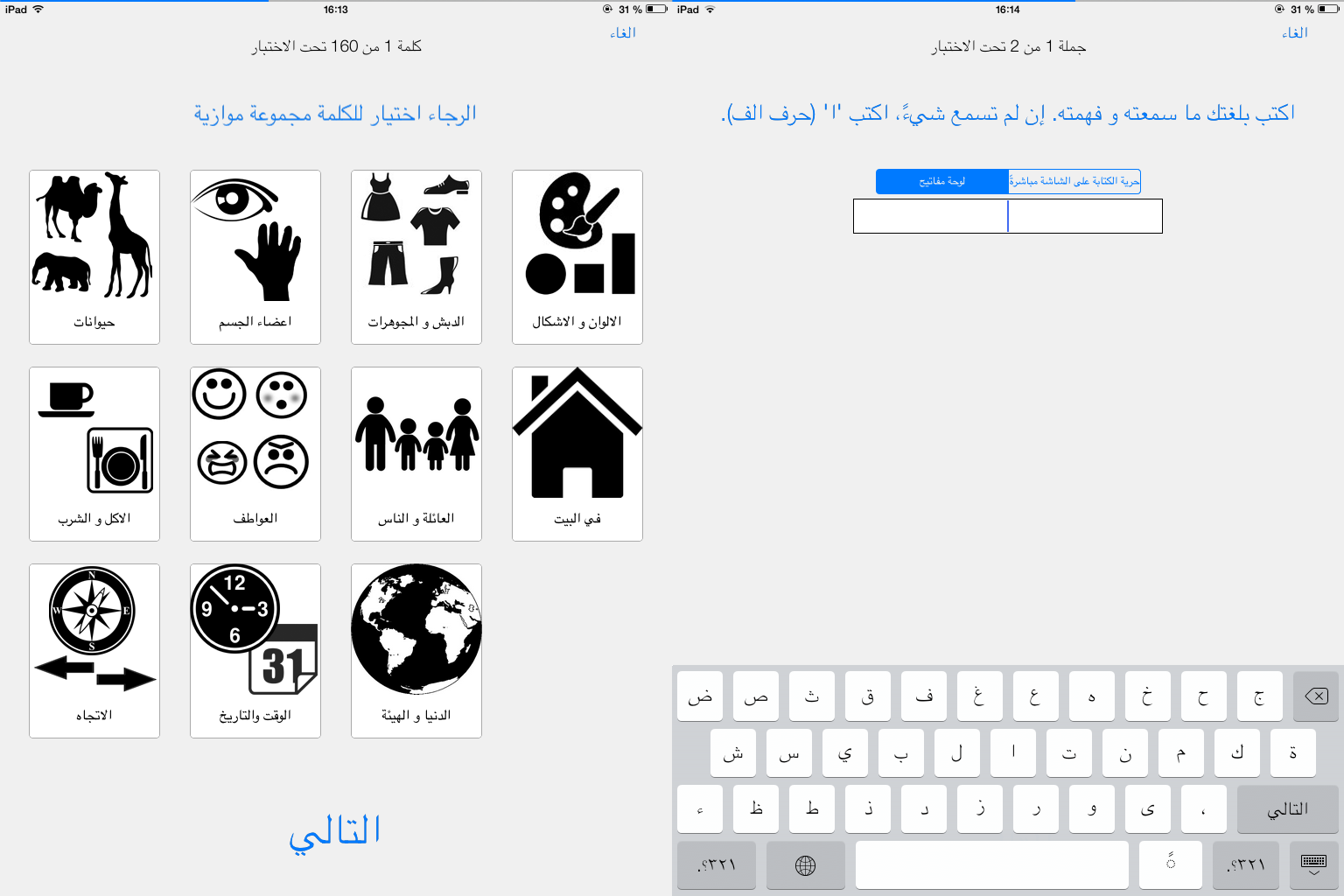
The testing procedure was actually pretty simple. Particpants simply sat down with an iPad and a pair of headphones, and spent about 30 minutes listening and and responding via the touch screen. (Of course, making the software itself was much more complicated, and accomplished by Slavomír and his colleagues over at Sonic Studio). If you’re interested in the details, you can read a description of the application used for testing.

Here you can get a glimpse of how the actual app looks. The left-hand sideshows the word test, while the right-hand side shows the sentence test.

mutual-intel-test-sample-image

*Note: more pictures coming soon!

Journal Issue: The Multiple Narratives of the Libyan Revolution

At the end of last year appeared a special issue of the journal Middle East Critique dedicated to Libya and entitled “The Multiple Narratives of the Libyan Revolution” (vol 23 issue 4 2014). It was guest-edited by Matteo Capasso and Igor Cherstich, who write in their guest editors’ Note:

“…since Qadhdhafi’s oil nationalization and the gradual rapprochement of Libya with the Soviet bloc through the purchase of weapons, western media and scholarship have used ‘Qadhdhafi’ and ‘Libya’ as synonyms, reiterating an Orientalist understanding of the Middle East. Scholars, analysts, and journalists depicted the ‘Libyan head for the Libyan whole,’ to quote anthropologist John Davis, assuming that there was no ‘Libya-ness’ beyond the macro-historical meta- narrative of ‘Qadhdhafi-ness.’ The cumbersome and ubiquitous personality of Qadhdhafi obscured Libya’s complexity, and one Libyan became the symbol for all Libyans.

This habit—‘the part for the whole’—has continued even after Mu’ammar Qadhdhafi’s fall. On the one hand, the revolution of 2011 has forced analysts to realize that beyond the Libyan regime there was a Libyan society: A complex universe comprised of tribes, cities, and agents that did not necessarily identify with Qadhdhafi’s project. On the other hand, the discovery of a ‘Libyan multiplicity’ has overwhelmed the analysts who have continued to look desperately for the narrative, the key to unveil Libyan mysteries. Some writers have proposed ‘tribalism’ as the narrative to understand the revolution, others ‘Islamism’, and others, in turn, have demonstrated a fetishist attachment to the old narrative, reading the facts of 2011 simply as the end of ‘Qadhdhafi-ness.’ This Special Issue criticizes this phenomenon by demonstrating that post-revolutionary Libya cannot be understood by focusing on one story, one reading, or one aspect. Rather, it is necessary to consider a multiplicity of narratives, which collectively can be called upon to confront the problematic essentialist and Orientalist representations of the country. We deem this issue as an homage to Libya’s sophisticated intricacy, an attempt to demonstrate that we need to look for the multiple ‘parts’—rather than for ‘the part’—in order to understand the whole.”

The articles featured in this special issue are the following (accessible online with a subscription via the link above):

  • Capasso, Matteo. The Libyan Drawers: ‘Stateless Society,’ ‘Humanitarian Intervention,’ ‘Logic of Exception’ and ‘Traversing the Phantasy’. 387–404.
  • Cherstich, Igor. When Tribesmen do not act Tribal: Libyan Tribalism as Ideology (not as Schizophrenia). 405–421.
  • Kohl, Ines. Libya’s ‘Major Minorities’. Berber, Tuareg and Tebu: Multiple Narratives of Citizenship, Language and Border Control. 423–438.
  • Diana, Elvira. ‘Literary Springs’ in Libyan Literature: Contributions of Writers to the Country’s Emancipation. 439–451.

The articles are unfortunately behind a paywall (unless you have access via a university), but I’m sure the authors would be willing to share PDFs on an individual basis—so drop me a line if you’re interested.