Category Archives: Resources

Documentary: The Last Jews of Libya

For this blog’s first post about Libyan Jews, it is most fitting to start off with Vivienne Roumani’s 2007 documentary entitled The Last Jews of Libya. The synopsis:

lastjewsoflibya“The Last Jews of Libya documents the final decades of a centuries-old Sephardic Jewish community through the lives of the remarkable Roumani family. Thirty-six thousand Jews lived in Libya at the end of World War II, but not a single one remains today. A tale of war, cultural dislocation, and one family’s ultimate perseverance, this fifty-minute film traces the story of the Roumanis of Benghazi, Libya from Turkish Ottoman rule through the age of Mussolini and Hitler to the final destruction and dispersal of Libya’s Jews in the face of Arab nationalism.

Based on the recently discovered memoirs of the family’s matriarch, Elise Roumani, as well as interviews in English, Hebrew, Italian, and Arabic with several generations of the Roumani family and a trove of rare archival film and photographs, it is an unforgettable tale.”

You can watch the film’s trailer below:

As well as an interview with the filmmakers:

Libyan crafts in the 1960s (short film)

Here is a short documentary film depicting crafts and production in Libya during the 1960s. It belongs to the Huntley Film Archives, one of the largest independent film libraries in the UK. I have not yet been able to locate any information on who made the film, or for what purpose.

هنا فيلم وثائقي قصير يظهر فيه الصناعات اليدوية في ليبيا خلال الستينات من القرن الماضي. الفيلم جزء من ارشيف هنتلي، احد مكتبات الافلام الكبيرة في المملكة المتحدة. لكنني لم استطيع ان اجد معلومات عما سبب انتاج الفيلم او من خرجه.

Book: The Origins of the Libyan Nation | اصول الدولة الليبية

Anna Baldinetti, The Origins of the Libyan Nation: Colonial Legacy, Exile and the Emergence of a New Nation-State (Routledge, 2010).

From the book’s abstract:

“Libya is a typical example of a colonial or external creation. This book addresses the emergence and construction of nation and nationalism, particularly among Libyan exiles in the Mediterranean region. It charts the rise of nationalism from the colonial era and shows how it developed through an external Libyan diaspora and the influence of Arab nationalism.

From 1911, following the Italian occupation, the first nucleus of Libyan nationalism formed through the activities of Libyan exiles. Through experiences undergone during periods of exile, new structures of loyalty and solidarity were formed. The new and emerging social groups were largely responsible for creating the associations that ultimately led to the formation of political parties at the eve of independence.

Exploring the influence of colonial rule and external factors on the creation of the state and national identity, this critical study not only provides a clear outline of how Libya was shaped through its borders and boundaries but also underlines the strong influence that Eastern Arab nationalism had on Libyan nationalism. An important contribution to history of Libya and nationalism, this work will be of interest to all scholars of African and Middle Eastern history.”

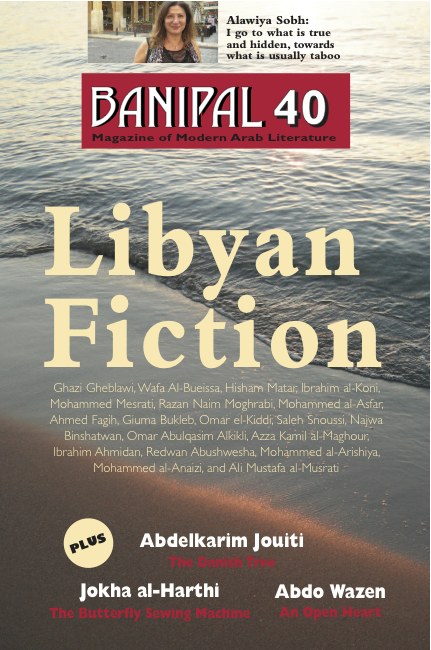
Libyan Fiction – Banipal Magazine

Banipal, the UK-based magazine of modern Arabic literature in English translation, published an issue dedicated to Libyan Fiction back in 2011. The print edition is reasonably priced and well worth having, but issue 40 also happens to be available online at Banipal’s website! You can read every piece of Libyan fiction in the issue for free. Together with the recent second edition of Ethan Chorin’s Translating Libya (see here), it represents the best and most recent collection of Libyan literature in English translation, and both are absolutely essential introductions to many of today’s important writers.

From the editor’s description of the issue:

“What an amazing coincidence that [Banipal’s 40th issue] should be dedicated to the celebration of Libyan literature at such an extraordinary historical moment in the Arab world when the region is witnessing a chain of uprisings and revolutions against dictatorial and corrupt regimes in Tunisia, Egypt, Bahrain, Yemen and, finally, Libya.

We at Banipal are very proud of this special issue on Libyan fiction, and with it announce our absolute solidarity with the Libyan people in their aspiration to democratic rule and the exercising of all their rights, the first of which are to express their thoughts and the abolition of all forms of censorship on audio-visual media and literature.

When I met by chance the veteran Libyan writer Ali Mustafa al-Musrati, one evening at the Greek Club in Cairo, February 2007 (at this time exactly), I said to him: “I’m extremely saddened by the neglect of Libyan literature in the Arab world and by the ignorance of the West.” I promised him that Banipal would publish a special feature on the wonderful literature of Libya. And how happy we are to fulfil this promise at this time in particular…”

The Libyan authors whose work appears are (in no particular order): Ghazi Gheblawi, Wafa al-Bueissa, Hisham Matar, Ibrahim al-Koni, Mohammed Mesrati, Razan Naim Moghrabi, Mohammed al-Asfar, Ahmed Fagih, Giuma Bukleb, Omar el-Kiddi, Saleh Snoussi, Najwa Binshatwan, Omar Abulqasim Alkikli, Azza Kamil al-Maghour, Ibrahim Ahmidan, Redwan Abushwesha, Mohammed al-Arishiya, Mohammed al-Anaizi. There is also profile on Ali Mustafa al-Musrati.

Journal: Bulletin of the Faculty of Arts, University of Benghazi

majalla-coverThe Bulletin of the Faculty of Arts, Benghazi (مجلة كلية الاداب، بنغازي) was an academic journal in English and Arabic published at irregular intervals by the University of Benghazi* from 1958 to 2002. It contained articles by noted Libyan as well as European academics, on all manner of subjects.

Since the Bulletin is not held by most libraries in Europe or the US (the SOAS library does have an almost complete set) nor indexed by research databases, I decided to scan and upload the table of contents of issues 1–16 to this blog. I haven’t been able to access issues later than 16 although colleagues in Benghazi tell me that the most recent issue was #23  in 2002. Apparently the Bulletin still exists in name and plans are underway to continue it, but it goes without saying that things are on hold until conditions improve.

1 (1958)2 (1968)3 (1969)4 (1972)5 (1973)6 (1974)7 (1975)8 (1976)9 (1980)10 (1981)  – 11 (1982)12 (1983)13 (1984)14 (1985)15 (1986)16 (1987) — 17 — 18 —19 — 20 —21 —22 —23 (2002)


* Originally the Libyan University (الجامعة الليبية), then from 1973 the University of Gar Younis (جامعة قار يونس), and from 2011 the University of Benghazi (جامعة بنغازي).

Book: A report on the 1874 plague in Benghazi

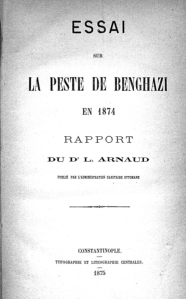
pesteI recently came across a small, old pamphlet entitled, in French, “Essai sur la peste de Benghazi en 1874” (Essay on the 1874 plague of Benghazi) written by a certain Dr. Léonard Arnaud (a “médécin sanitaire au service Ottomane”) and published by the Ottoman Health Administration in Constantinople in 1875.

The report deals with an interesting and practically unknown episode of eastern Libyan history: an outbreak of the plague in ‘Benghazi’—then used to indicate the eastern part of modern-day Libya in general—which followed an earlier outbreak in the same region in 1858. This particular outbreak occurred in the encampments of several groups of nomadic Bedouin in the plateaus between Benghazi and al-Merj. Of concern to the Ottoman officials, no doubt, was that Dr. Arnaud identified the disease as the same as the plague which had been occurring in the Levant (according to a report made in London, the Ottoman health service was apparently dealing with a number of plague outbreaks in their Middle Eastern provinces). A quick search for the author reveals that he seems to have been a specialist in dealing with the plague and other epidemics in various territories of the Ottoman empire.

Are there any other sources for this episode of history, Ottoman, Arabic, or European?

Two papers on Property and Law in Libya

Two recent articles, to my knowledge, attempt a discussion of property law in Libya and what recent changes in the political structure of the country may mean.

Jessica Carlisle. “‘We woke up and everything had gone to Qadhafi.’ Corruption, Rent-Seeking, and Struggle for Elite Status During Libyan Property Disputes.” Middle East Law and Governance 6 (2014), 93-122.

Abstract: “Since the 2011 revolution claimants in Libya have been lobbying to demand reinstatement of property confiscated from their families by Qadhafi under Law 4/1978. During this campaign they have forcefully argued that they have been impoverished and side-lined as victims of corruption. In particular, they highlight how their property enriched and empowered the Qadhafi regime’s corrupt elites as it was redistributed as a form of state controlled ‘rent’. However, in making this argument they have tried to limit retrospective evaluations of property rights to the Qadhafi period, preventing investigation of their own families’ accumulation of property under the Italian occupation or the monarchy. Property claimants’ preferred solution is for the democratically elected government to enforce property restitution and to allocate state funds for compensa-tion and for housing construction. The prospects for this are not good. In post- revolutionary Libya powerful militia have made land and property grabs, and other post-revolutionary elites are accused of engaging in corruption, in a continuing threat to property claimants’ future political and economic status.”

Mary Fitzgerald & Tarek Megerisi. Libya: Whose Land is it? Property Rights and Transition. Legatum Institute: Transitions Forum (2015).

Summary: “In 1978, Muammar Qaddafi decreed that no Libyan could own more than one house. All rental properties were subsequently reallocated to tenants or confiscated by the state. In 1986, he abolished land ownership altogether. These and other sweeping redistribution policies had farreaching consequences, creating the profound grievances, administrative chaos and economic imbalances that have hampered the reconstruction of Libya since 2011.

Without an understanding of the history of Libyan property rights, both before and after the revolution, it is impossible either to understand how Libyan politics came to deteriorate so quickly, or to design a realistic path out of the current crisis. Disputes over property helped spark the post-revolutionary fighting, and they continue to fuel conflict today.

The resolution of property rights issues also has a deeper significance. Before peace and prosperity can have any chance of succeeding in Libya, the country’s citizens will have to resolve longstanding historical grievances in a manner which all perceive to be just. The conversations that will be required to fix the chaos over land and housing are the same kinds of conversations that will be required to create a stable political and economic system.”

Article: Italian rural centres in colonial Libya (1934-1940)

The Built Utopia: The Italian rural centres in colonial Libya (1934-1940) | L’utopia costruita: I centri rurali di fondazione in Libia (1934-1940), ed. Vittoria Capresi, Bologna (2009).

The Built Utopia is a bilingual English-Italian ‘guide’-book to Italian colonial architecture in Libya. As the author notes in the chapter ‘A guide to travel, a search to deepen’, “this volume provides a comprehensive description and introduction to the architecture of the newly founded rural centres in Libya, created by Italian architects during the Fascist colonial occupation. The period analysed, from 1934 to 1940, includes the starting point for the construction of the rural centres, 1933-1934, which saw the establishment of the first centres for the political, religious and administrative management of the territory. The project for the last centre was designed in 1940, but it was never constructed due to the outbreak of the Second World War. Particular attention is given to two key dates, 1938 and 1939, which marked the stages of mass colonization with the transfer of rural Italian families to the coast of Libya.”

The book is available online in PDF form at the above link. A review of the volume can be found in Libyan Studies 42 (2011), p. 160.

Two articles on Berbers and Revolution

After a brief pause, here are two articles in Italian on Berber and other minority communities in Libya and the Libyan Revolution by Anna Maria di Tolla, a specialist in Berber literature and Ibadism at the University of Naples and Anna Baldinetti, a historian of Libya at the University of Perugia. Since the articles are not easily available online, get in touch if you would like copies.

Anna Maria di Tolla. “I berberi del Gebel Nefusa tra rivoluzione e identità culturale.” in La rivoluzione ai tempi di Internet: Il futuro della democrazia nel Maghreb e nel mondo arabo. Napoli (2012), 73-91.

Anna Baldinetta. “Identità nazionale e riconoscimento delle minoranze in Libia: le richieste della società civile.” in La guerra ai confini d’Europe: Incognite e prospettive mediterranee per l’Italia. Roma (2014), 103-119.

Documentary: Libya’s Forgotten King

Al-Jazeera English is releasing a multiple-part documentary about the political life and times of King Idris called ‘Libya’s Forgotten King‘. The episodes are available online and can be watched at AJE’s website or on Youtube (below).

In the first part of the documentary we hear from a number of local voices including historians based at the University of Benghazi, and political leaders and activists from the time of kingdom until today, such as former Prime Minister Mustafa bin Halim and Saleh al-Naeli. Historian Anna Baldinetti (who has written a book about the formation of Libya after the colonial period) was also interviewed for the documentary. Although the narration is a bit weak, including mispronunciation of names and places that could have been avoided, the documentary material gathered and interviews with Libyan historians more than make up for it. However, one has to ask, why King Idris is characterized as “forgotten”. I seriously doubt that any Libyan has forgotten him, and all scholars of Libya certainly haven’t either; so, is it only for the average Westerner that associates Libya only with what came after 1969 that Idris is “forgotten”?

Episode I

Episode II