Tag Archives: journals

Articles: Afro-Asian Reactions to the Italo-Ottoman War, 1911-1912

A dossier entitled “Responding to Invasion: Afro-Asian Reactions to the Italo- Ottoman War, 1911-1912” edited by Carlotta Marchi and Massimo Zaccaria has appeared in the journal Africa. Rivista semestrale di Studi e Ricerche (VI/2, 2024). The dossier’s abstract states:

This dossier provides a comprehensive examination of the social, cultural, and material consequences of the Italo-Ottoman War (1911–1912) within a global historiographical perspective. It explores how the Italian invasion of Tripolitania and Cyrenaica sparked widespread solidarity across non-European regions. While the historiography of the conflict has hitherto focused on its European ramifications, this dossier investigates the unexplored reactions from non-European societies, particularly in those regions connected to the Ottoman Empire, such as North Africa, the Horn of Africa, the Arabian Peninsula, and the Indian Ocean. The articles examine global opinion and transnational networks of anti-imperialist and pan-Islamist activists, as well as alternative perspectives supporting Italy. By conducting such an analysis, the articles unveil intricate dynamics that supersede the conventional colonial dichotomy, emphasising collaborative endeavours and mediation initiatives.

Articles

Vanda Wilcox, “Towards a Global History of the Italo-Ottoman War”

Though often overshadowed by the events of the First World War, the Italo- Ottoman War deserves closer attention. Its study might be revitalized by drawing on recent historiographical trends within First World War studies, which emphasize both global perspective and a re- evaluation of chronological boundaries. Future studies might also draw on diverse methodological approaches, including military, social, political, and cultural histories, to deepen our understanding of the war’s multifaceted dimensions. The fields of African and colonial history can suggest further possible future avenues of approach, as can the Second Italo- Ethiopian War. The article calls for a nuanced re-evaluation of the Italo-Ottoman War that transcends Eurocentric perspectives and acknowledges its significance as a pivotal moment in global history, and concludes with a short evaluation of the war’s impact in British India.

Carlotta Marchi, “‘Arab Voices’: Press, Public Opinion and the Intellectual Response in Egypt on the Italo-Ottoman War”

During the Italo-Ottoman conflict of 1911-1912, Egypt played an important moral and material role. It was the scene of a series of manifestations and reactions of solidarity that took place in the press, in public opinion, and in literary and intellectual production. This response reflected the circulation of shared sentiments and ideals, of which Egypt became one of the centres of reference, based on a tangible trans-colonial perspective. In this sense, this paper aims to analyse the construction of awareness of the Italo-Ottoman war in Egypt, focusing on the role of “Arab voices” in promting a common sense of Ottoman, Arab and Islamic identity and solidarity, and a shared critique of Western “civilisation”. The study of newspapers, poems, discourses, reactions, and their impact and circulation favour a broader analysis of the expansion of anti-colonial solidarity, both geographically and temporally.

Massimo Zaccaria, “Courting African Public Opinion: Echoes of the Italo-Ottoman War along the Red Sea and the Indian Ocean”

The Italo-Ottoman war played an important role in mobilising public opinion. In the Americas as well as in Asia, the war aroused a great deal of participation, generated polemics and protests and, to a much lesser extent, gathered support. The study of the reactions to the Italian aggression in Africa has mainly concerned the northern part of the continent. Sub-Saharan Africa remains the great absentee, implicitly conveying the message that this region’s involvement in the conflict was minimal. Indeed, the area was not short of reactions, but one has to use the right sources and look beyond the newspapers. This is the only way to understand the profound impact that the war between Italy and the Ottoman Empire had on the Horn of Africa. Reactions were not clear-cut: the article explains why Pan-Islamism was not the only option available and why in some areas the Ottoman appeal was deliberately ignored.

Çiğdem Oğuz, “Beyond the Nationalist Propaganda: Rethinking Ottoman Literary Production on the Italo-Ottoman War of 1911”

As the last African territory of the Ottoman Empire, Tripolitania was of great importance to the Ottoman government in maintaining its prestige in the Muslim-Arab world. This paper examines the short stories mostly published in the new genre of “national literature” at the time of the Italo-Ottoman War of 1911. The stories provide insights into Ottoman-Turkish perspectives on Turkish-Arab solidarity, especially around the figure of the Caliph, as an Ottomanist strategy. While most of the stories aimed to illustrate the economic and social struggles of the empire and to evoke a sense of voluntarism to save the crumbling empire, they also served the practical purpose of responding to Italian claims of a “civilizing mission” that reduced the Ottoman Empire to colonial status, despite its recent attempt at political reform in 1908 with the Young Turk Revolution.

Silvia Pin, “The Reaction to the Italo-Ottoman War in the Hebrew Press of Jerusalem: A Reading of the Newspapers Ha-’Or and Ha-Ḥerut, October-November 1911″

The Italo-Ottoman war of 1911-1912 sparked bitter reactions in the contemporary press across the Ottoman Empire, as well as indignation and mobilisation against Italy. Amongst the Ottoman press, the Hebrew language newspapers of Jerusalem broadly covered the war, providing local Jewish perspectives on this much-debated event. This article aims to analyse the initial press coverage of the Italo-Ottoman war in two Zionist Hebrew-language newspapers of Jerusalem, the Ashkenazi Ha-’Or and the Sephardi Ha-Ḥerut. In the first months of war, the two Hebrew journals strongly though with some contradictions condemned the Italian invasion of Tripolitania, professed – and promoted – Jewish loyalty to the Empire and in so doing defended the harmless ends of Zionism. They denied that Jews in Tripoli supported the Italians and, in covering pro-Ottoman demonstrations in and out of Palestine, notably in Egypt, Ha-Ḥerut also took note of a burgeoning pan-Islamic sentiment triggered as a reaction to the Italian assault.
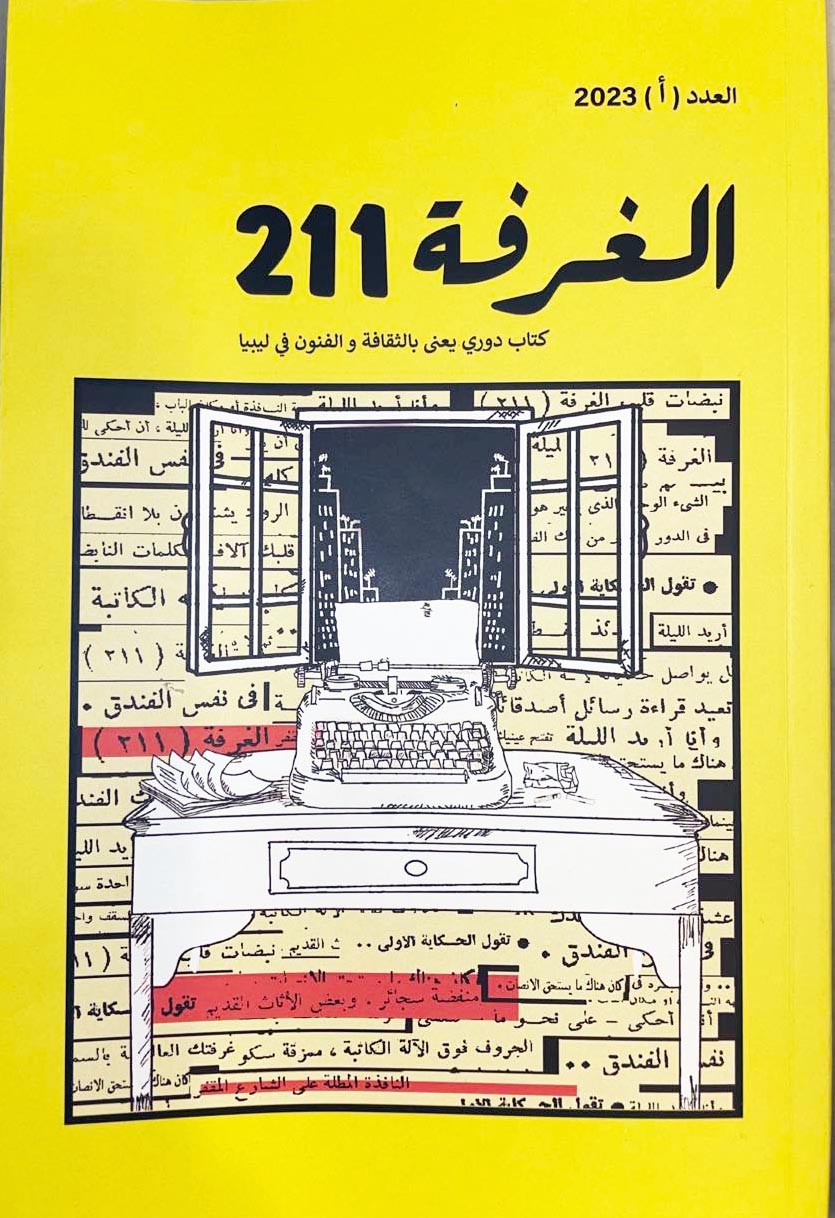
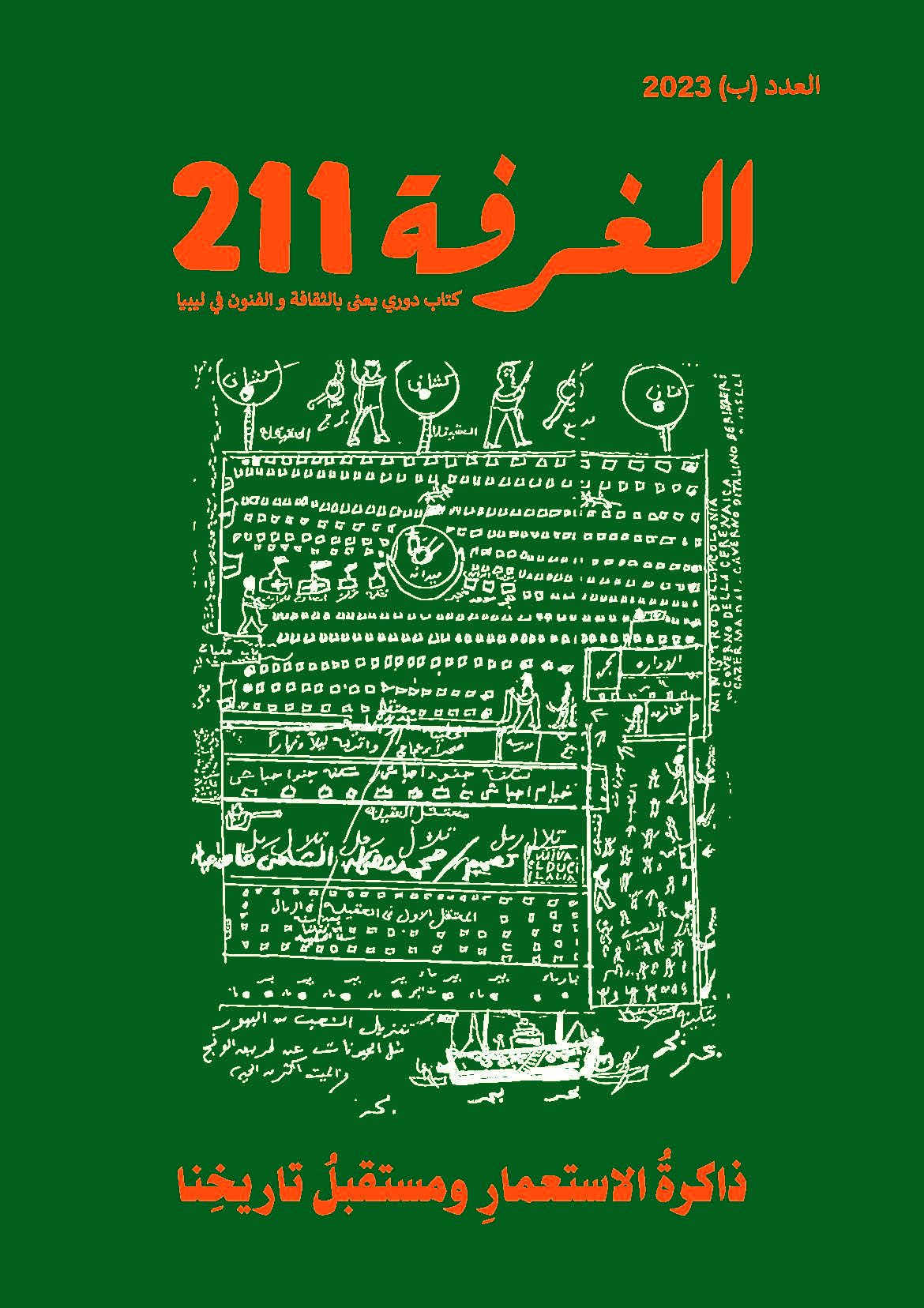
Ghurfa 211 / الغرفة 211

Ghurfa 211 is a new Arabic-language periodical focusing on arts and culture published by the Arete Foundation for Arts and Culture in Libya.

Its name comes from the work “Season of Stories” by Khalifa al-Fakhri, in which “he writes that Room 211 is a refuge during the night-time winter rains. When the cafes shake off their patrons and the sitting-rooms their guests, “the only thing you have is to return to Room 211″ where there is loneliness and the gathering words pulsating in the chest until a charge that sifts the feelings fills the body and from it writing begins.”

The first two issues appeared in 2023, containing poetry, short fiction, commentary, essays, and letters by Libyan writers (some translated from English and other languages into Arabic).

See also their facebook site.

Evaluating “understudied”

So often many of us use the word “understudied” to describe Libya as a topic in different fields of research. I myself have done so on this blog (probably quite often) and I hear colleagues do the same. In this post, I want to make one kind of attempt to quantify this. Not to complain (more than I already do), or propose any particular solution, and certainly not to validate the idea that quantity of research on a topic somehow indicates better, more useful research. Rather, just as an informal exercise, get some more precision about what “understudied” might really mean, as a complement to the (rather vague) impression many of us have. To do this, I’ve decided to look at general venues of research in which a Libyan-related topic might be reasonably expected to appear, and make a rough calculation about what percent of work in those venues relates to Libya. I focus on early-modern to contemporary Libya here (ancient Libya already has good coverage through several dedicated journals).

Continue reading

Lamma: A Journal of Libyan Studies 2

The second issue of Lamma has been published! It is accessible in open-access via punctum books (where one can purchase a physical copy of the issue) or eScholarship (for individual articles).

The description of the issue reads:

We are thrilled to present the second issue of Lamma to our readers and colleagues. Our hope, as with our inaugural issue, is that the contributions here open up space for interrelated discussions on a variety of topics, almost all largely neglected in the contemporary scholarly study of Libya. The focal point of this issue is the reflective contributions by members of a roundtable discussion ‘Methods and Sources for a New Generation of Libyan Studies’ which was organized by Leila Tayeb at the MESA conference in 2020. We also mark the publication of Ali Ahmida’s watershed book on genocide in colonial Libya with a trio of responses. As ever, we believe in the generative power in dialoguing with and between works of art, literature, and scholarship as we seek to shape and re-shape new discussions on, about, from, and in Libya.

يسعدنا تقديم العدد الثاني من مجلة لمّة إلى قرّائنا وزملائنا الأعزاء. أملنا منذ العدد الأول هو أن تفتح مساهمات المؤلفين باب النقاش حول مواضيع مختلفة أُهمِل أغلبها في النقد الليبي المعاصر. يتمحور هذا العدد حول المساهمات التأمّلية للأعضاء المشاركين في ندوة “مناهج ومصادر لجيل جديد من الدراسات الليبية” والتي نظّمتها ليلى الطيب في مؤتمر MESA في عام 2020. في هذا العدد كذلك ثلاث ردودٍ نقدية تتناول صدور كتاب علي احميدة البارز عن المجازر في ليبيا في مرحلة الاستعمار. وإذ نسعى إلى تشكيل – بل وإعادة تشكيل – حوارات جديدة عن ليبيا ومنها وحولها وفيها، فإننا ما زلنا نؤمن بالقدرة التوليدية للحوار مع أعمال الفن والأدب والنقد وبينها.

Online archive of al-Inqadh

A number of old issues of the well-known Libyan opposition magazine Al-Inqadh (الانقاذ) are now available online. The main publication of the National Front for the Salvation of Libya (الجبهة الوطنية لانقاذ ليبيا), one of the main opposition groups to the regime of Muammar Qaddafi especially in the 1980s and early 90s, Al-Inqadh circulated widely among the Libyan diaspora in the US, UK, and Europe. It is now archived on the website of the National Front Party, which seems to view itself as the successor to the NFSL.

Collage of six different covers of the opposition magazine Al-Inqadh

The back issues are well worth browsing—they are a monument to the opposition movements of the 1980s and contain some very interesting political art and poetry.

Research Roundup Spring 2019

Seasonal (that is, according to my whim and free time) roundup of research on Libya, some published recently, and some older works I’ve only recently come upon.

This series of articles focuses on Libya to investigate how individual and collective identities are imagined, experienced, and narrated in a mobile and interconnected world. Drawing from original and unexplored sources in seven different languages, our case studies illuminate subjects and circuits long neglected from historiography, and yet crucial for the understanding of the transnational and transcultural memory of Libya. Our critical engagement with ways in which histories of Libya have been materialised, colonised, regimented and forgotten reflects a wider shift across the academic discipline of History.

The contents include the following articles:

***

Oh hey, the latest issue of Quaderni di archeologia della Libya (#21) is out. It is one of the three academic journals which cover archaeological-related topics in Libya. It hadn’t appeared since 2009, due no doubt to the complications of carrying out work in Libya during the regime and afterwards. But at the totally insane price of €276 for a hard copy or €184 for an ebook, and without online subscription options, it’s basically unobtainable and inaccessible. Too bad. At least the table of contents of the latest issue can be viewed here.

***

Two articles about Libyan politics and policy after 2011 have been published in The Journal of North African Studies:

This article compares the actors, institutions and strategies of the first Tunisian Provisional Administration (TPA), which was in place from the departure of authoritarian President Ben Ali until the elections for a National Constituent Assembly, with those of the Libyan National Transition Council (NTC), in place from the start of authoritarian collapse to the first post-uprising elections. The two first provisional administrations exhibited important differences. Key actors in the TPA were ‘soft-liners’ from the old regime and a network of civil society actors, while in the NTC armed groups soon became the most important actors. Functioning state institutions also permitted the TPA to carry out its work more effectively. Finally, the two provisional administrations deployed very different strategies, with the TPA operating on a basis of dialogue and consensus while the NTC often struggled to reach collective decisions. The paper argues that, while many of the differences between the two first provisional administrations can be traced back to different historical and structural influences and these channeled actors’ decisions, the first provisional administrations nonetheless had opportunities to shape later phases of change.

This case study of Libya’s foreign policy after the regime change in 2011 represents a major analytical challenge, since the country’s massive internal dysfunctions – extreme weakness of the state, the emergence of new elites, proliferation of private actors, power competition and widespread violence – have prevented the normalisation of its political and economic life and, consequently, the normalisation of its foreign policy. However, this does not mean that there is no Libyan ‘foreign policy’, or perhaps a number of intertwined foreign policies, as different Libyan political actors have been proactive in establishing contacts and maintaining alliances – often antagonistic – with external powers. Libya’s recent evolution provides some indication of what its foreign policy might look like in the future, once the situation in the country has normalised. On the one hand, it is possible to determine the external determinants on both the regional and global level, which have and will have the most influence on Libyan foreign policy. On the other hand, with all the caution required to interpret the current unstable and fluid situation, an analysis of the political process and the behaviour of the actors in Libya highlights some key issues that constitute the universe of Libyan interests abroad and, consequently, the top priorities of its foreign policy, which will inevitably focus on hydrocarbons and security in any future scenario. Finally, the article addresses whether discontinuity in domestic politics resulting from regime change might lead to a structural modification of Libya’s external behaviour.

***

This article analyses the practices of deportation and transportation of colonial subjects from Libya, Italy’s former possession, to the metropole throughout the entire colonial period (1911–1943). For the most part, the other colonial powers did not transport colonial subjects to Europe. Analysing the history of the punitive relocations of Libyans, this article addresses the ways in which the Italian case may be considered peculiar. It highlights the overlapping of the penal system and military practices and emphasizes the difficult dialogue between “centre” and “periphery” concerning security issues inside the colony. Finally, it focuses on the experience of the Libyans in Italy and shows how the presence there of colonial subjects in some respects overturned the “colonial situation”, undermining the relationship of power between Italians and North Africans.

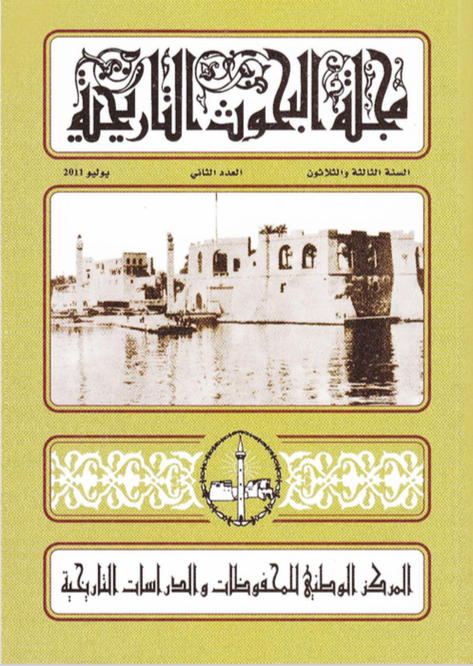
مجلة البحوث التاريخية | Journal of Historical Research

1Libya’s foremost research journal for history, in its broadest conception, is the مجلة البحوث التاريخية (Journal of Historical Research), published by the Libyan Center for Historical Studies.* Since 1979, the journal has consistently published articles by Libyan scholars, as well as several well-known European scholars writing in Arabic, on a very broad array of topics. In many cases, in fact, there is little or no research published outside of Libya on these topics, and the journal therefore offers extremely valuable insight into the range of possibilities for research as well as useful starting points for those who can read Arabic. Unfortunately, it is difficult to come by in European or American libraries (in London, the SOAS library has many of the issues)—a goal for the appropriate authority in Libya would be to make back issues available online. The website of the Center shows issues from 2013 as being the most recent. Although it seems not to have been updated for some time now, later issues are not known to me. I hope the journal is still alive.

*The Center was previously called مركز جهاد الليبيين ضد الغزو الايطالي للدراسات التاريخية (The Libyan Resistance against the Italian Invader Center for Historical Studies), later shortened to مركز جهاد الليبين للدراسات التاريخية (The Libyan Resistance Center for Historical Studies).

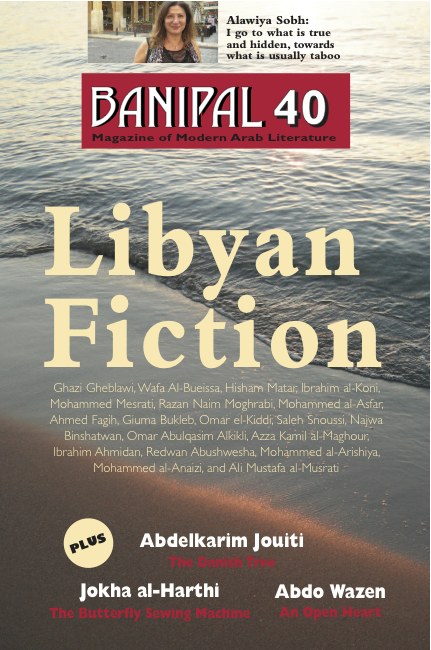
Libyan Fiction – Banipal Magazine

Banipal, the UK-based magazine of modern Arabic literature in English translation, published an issue dedicated to Libyan Fiction back in 2011. The print edition is reasonably priced and well worth having, but issue 40 also happens to be available online at Banipal’s website! You can read every piece of Libyan fiction in the issue for free. Together with the recent second edition of Ethan Chorin’s Translating Libya (see here), it represents the best and most recent collection of Libyan literature in English translation, and both are absolutely essential introductions to many of today’s important writers.

From the editor’s description of the issue:

“What an amazing coincidence that [Banipal’s 40th issue] should be dedicated to the celebration of Libyan literature at such an extraordinary historical moment in the Arab world when the region is witnessing a chain of uprisings and revolutions against dictatorial and corrupt regimes in Tunisia, Egypt, Bahrain, Yemen and, finally, Libya.

We at Banipal are very proud of this special issue on Libyan fiction, and with it announce our absolute solidarity with the Libyan people in their aspiration to democratic rule and the exercising of all their rights, the first of which are to express their thoughts and the abolition of all forms of censorship on audio-visual media and literature.

When I met by chance the veteran Libyan writer Ali Mustafa al-Musrati, one evening at the Greek Club in Cairo, February 2007 (at this time exactly), I said to him: “I’m extremely saddened by the neglect of Libyan literature in the Arab world and by the ignorance of the West.” I promised him that Banipal would publish a special feature on the wonderful literature of Libya. And how happy we are to fulfil this promise at this time in particular…”

The Libyan authors whose work appears are (in no particular order): Ghazi Gheblawi, Wafa al-Bueissa, Hisham Matar, Ibrahim al-Koni, Mohammed Mesrati, Razan Naim Moghrabi, Mohammed al-Asfar, Ahmed Fagih, Giuma Bukleb, Omar el-Kiddi, Saleh Snoussi, Najwa Binshatwan, Omar Abulqasim Alkikli, Azza Kamil al-Maghour, Ibrahim Ahmidan, Redwan Abushwesha, Mohammed al-Arishiya, Mohammed al-Anaizi. There is also profile on Ali Mustafa al-Musrati.

Journal: Bulletin of the Faculty of Arts, University of Benghazi

majalla-coverThe Bulletin of the Faculty of Arts, Benghazi (مجلة كلية الاداب، بنغازي) was an academic journal in English and Arabic published at irregular intervals by the University of Benghazi* from 1958 to 2002. It contained articles by noted Libyan as well as European academics, on all manner of subjects.

Since the Bulletin is not held by most libraries in Europe or the US (the SOAS library does have an almost complete set) nor indexed by research databases, I decided to scan and upload the table of contents of issues 1–16 to this blog. I haven’t been able to access issues later than 16 although colleagues in Benghazi tell me that the most recent issue was #23  in 2002. Apparently the Bulletin still exists in name and plans are underway to continue it, but it goes without saying that things are on hold until conditions improve.

1 (1958)2 (1968)3 (1969)4 (1972)5 (1973)6 (1974)7 (1975)8 (1976)9 (1980)10 (1981)  – 11 (1982)12 (1983)13 (1984)14 (1985)15 (1986)16 (1987) — 17 — 18 —19 — 20 —21 —22 —23 (2002)


* Originally the Libyan University (الجامعة الليبية), then from 1973 the University of Gar Younis (جامعة قار يونس), and from 2011 the University of Benghazi (جامعة بنغازي).

Sketch Magazine | مجلة سكتش

A new electronic magazine has just been launched out of Benghazi, and two issues are already online. Sketch Magazine is a digital periodical focusing on architecture and design (in Arabic). Furthermore, it is produced by two young women, Aisha Abdelhaqq and Fatoum al-Fallah.

sketch1

sketch2

The first issue includes pieces, with plenty of photographs, about Benghazi’s architectural heritage, including buildings such as the baladiyya (town hall) and the cathedral, as well as a presentation of projects by university architecture students and a selection of creative works. The second issue has a feature on the traditional mud architecture of the Awjila oasis in eastern Libya. Both are worth your reading time!