Here is my occasional roundup of published research on Libya in the humanities and social sciences which I find interesting or useful. I’ll also slowly be gathering some of the older individual posts on this blog into collective roundup posts.
This original research on the forgotten Libyan genocide specifically recovers the hidden history of the fascist Italian concentration camps (1929–1934) through the oral testimonies of Libyan survivors. This book links the Libyan genocide through cross-cultural and comparative readings to the colonial roots of the Holocaust and genocide studies. Between 1929 and 1934, thousands of Libyans lost their lives, directly murdered and victim to Italian deportations and internments. They were forcibly removed from their homes, marched across vast tracks of deserts and mountains, and confined behind barbed wire in 16 concentration camps. It is a story that Libyans have recorded in their Arabic oral history and narratives while remaining hidden and unexplored in a systematic fashion, and never in the manner that has allowed us to comprehend and begin to understand the extent of their existence. Based on the survivors’ testimonies, which took over ten years of fieldwork and research to document, this new and original history of the genocide is a key resource for readers interested in genocide and Holocaust studies, colonial and postcolonial studies, and African and Middle Eastern studies.
In 1906, Harry Lyman Koopman wrote a lengthy speculative poem about the transfer of the Senussi library from Jaghbub to Kufra some ten years earlier, part of the removal of the entire Senussi headquarters. A librarian at Brown University, Koopman (1860-1937) seemed captivated by the Senussi center of learning deep in the Sahara: the library was supposed to be so vast that, he relates, it required hundreds of camels to transport. Reflecting on this feat as a librarian himself, Koopman’s poem takes the perspective of the hypothetical Senussi librarian at Kufra. This fictitious narrator expounds on the history of Islam, the trajectories of Islamic learning, and finally the removal of the library from one oasis in the Sahara to another even more deep in the desert.
One might characterize the poem as Koopman’s attempt to describe the library job he might have enjoyed having, in an alternate universe. Appropriately, it was first published in The Library Journal, the official organ of American library associations, where it probably enjoyed a favorable reception among other librarians of venerable Anglophone educational institutions. It was then included two years later in a collected volume of Koopman’s poetry, his fifth, entitled The Librarian of the Desert and other poems (Boston, 1908). Since readers at that time may have been rather unfamiliar with the topic and its background, Koopman provided the poem with a “prefatory note”: Continue reading →
Jens Hoppe, “The Persecution of Jews in Libya Between 1938 and 1945: An Italian Affair?” in The Holocaust and North Africa (Stanford University Press, 2018).
This chapter explores the measures adopted by Italy against Jews in Italian-occupied Libya, particularly those laws passed between 1938 (when the so-called racial laws were also introduced in Libya) and 1943 (when the British Eighth Army occupied the country and ended Italian rule). Paying close heed to the internment of Libyan Jews in special camps and the deportation of foreign Jews to Tunisia or Italy in 1942, the essay includes background history since the 1920s and extends to the period after 1943, especially the pogroms in November 1945, before finally assessing the Libyan situation.
This book focuses on the issues of resilience and variability of desert pastoralists, explicitly challenging a set of traditional topics of the discourse around pastoralism in arid lands of the Old World. Based on a field research carried out on the Kel Tadrart Tuareg in Libya, various facets of a surprisingly successful adaptation to an extremely arid environment are investigated. By means of an ethnoarchaeological approach, explored are the Kel Tadrart interactions with natural resources, the settlement patterns, the campsite structures, and the formation of the pastoral archaeological landscape, focusing on variability and its causes. The resilience of the Kel Tadrart is the key to understand the reasons of their choice to stay and live in the almost rainless Acacus Mountains, in spite of strong pressure to sedentarize in the neighboring oases. Through the collection of the interviews, participant observation, mapping of inhabited and abandoned campsites, remote sensing, and archival sources, various and different Kel Tadrart strategies, perceptions, and material cultures are examined. This book fills an important gap in the ethnoarchaeological research in central Sahara and in the study of desert pastoralism. Desert lands are likely to increase over the next decades but, our knowledge of human adaptations to these areas of the world is still patchy and generally biased by the idea that extremely arid lands are not suited for human occupation.
Abstract: This chapter discusses the human condition in extremely arid lands, namely the interaction of people and environment, and the relevance of the study of the present for the comprehension of the past. This entire area falls under the prescriptive understandings of western climatology and geography, as well as established stereotypes regarding the world’s largest desert. Our challenge to move beyond ‘aridity’ is straightforward: if contemporary pastoralists inhabiting what is technically speaking a hyper-arid area neither perceive nor imagine it as such, then it is unlikely that their historic and prehistoric predecessors perceived it any differently. The study area is located in the southwest corner of Libya, bordering Algeria, in the region of the Fezzan. The main physiographic element in the area is the Tadrart Acacus massif, comprising a dissected mountain range mainly composed of sandstone. Most importantly, the longitudinal orientation of the Acacus massif lends its eastern and western sides very different characteristics.
This article analyzes the labor relations the US government and American oil companies introduced in Libya between the Suez Crisis of 1956 and the rise of Muammar Qaddafi’s regime in 1969. It argues that labor policies played a crucial role in American Cold War efforts to place Libya in the Western bloc and assure access to its oil resources. Like in other contexts, the American government relied on anti-Communist trade unions, in particular the American Federation of Labor and Congress of Industrial Organizations (AFL-CIO), to oppose radical forms of labor organizing. Bini examines the ways in which Libyan oil workers resisted the forms of segregation and discrimination introduced in oil camps and company towns, by demanding the right to redefine labor relations through trade unions, and establishing ties with other trade unions in Egypt, Tunisia, and Algeria. This article shows that despite American efforts to repress Libyan trade unions, in the second half of the 1960s oil workers were a crucial force in redefining international oil politics. During the Six Day War of 1967, they constituted one of the main forces behind Libya’s support of oil nationalism and set the stage for the emergence of Qaddafi’s regime in 1969.
The following article, the first to do so, examines the phenomenon of Libyan patients seeking medical care outside of Libya, in this case in Tunisia in the years after the revolution:
This paper analyses the emergence of transnational care through the case study of Libyan patients seeking care in the Tunisian city of Sfax as a result of changes triggered by the 2011 Arab uprisings. Deconstructing categories of ‘medical tourist’ and ‘medical traveller’, we examine how the evolving geopolitical context produced specific migratory profiles (diasporic, traveller, cross-border, war-wounded and transnational patients) and spaces (cross-border, (intra)regional and transnational spaces of care) between Libya and Tunisia. Given a lack of data on the topic in North Africa, we developed a study on health mobilities and circulations from a South-South perspective. Based on a survey amongst Libyan patients (n = 205) in four private clinics and nine semi-structured interviews with health professionals in Sfax, we identified, how four key geopolitical periods shaped medical travel to this city: (1) initial diasporic exchanges facilitated by bilateral agreements; (2) an emerging medical tourism industry within private health services arising from the UN embargo on Libya; (3) the 2011 political crisis and arrival of war-wounded; and (4) therapeutic circulations and emerging transnational spaces of care resulting from the context of war.
This volume is a contribution to the growing literature of documentary source publications from northeastern Africa. Its primary purpose is to help restore African voices to an historiography too often dominated by the perception of Europeans, and to allow authentically African definitions of historical experience to emerge. … The subject of this book is the defense, by devoutly Islamic leaders, of one of the last parts of the African continent to be overrun by the imperial European “Scramble for Africa” during the decade that culminated in the First World War, a region which extended south from the Mediterranean coast of Cyrenaica for more than two thousand miles to embrace parts of northern Chad, and the sultanate of Dār Fūr in the western portion of the modern Republic of Sudan. … These surviving pieces of diplomatic correspondence concentrate on the alliance between ‘Alī Dīnār, prince of the sultanate of Dār Fūr in the western Sudan, and the leaders of the Sanusi brotherhood then based in southern Libya. In contrast to the European view of the alliance as ephemeral, the documents indicate a sincere, passionate attempt to join–despite immense physical difficulties–an ancient monarchist tradition to a more modern, trade-based sociopolitical organization. The first part of the study is an extended interpretive essay, organized chronologically, that attempts to place the documents themselves and the information they contain in a wider historical context. The second part presents the documents themselves.
Abstract: During the 1920s and 1930s, French Algeria and Italian Libya witnessed spectacular motor-sports events: desert rallies as well as car races on closed circuits. Speed sports events, in this context, served three main purposes: they integrated or reconquered the colonial territory symbolically; they demonstrated the advancement and technological superiority of the conquerors vis-à-vis the “backward” indigenous population; and beyond that, they established the colonies as laboratories of modernity and experimentation grounds of progress. In this sense, this essay employs the Foucauldian term heterotopia to designate the sites of motor sports competitions in Libya and Algeria. The colonies now were even more modern than France or Italy itself, or, put differently, they served as showcases for a possible future. Motor sports were especially apt to serve the outlined purposes. Road races and new circuits constantly referred to colonial claims about the progress of infrastructure. “Automobilism” was perceived as the very epitome of modernity and progress, set to take over the colonies, which were imagined as a tabula rasa. Finally, mastery of a car at a “devilish speed” was metonymically extended to represent the taming of the wheel of contingency in an uncertain situation and staying in control of the colonies.
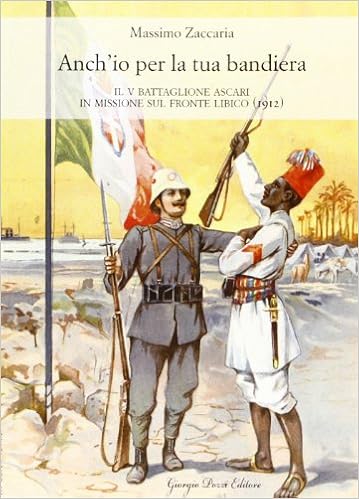
Massimo Zaccaria. 2012. Anch’io per la tua bandiera. Il V Battaglione Ascari in missione sul fronte libico (1912). Giorgio Pozza Editore, Ravenna.
This book traces the history of the first Eritrean “ascari” battalion employed by the Italians in their conquest of Libya in 1912. For the colonizing forces, this battalion served two purposes besides military: the Italians aimed to show in Libya and other colonies that there were “Muslim” forces on their side, and enabled them to show other European colonial powers that they had a successful “civilizing” mission. The book is in Italian, but has been reviewed in English by Francesca Di Pasquale here.
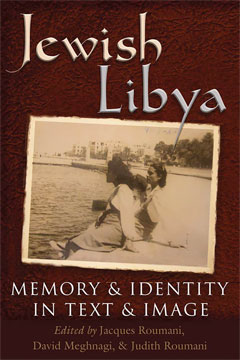
A new book, Jewish Libya: Memory and Identity in Text and Image, edited by the Libyan Jewish writers and scholars Jacques Roumani (†), David Meghnaghi, and Judith Roumani, is coming out soon from Syracuse University Press. It includes chapters on Libyan Jewish language, cuisine, history, social change, women, diaspora, and biographical and liturgical literatures. Update: for those who have access, the book is available online at Project Muse.
From the publisher’s description:
“In June 2017, the Jews of Libya commemorated the jubilee of their complete exodus from this North African land in 1967, which began with a mass migration to Israel in 1948–49. Jews had resided in Libya since Phoenician times, seventeen centuries before their encounter with the Arab conquest in AD 644–646. Their disappearance from Libya, like most other Jewish communities in North Africa and the Middle East, led to their fragmentation across the globe as well as reconstitution in two major centers, Israel and Italy.
Distinctive Libyan Jewish traditions and a broad cultural heritage have survived and prospered in different places in Israel and in Rome, Italy, where Libyan Jews are recognized for their vibrant contribution to Italian Jewry. Nevertheless, with the passage of time, memories fade among the younger generations and multiple identities begin to overshadow those inherited over the centuries. Capturing the essence of Libyan Jewish cultural heritage, this anthology aims to reawaken and preserve the memories of this community. Jewish Libya collects the work of scholars who explore the community’s history, its literature and dialect, topography and cuisine, and the difficult negotiation of trauma and memory. In shedding new light on this now-fragmented culture and society, this collection commemorates and celebrates vital elements of Libyan Jewish heritage and encourages a lively inter-generational exchange among the many Jews of Libyan origin worldwide.”
This post draws your attention to three book-length studies published on Islamic law as preserved in documents from the courts of Ajdābiya and Kufra, two cities that are home to mostly sedentarized Bedouin. The cases preserved in those court archives date from the 1930s to the 1970s—thus the studies reveal the nature of the interaction between law and custom as it was in mostly nomadic but sedentarizing societies, as opposed to how it is now.
Layish, Aharon. 1991. Divorce in the Libyan Family. A study based on the sijills of the sharī‘a courts of Ajdābiyya and Kufra. New York: NYU Press.
Layish, Aharon. 1998. Legal Documents on Libyan Tribal Society in Process of Sedentarization. A selection of decisions from the sijills of the sharī‘a courts of Ajdābiya and Kufra. Part 1: The documents in Arabic with a glossary of Arabic legal terms and phrases, with an anthropological critique by John Davis. Wiesbaden: Harrassowitz.
Layish, Aharon. 2005. Sharī‘a and custom in Libyan tribal society. An annotated translation of decisions from the Sharī‘a courts of Ajdābiya and Kufra, with a linguistic essay by Alexander Borg. Leiden: Brill.
Publisher’s blurb: “Desert Borderland investigates the historical processes that transformed political identity in the easternmost reaches of the Sahara Desert in the half century before World War I. Adopting a view from the margins—illuminating the little-known history of the Egyptian-Libyan borderland—the book challenges prevailing notions of how Egypt and Libya were constituted as modern territorial nation-states.
Matthew H. Ellis draws on a wide array of archival sources to reconstruct the multiple layers and meanings of territoriality in this desert borderland. Throughout the decades, a heightened awareness of the existence of distinctive Egyptian and Ottoman Libyan territorial spheres began to develop despite any clear-cut boundary markers or cartographic evidence. National territoriality was not simply imposed on Egypt’s western—or Ottoman Libya’s eastern—domains by centralizing state power. Rather, it developed only through a complex and multilayered process of negotiation with local groups motivated by their own local conceptions of space, sovereignty, and political belonging. By the early twentieth century, distinctive “Egyptian” and “Libyan” territorial domains emerged—what would ultimately become the modern nation-states of Egypt and Libya.”
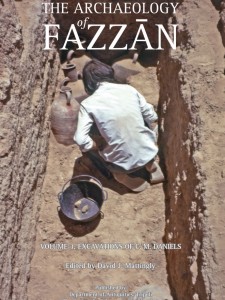
‘An extraordinary civilisation emerged on the very margins of the Classical world in the remote Libyan desert. This is a vital study of a society at the crossroads between the Mediterranean and continental Africa.’ (Professor Michael Fulford, University of Reading)
‘The Garamantes have emerged from the shadows. This study of the Fazzan from remotest antiquity to the present day is striking for the extent and range of the enquiry, the meticulousness of its documentation, and the clarity of its exposition. The completed volumes will immediately become the standard work on the region, and seem unlikely ever to be superseded.’ (Professor Roger Wilson, University of Nottingham)
This is the second volume detailing the combined results of two Anglo-Libyan projects in Fazzan, Libya’s projects in Fazzan, Libya’s southwest province. The late Charles Daniels led the first expeditions between 1958 and 1977, with David Mattingly directing the subsequent Fazzan Project from 1997-2001.
This second volume presents some of the key archaeological discoveries in detail, including a richly illustrated gazetteer of sites discovered and the first attempt at a full-scale pottery type series from the Sahara. In addition, there are separate reports on the programme of radiocarbon dating carried out, on lithics, metallurgical and non-metallurgical industrial residues and various categories of small finds (including coins, metal artefacts, beads, glass and stone artefacts).
This volume contains reports and analysis on a series of excavations carried out between 1958 and 1977 by the British archaeologist Charles Daniels, lavishly illustrated by site plans and numerous colour photographs – particularly of the rich artefact assemblages recovered. The publication is a high-profile and significant landmark in work seeking to record information about Libya’s long-term Saharan heritage. It is an indispensable reference work to the nature of Libya’s Saharan archaeology.
Description (German, see below for English): Libyen wird oft als eine Art „zufällige Nation“ beschrieben. Dennoch gibt es Versuche, eine einheitliche, chronologische Geschichte von der Antike bis in die Gegenwart zu formulieren. 1978 entstand unter Muammar al-Gaddafi ein eigenes Forschungszentrum – das Libyan Studies Centre (LSC) – zur umfassenden Neuschreibung der libyschen Nationalgeschichte als anti-kolonialer „Geschichte von unten“. Die vorliegende Arbeit geht diesem Geschichtsbild nach. Sie fragt nach der Entstehung eines libyschen Selbstbewusstseins im Spannungsfeld von arabischen und berberischen, maghrebinischen und afrikanischen, muslimischen und mediterranen Einflüssen. Sie fragt nach der Bedeutung des Widerstand gegen Fremdherrschaft für das nationale Geschichtsbild der LSC-Historiker – sei es nun gegen die Römer, Kreuzritter oder moderne Kolonialisten. Darüber hinaus geht die Studie der Frage nach, was es heißt, Geschichte zu dekolonisieren –indem man versucht, die Historiographie vom Einfluss der früheren italienischen Kolonialherren zu befreien. Jenseits des konkreten Falls interessiert sie sich dafür, wie es heute gelingen kann, eine postkoloniale, anti-orientalistische und nicht eurozentrische Geschichte zu schreiben.
Description (English): Libya is often described as a type of “accidental nation”. However, there have been attempts to formulate a consistent and chronological history from antiquity until the present. In 1978, under Muammar al-Gaddafi, a research center—the Libyan Studies Centre (LSC)—came into existence with the goal of writing a comprehensive Libyan national history as an anti-colonial “history from below”. The present work traces this history. It inquires about the development of a Libyan self-awareness at the crossroads of Arab, Berber, Maghrebi and African, Muslim, and Mediterranean influences. It inquires about the meaning of resistance against foreign rule for the national history of the LSC historians—be it against the Romans, Crusaders, or modern colonizers. Furthermore, this study traces the question of what it means to decolonize history, as one attempts to liberate historiography from the influence of the previous Italian colonial masters. Beyond the specific Libyan case, this study is interested in how it may be possible today to write a postcolonial, anti-orientalist, and non-eurocentric history.
The publisher’s description reads: “This tripartite volume with 18 contributions in English and French is dedicated to Tunisian and Libyan Arabic dialects which form part of the so-called Maghrebi or Western group of dialects. There are ten contributions that investigate aspects of Tunisian dialects, five contributions on Libyan dialects, and three comparative articles that go beyond the geographical and linguistic borders of Tunisia and Libya. The focus of “Tunisian and Libyan Arabic Dialects” is on linguistic aspects but a wider range of topics is also addressed, in particular questions regarding digital corpora and digital humanities. These foci and other subjects investigated, such as the syntactic studies and the presentation of recently gathered linguistic data, bear reference to the subtitle “Common Trends – Recent Developments – Diachronic Aspects”.”
Several essays in the book deal with aspects of Libyan Arabic dialects, in particular the following:
Adam Benkato, “Vowels in Benghazi Arabic: Maghrebi or Bedouin?”, pp. 291-300.
Najah Benmoftah & Christophe Pereira, “Preliminary Remarks on the Arabic spoken in Al-Khums (Libya)”, pp. 301-326.
Dominique Caubet, “A Tentative Description of Aspect and Modality in the Fezzan: W. and Ph. Marçais’ Texts Revisited”, pp. 327-350.
Luca D’Anna, “On the Development of Conditional Particles in the Arabic Dialects of the Fezzān”, pp. 351-370.
Maciej Klimiuk, “The Particle rā- in Libyan Arabic Dialects (with emphasis on the Arabic dialect of Msallāta)”, pp. 371-386.
The latest work of Benghazi-born writer Najwa Bin Shatwan, The Slave Pens (زرايب العبيد) has been garnering praise across the Arab literary world. She was recently shortlisted for the 2017 International Prize for Arabic Fiction, and a translated excerpt from her book is featured in the current issue of Banipal magazine (#58 ‘Arab Literary Awards’).
The novel is set just outside of downtown Benghazi in the early 20th century. In this part of the city, known as al-Sabri (الصابري), both enslaved and free people lived in a dense network of rudimentary palm-leaf dwellings, essentially a ghetto. Bin Shatwan is the first writer or scholar to attempt to address this aspect of Benghazi’s history in particular, perhaps the first Libyan writer to deal deeply with slavery and its legacy in Libya.
Summary: The Slave Pens lifts the lid on the dark, untold history of slavery in Libya, of which the effects can still be felt today. Slave owner Mohammed and his slave Ta’awidha have fallen in love, but their relationship is considered taboo. Living in a community where masters take female slaves as lovers as they please, Mohammed’s father sends him on a trading mission in an attempt to distance him from Ta’awidha. During his absence, his mother forces her to miscarry by serving her a spiked drink, and she is married off to another slave. On his return from his trip, Mohammed learns of his family’s activities and he begins searching for his beloved.


 A new book,
  Layish, Aharon. 1991. Divorce in the Libyan Family. A study based on the sijills of the sharī‘a courts of Ajdābiyya and Kufra. New York: NYU Press.


 Jakob Krais,
  A new volume containing linguistic studies of Arabic dialects in Libya and Tunisia has just been published:
 The Silphium Gatherer | مجمّع سلفيوم